Early Life and Training in France
Ernest Narjot entered the world on December 25, 1826, in the coastal town of Saint-Malo, France. His early years were shaped by the atmosphere of Paris, where he was brought up and eventually began his formal training. It was in the French capital that he dedicated himself to the study of art, honing the technical skills that would later define his visual observations of the New World. His education provided him with a disciplined foundation, yet the pull of distant opportunities proved stronger than the stability of a Parisian studio.
The year 1849 marked a decisive turning point for the young artist. Driven by the global fervor of the California Gold Rush, Ernest Narjot left his training behind to seek fortune in the American West. He traded the structured life of a student for the uncertainty of the frontier, arriving in California with little more than his artistic sensibilities and the hope of a new life. This transition from the refined circles of Paris to the rugged landscapes of the Pacific would ultimately provide the primary subject matter for his life's work.
Life in the Gold Country and Mexico
The pursuit of fortune led Narjot away from his formal training and into the rugged realities of the American West. He spent three unproductive years panning for gold at Fosters Bar on the Yuba River, a period of labor that offered little material gain but provided a deep, firsthand understanding of the frontier. In 1851, he joined a French mining expedition to Sonora, Mexico. While the venture failed to yield the expected riches, it fundamentally altered the course of his life.
Settling in Sonora, Narjot transitioned from a seeker of gold to a man of the land. He purchased a ranch and married a local woman, Santos Ortiz. His life in Mexico became a multifaceted existence of industry and observation; he continued to mine and breed horses while maintaining his practice as a painter. These years of manual labor and domestic stability provided the raw material for much of his later work, which would often look back upon these experiences with a sense of nostalgia.
Artistic Career in San Francisco
In 1865, Narjot returned to San Francisco with his family, seeking a more stable existence after years of mining and ranching. He established a studio at 610 Clay Street, a space that would become central to his professional life. While his earlier years were defined by the physical toil of the Gold Country, his time in the city allowed him to refine his observations into formal art. He became a significant figure in the local scene, and by the 1880s, he had established himself as one of California's foremost painters.
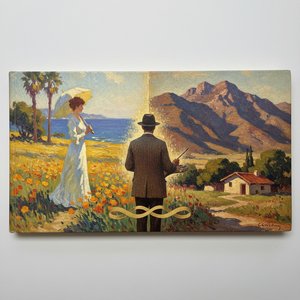
His subject matter often drew upon the nostalgia of his past, translating his memories of the Mother Lode into composed scenes. These works frequently depicted the life of the forty-niners, capturing a specific era of California history through a lens of recollection. His reputation for handling diverse subjects—ranging from landscapes to portraits and frescos—led to significant commissions. Most notably, he was tasked with painting the ceiling at the tomb of Leland Stanford, Jr. at Stanford University.
- Miners: A Moment at Rest (1882)
Later Years and Death in San Francisco
The final chapter of Narjot's life was marked by a sudden and physical decline. While commissioned to paint the ceiling of the Leland Stanford, Jr. tomb at Stanford University, an accident occurred when paint splashed into his eyes. This injury left him blinded in one eye and triggered a steady deterioration of his overall health. As his physical strength waned, his financial stability followed. By 1897, his economic circumstances had declined so severely that he was forced to move into a tenement.
His plight did not go unnoticed by the artistic community he had helped shape. In a gesture of solidarity, thirty prominent California artists, including Thomas Hill, Amédée Joullin, William Keith, and Arthur Mathews, organized a benefit sale of their work to provide him with much-needed aid. This collective effort offered a moment of respite during his difficult final years.
Ernest Narjot passed away in San Francisco on August 24, 1898. He left behind a body of work that captured the grit and nostalgia of the California Gold Rush, much of which survived the destruction of the 1906 San Francisco earthquake and fire.
问答详情
Ernest Narjot 最常使用的色彩有哪些?
您可以在Ernest Narjot的色彩基因页面上,深入研究其在本站所列作品中的色彩运用。
如何按年份顺序浏览 Ernest Narjot 的作品?
您可以在Ernest Narjot的作品时间轴页面上按时间顺序查看其作品。
Ernest Narjot 的哪些作品浏览量最高?
Ernest Narjot 拥有一个 统计数据 页面,其中展示了该艺术家在 本站 上的作品统计数据。