Early Life and Artistic Foundations
Eric Hudson, born Elmer Forrest Hudson in Boston, Massachusetts in 1864, embarked on a journey that would firmly establish him as a prominent figure within the American marine painting tradition. His initial artistic training took place at the prestigious School of the Boston Museum of Fine Arts, where he studied under influential instructors like Edmund C. Tarbell and Frank Benson. This foundational education instilled in him a respect for realism and an appreciation for capturing the subtleties of light and atmosphere – qualities that would become hallmarks of his mature style. Further honing his skills, Hudson traveled to Paris and enrolled at the Academie Julian, immersing himself in European artistic currents and broadening his perspective on painting techniques.
The Rise of a Marine Painter
Upon returning to the United States, Hudson dedicated himself to marine subjects, a decision that would define his career. He initially exhibited under his birth name, Elmer Forrest Hudson, gaining recognition for evocative harbor scenes, lively depictions of fishing activity, and captivating nocturnes. In 1914, while residing in Bronxville, New York, he secured a place at the National Academy of Design, marking a significant step forward in his professional life. A pivotal moment came in 1918 when Hudson formally changed his name to Eric Hudson, perhaps signaling a renewed artistic focus and identity. This period saw him actively participating in exhibitions at prominent venues like the Pennsylvania Academy of Fine Art, the North Shore Art Association, and the Corcoran Gallery.
Monhegan Island and Artistic Community
Hudson’s connection with Monhegan Island, Maine, proved profoundly influential. He first visited the island in 1897 and quickly established a studio there the following year, becoming deeply integrated into its thriving artist colony. This community fostered an exchange of ideas and techniques among painters such as Robert Henri, Sears Gallagher, and Frederick Waugh. The rugged beauty of Monhegan Island – its dramatic coastline, turbulent seas, and ever-changing light – provided endless inspiration for Hudson’s work. He captured the essence of maritime life with a sensitivity that resonated with collectors and critics alike.
Hudson River School Influence & Style
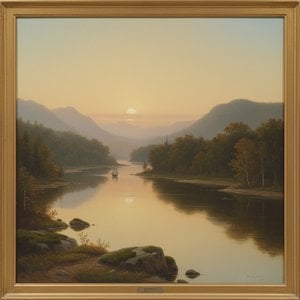
While not directly part of the original Hudson River School movement, Eric Hudson's paintings clearly demonstrate its enduring influence. Like his predecessors, he possessed a keen eye for detail and a commitment to portraying the grandeur of nature. However, Hudson’s work is characterized by a more intimate scale and a focus on the human element within the landscape. His scenes often feature fishermen at work, sailboats navigating choppy waters, or quiet harbors bathed in soft light. He masterfully employed atmospheric perspective, creating a sense of depth and realism that draws the viewer into the scene. The Smithsonian Archives describe his works as documenting “the career of marine painter Eric Hudson”, highlighting the importance of this subject matter throughout his life.
Legacy and Continued Appreciation
Eric Hudson’s paintings offer a glimpse into a bygone era of American maritime life. His ability to capture both the beauty and the challenges of the sea has ensured his enduring appeal. His works are held in the permanent collections of institutions such as the Portland Museum of Art, the Monhegan Museum, and the Farnsworth Museum, testament to their artistic merit and historical significance. Today, ArtsDot.com and other platforms continue to make his evocative landscapes accessible to a wider audience through high-quality hand-painted reproductions, allowing collectors and art enthusiasts to experience the captivating world of Eric Hudson’s 1920s paintings.
问答详情
在哪里可以查看 Eric Hudson 作品的色彩风格?
Eric Hudson 的 色彩基因 展示了该艺术家作品的色彩特征。
目前目录中共有多少件 Eric Hudson 的作品可供浏览?
您可以在 全部作品 页面浏览由 Eric Hudson 创作的 11 件作品 件作品。
我可以通过关键词来探索 Eric Hudson 的作品吗?
您可以通过艺术家关键词分类页面,按关键词探索Eric Hudson的作品。每个关键词都汇集了相关的艺术品。