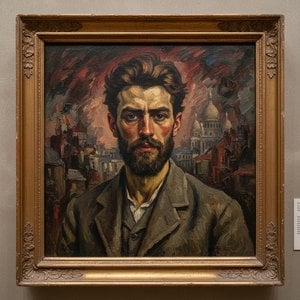
A Brief Radiance: The Life and Legacy of Émile Zipelius
The history of art is often written through the lives of those who endured long, prolific careers, yet there is a profound, haunting beauty in the stories of those whose light was extinguished far too soon. Émile Zipelius remains one such figure—a French painter whose talent flickered with intense brilliance before being tragically silenced at the tender age of twenty-five. Born in 1840 in the industrious city of Mulhouse, Zipelius was destined for a life steeped in the traditions of fine art. As the son of the esteemed painter Georges Zipélius, his early years were likely shaped by the scent of oil pigments and the disciplined rhythm of the brush, inheriting a lineage that connected him deeply to the artistic fabric of his region.
His journey from a student in his father's studio to the prestigious halls of the École des Beaux-Arts de Paris marks a period of rapid intellectual and technical maturation. Under the tutelage of masters such as Léon Cogniet and Bénédict Masson, Zipelius absorbed the rigorous academic standards of the mid-19th century. This training allowed him to navigate the complexities of light, form, and classical composition with a sophistication that belied his youth. By 1861, he had already begun to assert his presence on the grand stage of the Salon de Paris, signaling the arrival of a promising new voice in the French art world.
Technique and Artistic Vision
While much of Zipelius's oeuvre remains a whispered memory in the archives of history, the fragments that survive offer a glimpse into a versatile and sensitive hand. His work often oscillated between the delicate precision of pen-and-ink drawings and the more robust, emotive possibilities of painting and watercolor. There is an inherent intimacy found in his portraits, such as his Portrait d'enfant, which captures the ephemeral innocence of youth with a tender, observant eye. This ability to capture the human essence through subtle line work and tonal depth suggests an artist who was deeply attuned to the psychological nuances of his subjects.
The breadth of his technical exploration included:
- Academic Precision: A mastery of anatomical accuracy and classical structure learned from the great masters of Paris.
- Lyrical Draftsmanship: An ability to use the quill and ink to create evocative, atmospheric sketches that possess a life of their own.
- Tonal Sensitivity: A focus on the interplay of light and shadow, a hallmark of the French tradition that sought to breathe movement into static forms.
A Tragic Departure and Enduring Memory
The trajectory of Zipelius’s career was violently interrupted by a tragedy that remains as sudden as it was sorrowful. His life ended in 1865, following a drowning in the Moselle river near Pompey. This untimely death left the art world mourning not just a man, but the vast potential of an artist who had only just begun to find his true voice. The loss of such a promising talent serves as a poignant reminder of the fragility of creative life.
Despite the brevity of his existence, Zipelius’s contribution to the artistic heritage of Mulhouse and France remains preserved. Much of his legacy resides within the Musée des Beaux-Arts de Mulhouse, where his works continue to serve as a testament to a period of great transition in French art. To look upon a work by Émile Zipelius is to witness a moment frozen in time—a glimpse into a brilliant, unfinished symphony that continues to resonate with those who find beauty in the ephemeral.
问答详情
Émile Zipelius 最常使用的色彩有哪些?
Émile Zipelius 的 色彩基因 展示了该艺术家作品的色彩特征。
可以按心情浏览 Émile Zipelius 的作品吗?
您可以在艺术家 Émile Zipelius 的 情境空间 页面上按心情浏览其作品,该页面已根据作品所传达的情绪进行了分类整理。
在哪里可以按时间顺序欣赏 Émile Zipelius 的作品?
Émile Zipelius 的作品时间轴现已上线:在艺术家的 作品时间轴 页面中,所有作品均按创作日期排序。
Émile Zipelius 来自哪里?
Émile Zipelius 出生于 France。