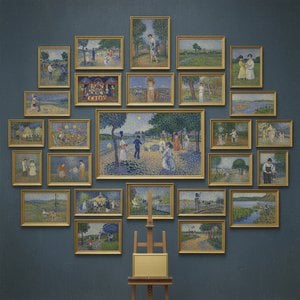
The Naturalist Eye of Edmond Picard
To look at the work of Edmond Picard is to witness a specific, disciplined transition in late 19th-century French painting. He did not rely on abstract whimsy; instead, he anchored his practice in the tangible realities of the Franche-Comté region and the rigorous training of the Parisian academies. Born in 1861, Picard entered the Besançon municipal drawing school at thirteen, a move that set the stage for a career defined by technical precision rather than mere sentiment.
His early development was shaped by direct mentorship. Under Honoré Chapuis and later the landscape artist Alexandre Rapin, Picard learned to observe the structural integrity of his subjects. This foundation allowed him to navigate the prestigious halls of the École nationale supérieure des arts décoratifs and study under established figures like Léon Gérôme and Jean Paul Laurens. By the time he first exhibited at the Salon in 1881, he possessed a command over form that was far beyond his years.
Technical Evolution and Achievement
Picard’s trajectory moved from academic discipline toward an assertive naturalism. While his early years focused on the controlled environments of genre scenes, his style matured significantly after 1890. He began to prioritize atmospheric rendering and emotional truth, seeking to capture the weight of a moment through light and texture. This shift is evident in his ability to handle both oil and pastel with equal authority.
His recognition was not merely anecdotal; it was backed by institutional validation. In 1885, he secured the Troyon prize for animal painting, an achievement that signaled his capability to handle complex, organic subjects. His repertoire remained grounded in the observable world, ranging from:
- Intimate genre scenes depicting everyday social interactions.
- Detailed landscapes that captured the specific light of the French countryside.
- Animal studies that demanded anatomical accuracy.
A Legacy of Regional Commitment
Picard was more than a solitary practitioner; he was an active architect of the local art scene. In 1893, he founded the Union comtoise des arts décoratifs, demonstrating a commitment to the institutional growth of his home region. He also shared his technical knowledge by teaching at the École municipale des Beaux-Arts in Besançon, ensuring that the standards of French naturalism were passed to the next generation.
His work, such as Les Adieux du marin (1893), remains a study in human gravity. Even in his more quiet compositions, there is a refusal to embellish reality. He focused on the grit and the grace of contemporary life, leaving behind a body of work that functions as a precise record of late 19th-century French society before his death in 1899.
问答详情
Edmond Picard 属于哪些艺术流派?
您可以在艺术家的 全部流派 页面中查看 Edmond Picard 所属的艺术流派,该页面按流派对作品进行了分类。
如何按特定色调查找 Edmond Picard 的作品?
按色调浏览 页面按色调将 Edmond Picard 的艺术作品进行了分类。
Edmond Picard 的艺术生涯是如何划分为不同时期的?
您可以在艺术家的 艺术历程 页面上查阅 Edmond Picard 作品的编年史,其作品按创作顺序分章节依次呈现。