Early Life, Family and Training
Datus E. Myers entered the world on September 29, 1879, in the town of Jefferson, Oregon. His early years in the West provided a foundation for a life spent observing the landscapes and people of the American frontier. As he matured, his interest in the visual arts led him away from his birthplace toward formal instruction. He sought out the disciplined study of form and composition, attending the Chouinard School of Art and later the Chicago Art Institute. These institutions provided him with the technical language necessary to translate the world around him onto canvas.
In 1910, his personal life became intertwined with the world of design when he married Alice Clark Myers. She was an architect, and her professional understanding of structure and space likely shared a common language with his own artistic pursuits. Together, they would eventually find their way toward the high desert, but their early years were defined by this union of creative disciplines. Their partnership was built on a shared commitment to the arts, as they moved through the formative decades of their professional lives.
Life and Activity in New Mexico
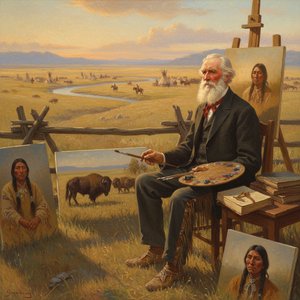
In 1923, Myers and his wife, the architect Alice Clark Myers, made the decision to move to Santa Fe. By 1925, they had settled in the Camino del Monte Sol area, finding a permanent home amidst the high desert landscape. It was here that his brush found its true subject. He became deeply preoccupied with the scenery of the region, producing many landscape paintings that sought to capture the essence of the terrain. His work often turned toward the people of the land, crafting idealized representations of Indigenous life within the American West.
His connection to the local community deepened during the 1930s through his involvement with the New Deal. He took on the responsibility of serving as the Indian Division field coordinator for the Public Works of Art Program. This was a position of significant social weight, as it required him to travel and connect with the local Pueblos. He spent much of his time recruiting Indigenous artists from these communities, helping them find a place within the WPA public art programs. Through this work, he helped bridge the gap between local talent and federal patronage, ensuring that the hands of the Pueblo artists were part of the era's public creative output.
问答详情
Datus E. Myers 的作品传达了怎样的情绪?
您可以在艺术家 Datus E. Myers 的 情境空间 页面上按心情浏览其作品,该页面已根据作品所传达的情绪进行了分类整理。
Datus E. Myers 的艺术生涯是如何划分为不同时期的?
您可以在艺术家的 艺术历程 页面上查阅 Datus E. Myers 作品的编年史,其作品按创作顺序分章节依次呈现。
在哪里可以按艺术流派浏览 Datus E. Myers 的作品?
全部流派 页面按艺术流派对 Datus E. Myers 的作品进行了分类。
在哪里可以按颜色分类查看Datus E. Myers的艺术作品?
您可以在Datus E. Myers的色彩索引页面上按色彩探索其作品。