Early Life and Education
- Born: April 12, 1898, London, United Kingdom
- Died: November 4, 1989
- Parents: Robert Leighton (author) and Marie Connor Leighton (author)
- Early artistic encouragement from father and uncle Jack Leighton.
- Studied at Brighton College of Art (1915).
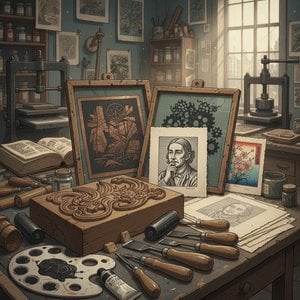
- Training at Slade School of Fine Art (1921–1923) and Central School of Arts and Crafts, studying wood engraving under Noel Rooke.
Artistic Career and Development
- Developed a strong affinity for portraying rural life and the dignity of labor through sketching trips in Europe.
- Visited the United States on lecture tours during the 1920s and 1930s, eventually emigrating in 1939.
- Became a naturalized U.S. citizen in 1945.
- Awarded the Mr. And Mrs. Frank G. Logan First Prize ($100) by the Art Institute of Chicago in 1930.
- Friendship with H.L. Mencken while living in Baltimore.
- Known for wood engravings depicting rural scenes, farming, and social themes.
- Created designs for Steuben Glass and Wedgwood plates.
Major Works and Notable Achievements
- Wood Engravings: Highly regarded for their detail and portrayal of working-class life.
- The Farmer’s Year (1933): A calendar of English husbandry, showcasing rural routines.
- Four Hedges – A Gardener's Chronicle (1935): Documenting the development of a garden in the Chilterns.
- Tempestuous Petticoat: The Story of an Invincible Edwardian (1948): An autobiographical work about her mother.
- Illustrated edition of Thornton Wilder's The Bridge of San Luis Rey, featuring sixteen woodcuts.
- Designs for stained glass windows in churches and Worcester Cathedral.
Influences and Historical Significance
- Influences: Her father and uncle’s encouragement fostered early artistic development. Observations of rural life during European travels shaped her subject matter.
- Social Realism: Her work reflects the social realism movement, portraying working-class individuals with dignity and respect.
- Wood Engraving Technique: Mastered wood engraving, a technique that allowed for intricate detail and precise lines in her prints.
- Feminist Perspective: Tempestuous Petticoat offers a unique perspective on Edwardian society through the lens of a woman's experiences.
- Legacy: Recognized as a significant figure in British and American art, particularly for her contributions to wood engraving and social commentary through art. Her work continues to be exhibited and studied today.
Further Information
- Wood-Engraving and Woodcuts: The first book on wood-engraving produced by a woman.
- Exhibited at the National Museum of Women in the Arts.
- Work featured in 'Print and Prejudice: Women Printmakers, 1700-1930' at the Victoria and Albert Museum.
问答详情
在哪里可以按颜色分类查看Clare Veronica Hope的艺术作品?
色彩索引 页面按色彩对 Clare Veronica Hope 的作品进行了分类整理。
在哪里可以按艺术流派浏览 Clare Veronica Hope 的作品?
您可以在Clare Veronica Hope的所有艺术流派页面上,按艺术流派浏览其作品。
在哪里可以查看 Clare Veronica Hope 作品的色彩风格?
您可以在Clare Veronica Hope的色彩基因页面上,深入研究其在本网站所列作品中的色彩运用。