Carl Oscar Borg: Painter of the Grand Canyon and California’s Southwest
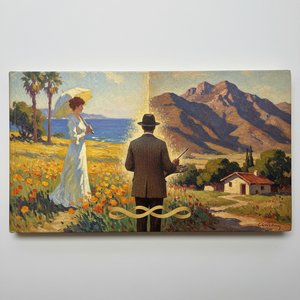
Carl Oscar Borg (March 3, 1879 – May 8, 1947) stands as a singular figure in American landscape painting—a Swedish-born artist who embraced the rugged beauty of the Southwestern United States with an unwavering dedication to realism and tonal harmony. His canvases capture not merely visual impressions but profound emotional responses to the grandeur of canyons, mesas, and desert vistas.
Born in Grinstad parish, Dalaland province, Sweden, Borg’s early life was marked by modest circumstances. He pursued his artistic ambitions independently, honing his skills through self-teaching before relocating to London at age 15 where he apprenticed under George Johansen, a respected marine artist.
A pivotal moment arrived in 1901 when Borg embarked on a transatlantic voyage destined for the United States. He quickly established himself as an educator at the California Art Institute and later at Santa Barbara School of the Arts, fostering a new generation of artists inspired by the Californian landscape.
His artistic vision was profoundly shaped by Phoebe Hearst—a wealthy philanthropist who recognized Borg’s talent and generously supported his return to Europe for intensive study. This patronage allowed him access to European art academies and broadened his understanding of artistic traditions.
Influences and Artistic Style
Borg's distinctive style emerged from a confluence of influences, notably tonalism—a movement emphasizing subtle gradations of color and atmospheric perspective—and Impressionism’s focus on capturing fleeting moments of light. He skillfully blended these approaches to create paintings characterized by luminous hues and textured surfaces that convey the palpable energy of the Southwest.
He excelled in various mediums, including oil paint, watercolor, etching, and woodblock prints. His meticulous technique—characterized by careful observation and painstaking execution—resulted in artworks imbued with remarkable detail and emotional depth. Borg’s compositions often prioritized dramatic vistas, emphasizing the scale of geological formations and conveying a sense of awe.
Notable Achievements and Commissions
Borg gained considerable recognition for his monumental depiction of the Grand Canyon, which cemented his reputation as one of the foremost landscape painters of his era. His artwork graced the walls of prestigious institutions such as Brigham Young University, Harvard University, Smithsonian American Art Museum, and the Fine Arts Museums of San Francisco.
Beyond academic acclaim, Borg achieved considerable success in commercial endeavors. He served as a founding member of the Painter’s Club of Los Angeles and the California Art Club—organizations dedicated to advancing artistic excellence. Furthermore, he played an instrumental role in establishing Hollywood’s first art studio, collaborating on silent films between 1925 and 1928.
Legacy and Recognition
Carl Oscar Borg's enduring legacy resides not only in his stunning visual creations but also in his contribution to the artistic landscape of the early 20th century. He was inducted into the National Academy of Design, the National Academy of Arts, Société nationale des beaux-arts, and Salmagundi Club—honors recognizing his exceptional artistry and dedication to the pursuit of creative excellence.
His work continues to inspire artists and captivate audiences today, serving as a testament to Borg’s unwavering commitment to portraying the sublime beauty of the American Southwest with unparalleled skill and sensitivity.
问答详情
Carl Oscar Borg 的哪些作品浏览量最高?
Carl Oscar Borg 的 统计数据 页面展示了基于 本站 上列出的艺术家作品所计算出的统计数据。
在哪里可以按氛围浏览 Carl Oscar Borg 的作品?
您可以在艺术家 Carl Oscar Borg 的 情境空间 页面上按心情浏览其作品,该页面已根据作品所传达的情绪进行了分类整理。
Carl Oscar Borg 的艺术风格是如何随时间演变的?
Carl Oscar Borg 的 艺术历程 是一个随滚动条变化的艺术时间轴,按创作时期进行章节划分,并按时间顺序呈现艺术家的作品。