The Portraitist of a Growing Nation
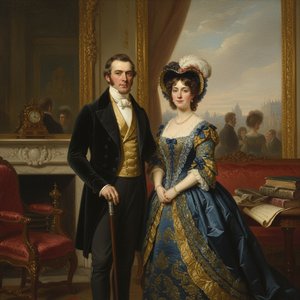
Benjamin A. Wallace operated during a formative era of American identity, a period when the burgeoning United States sought to document its own faces through the medium of oil on canvas. His work belongs to the first half of the 19th century, a time when portraiture was the primary vehicle for establishing social presence and familial legacy. He was a painter of people, focusing his technical attention on the likenesses of individuals who required a permanent visual record of their existence.
His output reflects the practical demands of his era. He did not chase abstract movements or experimental theories; instead, he adhered to the rigorous requirements of the portrait tradition. His brushwork was directed toward the specificities of human features and the textures of contemporary dress, ensuring that the sitter was captured with a clarity that served their social standing.
Technical Focus and Subject Matter
The surviving evidence of Wallace's career highlights a commitment to the formal portrait. His subjects were not mere archetypes but specific individuals whose identities were tied to the social fabric of the early 1800s. His ability to render the human form is evidenced by the works that have survived into modern collections.
- Portraiture of women and children
- Formal depictions of social figures
- Studies of texture and fabric in clothing
The precision of his work is most evident in his handling of light and shadow to define the contours of a face. In works like Mrs. Clarkson Crolius (ca. 1773–1856), the focus remains strictly on the subject, stripping away unnecessary ornamentation to prioritize the likeness itself. This directness is what allows his work to remain legible to modern viewers.
Historical Placement
Wallace's significance lies in his role as a documentarian of the American character during the early 19th century. He worked in a landscape where the art market was still establishing its own parameters, moving away from colonial dependencies toward a distinct national style. His presence in the historical record is confirmed by the preservation of his works in significant institutions, such as the New York Historical Society in New York City.
He died in 1850, leaving behind a body of work that captures a specific, unvarnished moment in American history. His paintings are not mere decorations; they are the visual evidence of a society in transition, providing a concrete link to the people who inhabited the early United States.
问答详情
是否有关于Benjamin A. Wallace所创作的所有主题的概览?
您可以在Benjamin A. Wallace的主题索引页面上,按主题探索其作品。
在哪里可以查看 Benjamin A. Wallace 作品的色彩风格?
Benjamin A. Wallace 作品的色彩特征展示在艺术家的 色彩基因 页面上。
是否有Benjamin A. Wallace作品的时间线?
您可以在Benjamin A. Wallace的作品时间轴页面上按时间顺序查看其作品。
Benjamin A. Wallace 的创作时期属于哪个历史阶段?
Benjamin A. Wallace 的创作活跃于 19th Century 时期,这一时期确立了艺术家在艺术史上的地位。