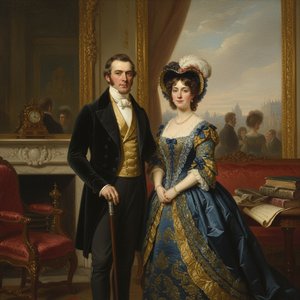
A Quiet Presence in Norwegian Portraiture
The life of Andreas Haavin was a brief one, marked by a focused dedication to the art of the portrait. Born in Norway in 1851, he moved through the mid-nineteenth century with a steady hand, capturing the likenesses of his contemporaries. His career was cut short by his death in 1891, leaving behind a body of work that offers a window into the social fabric of his era.
Haavin’s contribution to the Norwegian art scene is most clearly seen in his ability to render the individual. He did not seek to obscure the subject behind heavy abstraction, but rather to present the person as they were. His brushwork was disciplined, focusing on the subtle nuances of character and the quiet dignity of his sitters.
The Subjects of the Canvas
His surviving works provide a glimpse into the specific individuals who occupied the social circles of his time. These paintings are held in significant collections, reflecting the importance of his skill in capturing the likeness of the Norwegian people. His catalog includes:
These works, both dating from 1880, demonstrate a consistent interest in the human face. They are currently preserved within the Oslo Museum, where they serve as historical records of the people of that period.
A Legacy of Likeness
Though his time as a painter was limited, Haavin’s work remains a part of the Norwegian artistic record. He belonged to a generation of painters who sought to document the reality of their surroundings through the study of the human form. His portraits are not mere likenesses; they are studies of presence and identity. Through these works, the faces of the past remain visible, preserved by the steady hand of a man who understood the weight of a gaze.
问答详情
我可以通过色调来浏览 Andreas Haavin 的作品吗?
您可以在Andreas Haavin的按色调浏览页面上,按色调浏览其作品。
Andreas Haavin 的艺术风格是如何随时间演变的?
您可以在艺术家的 艺术历程 页面上查阅 Andreas Haavin 作品的编年史,其作品按创作顺序分章节依次呈现。
Andreas Haavin 的哪些作品浏览量最高?
有关 Andreas Haavin 作品的统计数据,请参阅艺术家的 统计数据 页面。
Andreas Haavin 的创作时期属于哪个历史阶段?
Andreas Haavin 的创作活跃于 19th Century 时期,这一时期确立了艺术家在艺术史上的地位。