


 购买版画
购买版画 分享
分享 分享
分享
 Details

 下载
下载
 相似作品
相似作品 X-Ray
X-Ray 幻灯片播放
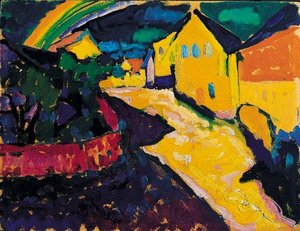
幻灯片播放Murnau with rainbow






P118B $10

P118H $10

P118W $10

P438Z $10

P508JH $12

P508YH $12

P805H $10

P805Z $10

P919BZ $10

P919G $10

P919XJ $10

P959ZH $10

P968JZ $12

W106C $8

W218G $10

W218JH $8

W218Y $10

W307PJ $10

W316G $10

W316PJ $8

W316Y $10

W398PJ $8

W4111J $10

W500HY $15

W500JH $15

W692G $12

W849H $8

W940BG $15

W953PJ $8




 了解更多
了解更多从与原作比例一致的预设尺寸中进行选择。

您可以输入自定义尺寸,以适配特定的画框或空间。如果所选尺寸与原图比例不符,我们将通过裁剪作品或添加手绘元素来扩展画面。数字样稿将在制作开始前发送给您确认。
请注意,屏幕预览无法准确反映实际的裁剪或扩展效果,只有样稿才能真实呈现最终的构图。
虽然我们提供定制尺寸服务,但为了保留原作比例,建议您从预设列表中选择尺寸。
下单后,ArtsDot.com 团队将通过电子邮件联系客户获取具体要求,并提供效果预览图。


 玻璃选项仅适用于110厘米以下的尺寸。

Murnau with rainbow
复制材质
复制品尺寸
-


最终总价
-
作品详情
Murnau with Rainbow (1909): A Symphony of Color and Emotion
Wassily Kandinsky’s “Murnau with Rainbow” stands as a cornerstone of Expressionism, capturing not merely a picturesque Bavarian landscape but also the artist's profound engagement with the burgeoning field of abstract art. Painted in 1909 during his formative years in Munich alongside Gabriele Münter, this canvas embodies Kandinsky’s belief that color possesses inherent expressive power—a conviction that would propel him to become one of the most influential figures in modern artistic thought.Background and Inspiration: The Spirit of Murnau
The painting depicts a vibrant street scene nestled within Murnau am Staffelsee, a location that served as a constant source of inspiration for Kandinsky. He sought solace and creative impetus in the region’s natural beauty—the towering mountains, shimmering lakes, and lush greenery—translating these sensory experiences into pigment on canvas. Influenced by Wagnerian opera and infused with spiritual contemplation, “Murnau with Rainbow” reflects Kandinsky's desire to transcend representational art and delve into the realm of pure feeling. The artist meticulously observed the interplay of light and color, striving to capture not just what he saw but also how it *felt*.Artistic Elements: Bold Color and Dynamic Composition
“Murnau with Rainbow” is characterized by a masterful use of color—bold reds, blues, and yellows dominate the palette—creating an atmosphere brimming with energy and movement. Kandinsky’s compositional choices amplify this dynamism; a pathway leads towards buildings adorned in complementary hues, while figures stroll along it, their postures conveying subtle nuances of emotion. The sky above is rendered in swirling clouds, contributing to the painting's depth and dimensionality. These elements coalesce into a harmonious whole that speaks directly to the viewer’s subconscious—a testament to Kandinsky’s pioneering approach to abstraction.Artistic Legacy: Pioneering Abstract Expressionism
Kandinsky’s influence extends far beyond “Murnau with Rainbow,” shaping the trajectory of subsequent artistic movements, notably Abstract Expressionism. His insistence on prioritizing color and form over narrative content revolutionized painting, establishing a precedent for artists to explore inner landscapes rather than merely depicting external reality. The Schlossmuseum Murnau diligently preserves his artwork, allowing visitors to immerse themselves in the spirit of this pivotal period in art history.- Painting by 'Wassily Kandinsky' | Wassily Kandinsky:Murnau with Rainbow, , Gabriele Münter Founda (Expressionism,)
- Painting by 'Wassily Kandinsky' | Wassily Kandinsky:Arabs I (Cemetery) (71 x 98 cm,Kunsthalle (Hamburg, Germany),Expressionism,Oil,)
Photo Description: The painting is a vibrant expression of the artist’s vision, featuring a street scene with houses and trees in the background. The colors used in the painting are bold and striking, creating an atmosphere of energy and movement. In the foreground, there is a pathway that leads to the houses, which are painted in various shades of red and blue. Along this pathway, there are several people walking, each with their own unique posture and expression. The scene also includes a horse, adding an element of liveliness to the painting. The sky above the scene is filled with clouds, creating a sense of depth and dimension in the artwork. Overall, this painting captures the essence of life and movement in a small town, using vivid colors and dynamic brushstrokes to convey its message. Size: Unknown Date: 1909
相似艺术品




艺术家简介
A Life Immersed in Color and Spirit
Wassily Wassilyevich Kandinsky, born December 4, 1866, in Moscow, Russia, was a revolutionary figure who irrevocably altered the course of modern art. His journey wasn’t one of immediate artistic calling; initially destined for a career in law and economics at the University of Moscow, it was a profound encounter with Impressionist painting – specifically Claude Monet's “Haystacks” – and a deeply moving experience witnessing Wagner’s opera "Lohengrin" that ignited within him an irrepressible desire to pursue art. This pivotal moment, occurring around age thirty, marked not merely a career change but a complete transformation of perspective, setting him on a path toward pioneering abstraction. He soon relocated to Munich, enrolling at the prestigious Academy of Fine Arts and studying under Franz von Stuck, though even within formal training, Kandinsky’s spirit yearned for exploration beyond conventional boundaries. Early Influences: Russian Folk Art and Impressionism's Embrace Kandinsky’s formative years were marked by exposure to diverse cultural influences. His fascination with Russian folk art stemmed from an ethnographic expedition to the Vologda region in 1889, fostering a deep appreciation for vibrant color palettes and symbolic imagery—elements that would permeate his early artistic endeavors. Simultaneously, Monet's “Haystacks” captivated him with its masterful depiction of light and atmosphere, introducing him to the principles of Impressionism and prompting an initial foray into representational painting. This dual influence laid the groundwork for his evolving artistic sensibilities. The Dawn of Abstraction: Expressionism and Beyond His early works exhibited a pronounced expressionistic style—characterized by bold colors and emotional intensity—exemplified by “Papeln (Poplars)” from 1902. However, Kandinsky swiftly recognized that mere visual representation couldn’t fully capture the complexities of inner experience. Driven by an unwavering conviction that color possessed inherent psychological effects, he embarked on a transformative journey away from representational art toward abstraction. This quest was profoundly shaped by his burgeoning interest in Theosophy—a spiritual movement emphasizing esoteric knowledge and universal brotherhood—inspiring him to explore visual language as a conduit for expressing profound spiritual truths.- He believed that art should not aim to imitate nature but rather to reveal the artist’s inner world.
- His theoretical writings articulated these beliefs, laying the groundwork for a new understanding of abstract art.

卡林斯基
1866 - 1944 , 俄罗斯
艺术家简介
- Artistic Movement Or Style: 抽象艺术、表现主义
- Artists Or Movements Influenced By This Artist: ['抽象表现主义']
- Artists Who Influenced This Artist:
- 克劳德·莫奈
- 理查德·瓦格纳
- Date Of Birth: 1866年12月4日
- Date Of Death: 1944年12月13日
- Full Name: Wassily Wassilyevich Kandinsky
- Nationality: 俄罗斯、法国
- Notable Artworks:
- Murnau与虹
- 多个圆
- 圣洁的宴会
- Place Of Birth: 莫斯科,俄罗斯
相关文章

Evoking Nature's Sublime: A Comprehensive Exploration of 19th-Century Landscape Painting
Explore the captivating world of 19th-century landscape painting! Discover renowned artists like Friedrich & Monet, key movements, and find the perfect artwork to bring nature's serenity into your home. Expert insights at ArtsDot.


人工智能驱动的抽象表现主义:重塑室内空间的情感基调与视觉叙事
ArtsDot为您提供高品质抽象表现主义油画复刻与定制服务,提升酒店空间氛围。匠心工艺、个性化设计、全程无忧体验。用艺术讲述品牌故事,打造独一无二的奢华酒店!
浪漫主义风景画中的崇高与绮丽:探索情感与自然之美
深入探索浪漫主义风景画中的崇高与绮丽之美!解读卡斯帕·大卫·弗里德里希、威廉·特纳等大师作品,分析19世纪绘画的社会背景与艺术影响。ArtsDot.com为您提供专业的艺术评论与收藏建议。

Oil on Canvas Masters: 10 Paintings That Redefined Art History |
Journey through art history with our guide to 10 legendary oil on canvas masterpieces! Explore iconic works by Van Gogh, Monet & Rembrandt. Find museum-quality reproductions and elevate your home decor at . Discover all masterpieces online.

Acrylic Canvas Masters: 10 Paintings That Redefined Modern Art |
Explore 10 legendary 'Acrylic On Canvas' masterpieces by artists like Rothko, Warhol & Frankenthaler. Discover the stories behind these iconic paintings and their impact on modern art. Find museum-quality reproductions at – elevate your home with timeless beauty.



