


 效果预览
效果预览
 分享
分享 分享
分享
 详情
详情 指南
指南

 下载
下载
 相似作品
相似作品 X射线
X射线 幻灯片播放
幻灯片播放 统计数据
统计数据Maithuna
 Oil On Canvas
- WallArt
- Madras Movement
 2006
2006- Contemporary
 176.0 x 104.0 cm
 Cholamandal Artists' Village
 展开详情
展开详情
艺术微喷/版画
博物馆级艺术微喷或帆布版画,制作高效,并提供多种饰面选择。 ( 购买手绘画作 切换至数字图像销售渠道)




P118B $10

P118H $10

P118W $10

P438Z $10

P508JH $12

P508YH $12

P805H $10

P805Z $10

P919BZ $10

P919G $10

P919XJ $10

P959ZH $10

P968JZ $12

W106C $8

W218G $10

W218JH $8

W218Y $10

W307PJ $10

W316G $10

W316PJ $8

W316Y $10

W398PJ $8

W4111J $10

W500HY $15

W500JH $15

W692G $12

W849H $8

W940BG $15

W953PJ $8




从与原作比例一致的预设尺寸中进行选择。

您可以输入自定义尺寸,以适配特定的画框或空间。如果您选择的尺寸与原图比例不符,我们将对作品进行裁剪,或通过镜像填充/纯色填充边缘的方式来扩展图像。在开始制作之前,我们会向您发送一份数字效果图供您确认。
请注意,屏幕上的预览并不能反映实际的裁剪或扩展效果。只有效果图才能准确展示最终的构图。
虽然我们提供定制尺寸,但为了保持原图比例,我们建议您从预设列表中选择尺寸。


 玻璃选项仅适用于110厘米以下的尺寸。

Maithuna
艺术微喷/版画
复制品尺寸
-


最终总价
$ 62
相似艺术品


艺术家简介
Robert Delaunay: A Pioneer of Color and Rhythm
Robert Delaunay, born Robert-Victor-Felix Delaunay in Paris on April 12, 1885, was a pivotal figure in the early development of modern art. His life, marked by both artistic innovation and personal drama, profoundly shaped his distinctive style – a vibrant synthesis of Cubism, Orphism, and Simultanism. Initially apprenticed to a theatrical designer, Delaunay’s early career focused on stagecraft, but it was his burgeoning interest in painting that ultimately defined him. He found himself drawn to the radical ideas circulating within Parisian artistic circles, particularly those championed by figures like Henri Matisse and Pablo Picasso, yet he forged his own unique path, one characterized by an intense exploration of color and its dynamic relationships. His work reflects a deep engagement with the world around him, from the bustling streets of Paris to the serene beauty of the Mediterranean coast.Early Influences and the Birth of Orphism
Delaunay’s artistic journey began in the early 20th century, coinciding with significant shifts in European art. He was deeply influenced by Neo-Impressionism, particularly the work of Paul Gauguin and Georges Seurat, which emphasized the use of pure colors and scientific color theory. However, Delaunay quickly moved beyond mere imitation, developing his own distinct approach – Orphism. This movement, named after the Greek word for “light,” sought to liberate color from its traditional representational function. Instead of depicting objects realistically, Delaunay used color as an independent element, creating dynamic rhythms and harmonies on the canvas. He collaborated closely with his wife, Sonia Delaunay, who was a key figure in developing Orphism’s visual language, often exploring geometric abstraction and textile design alongside him. Their shared aesthetic vision became a cornerstone of their artistic partnership.Key Characteristics and Artistic Techniques
Delaunay's paintings are immediately recognizable by their bold use of color – vibrant reds, yellows, blues, and greens—applied in flat planes with minimal shading or modeling. He employed techniques reminiscent of Cubism, breaking down forms into geometric shapes and presenting multiple viewpoints simultaneously. However, unlike the fragmented forms of Picasso’s Cubism, Delaunay's compositions are characterized by a sense of dynamism and movement. His canvases often feature overlapping circles, squares, and rectangles, arranged in rhythmic patterns that evoke feelings of energy and excitement. He frequently incorporated elements of Simultanism, a technique developed alongside Orphism, which aimed to capture the simultaneous perception of objects – how they appear at different moments in time. Delaunay’s use of color was not merely decorative; it served as a means of expressing emotion and conveying abstract ideas about space, light, and rhythm.Major Works and Historical Significance
Throughout his career, Delaunay produced a vast body of work encompassing paintings, sculptures, textiles, and designs. Notable examples include *Endless Rhythm* (1913), a dynamic composition dominated by overlapping circles and squares; *The Eiffel Tower* (1910-1914), which captures the iconic Parisian landmark through an abstracted lens; and his monumental panels for the Aeronautics pavilion at the 1937 Paris International Exhibition, showcasing his mastery of scale and color. His work was exhibited widely in Europe and America, gaining recognition from influential critics and collectors. Delaunay’s influence extended beyond painting, impacting fields such as graphic design and textile art. He played a crucial role in shaping the development of abstract art in the early 20th century, paving the way for later movements like Constructivism and Bauhaus.Later Years and Legacy
Robert Delaunay continued to paint and exhibit throughout his life, though his style evolved somewhat during his later years. He increasingly focused on exploring color relationships and creating abstract compositions that were both visually striking and emotionally resonant. He died in Montpellier, France, on October 25, 1941, leaving behind a rich legacy of artistic innovation. His pioneering work in Orphism helped to liberate color from its traditional role and opened up new possibilities for abstraction. Today, his paintings are celebrated for their vibrant energy, dynamic rhythms, and profound exploration of the relationship between color, form, and emotion. The Musée Matisse de Nice houses an extensive collection of his works, offering a valuable insight into the life and art of this extraordinary artist.
setlur gopal vasudev
1941 - , India
艺术家简介
- Artistic Movement Or Style:
- Divisionism
- Cubism
- Orphic Cubism
- Simultanism
- Artists Or Movements Influenced By This Artist:
- Klee
- Marc
- Apolinaire
- Artists Who Influenced This Artist:
- Neo-Impressionism
- Cézanne
- Date Of Birth: 1885-04-12
- Date Of Death: 1941-10-25
- Full Name: Robert Delaunay
- Nationality: French
- Notable Artworks:
- Endless Rhythm
- The Eiffel Tower
- City
- Place Of Birth: Paris, France
相关文章

The Language of Closeness: Intimacy & Representation in Art History
Explore the rich history of intimacy in art, from Renaissance courts to contemporary portraits. Discover how artists evoke emotion & connection – and commission a unique artwork at ArtsDot.

Pavel Filonov's Analytical Art: A Journey into Colorism & Cosmic Vision
Explore the revolutionary Analytical Realism of Pavel Filonov. Discover his unique color theory, cosmic vision & lasting impact on modern art. Expert insights for collectors.

Alfred Stevens: Capturing Parisian Elegance & Fin-de-Siècle Intimacy
Discover the captivating world of Alfred Stevens, master of Parisian elegance & intimate portraiture. Explore his techniques, influences, and legacy – a prized collection for discerning art enthusiasts.

Josep Mompou Dencausse: Exploring Intimacy & Catalan Identity Through Minimalist Expression
Explore the captivating world of Josep Mompou Dencausse, a master of Post-Impressionism whose intimate paintings reflect Catalan identity and minimalist beauty. Discover his life, style & legacy.
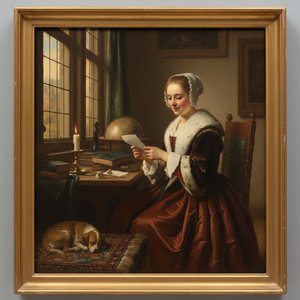
Gerrit Dou: Intimacy & Light in the Dutch Golden Age
Explore the exquisite world of Gerrit Dou, a master of Dutch Golden Age painting. Discover his intimate genre scenes, signature use of light, and lasting legacy. Learn about collecting Dou's works & their value.