


 实景预览
实景预览
 发送
发送 分享
分享
 详情
详情 指南
指南

 下载图片
下载图片
 相似作品
相似作品 X射线
X射线 幻灯片播放
幻灯片播放 统计数据
统计数据Pietà
 Acrylic On Canvas
- WallArt
- Baroque Splendor
 1581
1581 112.0 x 147.0 cm
 冬宫博物馆 (Hermitage Museum)
 阅读全文
阅读全文
手工油画复制品
由我们的艺术家按需定制,为您提供您所选尺寸及画框的布面手工油画。 ( 切换至版画销售渠道 切换至数字图像销售渠道)




P118B $10

P118H $10

P118W $10

P438Z $10

P508JH $12

P508YH $12

P805H $10

P805Z $10

P919BZ $10

P919G $10

P919XJ $10

P959ZH $10

P968JZ $12

W106C $8

W218G $10

W218JH $8

W218Y $10

W307PJ $10

W316G $10

W316PJ $8

W316Y $10

W398PJ $8

W4111J $10

W500HY $15

W500JH $15

W692G $12

W849H $8

W940BG $15

W953PJ $8




您可以从与原作比例一致的预设尺寸中进行选择。

您可以输入自定义尺寸,以适配特定的画框或空间。如果所选尺寸与原图比例不符,我们将通过裁剪作品或添加手绘元素来扩展画面。数字样稿将在制作开始前发送给您确认。
请注意,屏幕预览无法准确反映实际的裁剪或扩展效果,只有样稿才能真实呈现最终的构图。
虽然我们提供定制尺寸服务,但为了保留原作比例,建议您从预设列表中选择尺寸。
下单后,ArtsDot.com 团队将通过电子邮件联系客户获取具体要求,并提供效果预览图


 玻璃选项仅适用于110厘米以下的尺寸。

Pietà
复制品材质
复刻品尺寸说明
-


总计金额
$ 263
A Symphony of Color and Faith: Exploring Paolo Veronese’s Pietà
Paolo Caliari, universally known as Paolo Veronese (1528-1588), stands as a titan amongst Venetian Renaissance artists—a visionary who redefined artistic expression through an unparalleled mastery of color, composition, and theatrical grandeur. Born in Verona amidst the burgeoning humanist fervor of his time, Veronese’s formative years instilled within him a profound appreciation for classical ideals interwoven with the vibrant spirit of his region's artistic heritage. His initial apprenticeship under Antonio Badile and Giovanni Francesco Caroto honed foundational skills in traditional painting methods, yet it was his relocation to Venice in the 1550s that irrevocably propelled him toward unparalleled creative heights. The city itself became Veronese’s unwavering muse—its bustling marketplaces, opulent palaces, and shimmering canals fueling the monumental scale and dramatic narrative power of his oeuvre. He swiftly assimilated the stylistic innovations championed by Titian, whose masterful use of color served as a crucial catalyst for Veronese's distinctive palette – one characterized by luminous hues and subtle gradations that captured the very essence of Venetian light. Simultaneously, he cultivated an independent artistic voice, forging a style distinct from his contemporaries yet firmly rooted in Venetian tradition.The Baroque Embrace: Style and Technique
Veronese’s Pietà (1581), housed within Basilica dei Santi Giovanni e Paolo in Bologna, exemplifies this masterful blend of influences. Painted during the High Renaissance's waning years and transitioning into the Baroque era, it represents a pivotal moment in Venetian art history. Unlike the serene piety characteristic of earlier devotional paintings, Veronese’s Pietà bursts forth with vibrant color—a deliberate departure from prevailing artistic conventions—demonstrating his embrace of Baroque theatricality. The artist employed oil paint on canvas, utilizing layering techniques and meticulous glazing to achieve an astonishing level of realism and luminosity. Notice the masterful manipulation of light; it cascades across Mary's drapery, illuminating Jesus’s lifeless body with a poignant glow – a technique perfected by Veronese and his followers that would become synonymous with Baroque painting. The artist’s attention to detail extends beyond mere visual representation; he meticulously rendered textures—the folds of Mary’s robe, the smoothness of Jesus’s skin—creating an immersive experience for the viewer.Historical Context: Venetian Patronage and Artistic Innovation
The Pietà emerged from a period marked by significant artistic patronage within Venice – a city that actively fostered innovation and celebrated artistic achievement. Commissioned by Cardinal Giovanni Battista Castelli, Veronese's undertaking was ambitious in scope—a monumental altarpiece intended to dominate the basilica’s interior space and inspire devotion amongst its worshippers. This commission underscored Venice’s position as Europe’s foremost cultural center and fueled a competitive spirit among artists striving for recognition. Furthermore, Veronese’s work reflects broader intellectual currents of the time – particularly humanist ideals emphasizing human dignity and emotion alongside religious contemplation. He skillfully incorporated classical motifs—such as pyramidal composition—into his narrative scenes, demonstrating an awareness of artistic precedents while simultaneously forging a new visual language.Symbolism: Grief, Compassion, and Divine Grace
The Pietà transcends mere depiction; it embodies profound symbolic meaning rooted in Christian theology. Mary’s sorrowful posture conveys universal grief – the anguish experienced by mothers upon losing their children—yet her serene countenance speaks to an inner fortitude underpinned by faith and divine grace. Jesus’s lifeless body symbolizes humanity's vulnerability before death, while Mary’s embrace represents compassion and maternal love—a testament to God’s mercy and redemption. The positioning of Mary and Jesus within the pyramidal composition reinforces the centrality of Christ’s sacrifice as the cornerstone of Christian belief. Veronese’s masterful use of color – predominantly blues and reds – further amplifies these symbolic resonances, conveying feelings of solemnity and spiritual intensity.Emotional Impact: A Moment Frozen in Time
Ultimately, Veronese's Pietà achieves its enduring power through its ability to evoke profound emotional responses from the viewer. The luminous colors, combined with meticulous detail and dramatic lighting, transport us back to the moment of Jesus’s deposition—capturing the palpable grief of Mary and conveying a sense of sublime beauty amidst sorrow. It is a painting that compels contemplation – prompting viewers to grapple with questions of faith, mortality, and compassion. More than simply representing an iconic biblical scene, Veronese's Pietà serves as a timeless meditation on human suffering and divine grace—a masterpiece that continues to inspire awe and reverence centuries after its creation.相关艺术品


艺术家简介
威尼斯的幻景:保罗·委罗内塞的生平和艺术
保罗·卡利亚里,世人皆称他为保罗·委罗内塞,诞生于16世纪威尼斯的繁荣艺术氛围中,是一位色彩、构图和华丽壮观景象的大师。1528年出生于维罗纳,是石匠之子,早年生活沉浸在他周围的视觉丰富性中——该地区典型的古典建筑、雕塑形式以及新兴的人文主义理想。他最初在安东尼奥·巴迪莱和乔瓦尼·弗朗切斯科·卡罗托门下接受传统技巧训练,但真正点燃他艺术天才的是1550年代移居威尼斯。这座城市本身成为了他的缪斯女神,它熙熙攘攘的市场、宏伟的宫殿和波光粼粼的水道影响着他作品的规模和戏剧性。他迅速吸收了已确立的威尼斯大师的影响,例如提香,提香对色彩的掌握深刻地影响了委罗内塞的调色板,但他创造了一种独特的风格,其特点是无与伦比的戏剧性和宏伟感。宴会与史诗叙事的画家
委罗内塞的声誉建立在他纪念性的绘画作品之上,特别是那些描绘奢华宴会和转变为威尼斯生活令人惊叹景象的圣经场景的作品。1563年为圣乔治马焦雷修道院完成的《迦拿婚宴》是他技艺的证明。这幅巨大的画布不仅仅是对奇迹的说明;它是一幅16世纪社会生动的全景图,充满了穿着优雅的人物、音乐家和以惊人的精确度呈现的建筑细节。这幅画并非关于在迦拿发生的事情,而是*如果*它发生在委罗内塞时代的威尼斯会是什么样子。同样,《利未家的宴席》,最初名为《最后的晚餐》,由于其包含当代人物和看似不敬的气氛而引起了宗教裁判所的争议。 委罗内塞捍卫了他的艺术许可,声称画家有权享有与诗人或小丑相同的创作自由——这一大胆声明反映了他对艺术解释和重塑神圣叙述的力量的信念。这些作品不仅仅是宗教描绘;它们是对生活、财富和威尼斯本身辉煌的庆祝。他并不感兴趣于禁欲主义的精神,而是致力于捕捉存在的欢乐和丰富性。影响与艺术发展
虽然提香对委罗内塞色彩的影响不可否认,但他的艺术发展是各种影响复杂地相互作用的结果。他在构图中带来的建筑精确度归功于维罗纳在他形成时期盛行的古典传统,特别是米凯莱·桑米凯利等建筑师的作品。他还吸收了来自中意大利大师(如拉斐尔和帕米吉亚尼诺)的元素,这在他的绘画作品中优雅的线条和和谐的安排中显而易见。然而,委罗内塞并没有简单地模仿这些影响;他将它们综合成一种独特的威尼斯风格,其特点是对光线的戏剧性运用、鲜艳的色彩调色板以及对细节一丝不苟的关注。 他擅长创造空间和深度的幻觉,使用透视技术将观众带入他错综复杂的场景的核心。他对油画的掌握使他能够达到无与伦比的光辉和丰富的质感。他还经营着一个大型工作室,他的兄弟本尼迪托和儿子加布里埃尔和卡洛为之贡献力量,确保了他的风格在他1588年去世后继续繁荣。主要成就与历史意义
保罗·委罗内塞的影响远远超出了文艺复兴艺术的范畴。他的作品在几个世纪中引起共鸣,激励了各个学科的艺术家。 他的戏剧性构图和鲜艳的色彩方案已被认为是影响巴洛克绘画到现代电影的一切因素——甚至可以在意大利面条西部电影的视觉美学中找到回声。他是威尼斯“伟大三巨头”画家之一——与提香和丁托列托一起,每个人都为这座城市的艺术遗产做出了独特的贡献,但委罗内塞通常因其纯粹的活力和对世俗乐趣的庆祝而脱颖而出。 他的画作继续以其宏伟壮丽吸引观众,提供了一瞥16世纪威尼斯的奢华世界。- 他通过融入当代生活重新定义了历史绘画。
- 他对色彩的使用至今仍影响着艺术家。
- 他的作品体现了文艺复兴人文主义精神和对世俗美的庆祝。

保罗·委罗内塞
1528 - 1588
快速概览
- 代表作品:
- 迦拿的婚礼
- 利未之家的宴会
- 全名: 保罗·委罗内塞
- 出生地: 意大利维罗纳
- 出生日期: 1528年
- 受此画家影响的艺术家:
- 鲁本斯
- 瓦托
- 国籍: 意大利
- 影响此画家的艺术家: ['提香']
- 艺术运动或风格: 文艺复兴,矫饰主义
- 逝世日期: 1588年
相关文章

巴洛克艺术巅峰:十部巨作定义时代,点亮您的臻品格调
探索巴洛克艺术的辉煌!本文精选十部巨作,带您领略卡拉瓦乔、伦勃朗等大师的光影魔法与戏剧张力。从黄金时代到宗教绘画,感受奢华与精致。ArtsDot.com为您提供博物馆品质的艺术复制品和家居装饰灵感。尽在ArtsDot.com!

巴洛克艺术的戏剧性辉煌:历史背景、风格特征与持久影响
深入探索巴洛克艺术的辉煌历史、独特风格与持久影响。了解卡拉瓦乔、贝尼尼等大师的作品,洞悉反宗教改革运动下的艺术变革。ArtsDot.com为您提供专业的艺术解读与高清画作欣赏。

巴洛克戏剧性:将辉煌与情感融入当代室内设计
探索巴洛克艺术的辉煌与奢华!ArtsDot提供精湛的手工油画复制、定制服务和专业艺术咨询,助您将经典作品融入当代室内设计,提升家居品味。投资艺术,传承价值。
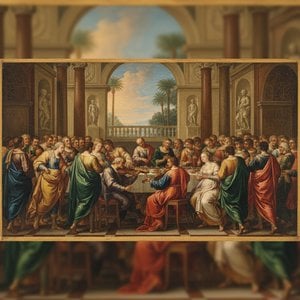
Paolo Veronese: A Renaissance Master of Color, Composition, and Venetian Splendor
Explore the vibrant world of Paolo Veronese, a Renaissance master renowned for his opulent compositions, masterful use of color, and dramatic Venetian scenes. Discover key artworks & legacy.

丁托列托25幅杰作:威尼斯光影大师的艺术传奇 | ArtsDot
探索丁托列托25幅杰作:深入了解这位威尼斯光影大师的艺术传奇!从宗教绘画到神话故事,感受文艺复兴与巴洛克风格的完美融合。ArtsDot.com提供高清艺术复制品和家居装饰灵感,点亮您的生活空间。立即探索完整系列!


