


The picture follows your choices: , .
藏品详情
A vibrant still life of nature's bounty featuring colorful fruits and flowers by Japanese modernist pioneer Narashige Koide, offering a timeless glimpse into 1927 avant-garde beauty for your collection.
 展开全文
展开全文
艺术家简介
Discover Narashige Koide (1887-1931), a pioneer of Hanshinkan Modernism in Japanese yōga painting. Explore evocative portraits, striking nudes & his innovative approach bridging Nihonga tradition and Western styles.
手工油画复制品
由我们的艺术家按需定制,为您提供您所选尺寸及画框的布面手工油画。 ( 切换至版画销售渠道 切换至数字图像销售渠道)
More about this painting
 实景预览
实景预览
 分享
分享 分享
分享
 详情
详情 指南
指南

 下载作品
下载作品
 相似作品
相似作品 X射线
X射线 幻灯片播放
幻灯片播放 Q&A
Q&A 统计数据
统计数据Order your painting in four simple steps
Take your time. You can change any answer; the price in your order card follows each choice.
1 Step one of four
Which size would you like?
These sizes keep the proportions of the original painting. The drawing shows your choice on a wall, above a two-metre sofa.
Or give your own measurements
您可以从与原作比例一致的预设尺寸中进行选择。

请输入您需要的宽度和高度,以适配您的画框或墙面。由于作品为手工绘制,若选择不同比例的尺寸,艺术家可能会在画面边缘多画一些或稍作裁剪 —— 由您决定。在开始绘画之前,我们会为您发送一份数字效果图供您确认。本页面上展示的图片并非最终实物 —— 只有效果图才能反映真实结果。
2 Step two of four
How should it be prepared: rolled, stretched or framed?
The prices below are for the size you chose in step one.
Choose the edges of the stretched canvas
Choose your frame

White ¥1

Blurside ¥1

Extended ¥1

P118B ¥10

P118H ¥10

P118W ¥10

P438Z ¥10

P508JH ¥12

P508YH ¥12

P805H ¥10

P805Z ¥10

P919BZ ¥10

P919G ¥10

P919XJ ¥10

P959ZH ¥10

P968JZ ¥12

W106C ¥8

W218G ¥10

W218JH ¥8

W218Y ¥10

W307PJ ¥10

W316G ¥10

W316PJ ¥8

W316Y ¥10

W398PJ ¥8

W4111J ¥10

W500HY ¥15

W500JH ¥15

W692G ¥12

W849H ¥8

W940BG ¥15

W953PJ ¥8

H24-GOLD ¥30

H24-SILVER ¥30

H36-GOLD ¥45

H36-SILVER ¥45
带框
Moulding: . Overall size with the frame: .
3 Step three of four
Would you like anything changed in the painting?
Most people answer no. Because each painting is made by hand, our artist can also adapt it for you.
After order, ArtsDot.com team will email client for instructions and provide a mockup preview
4 Step four of four
A few finishing options
All of them are optional. The answers already selected cost nothing extra.
Who paints it?
A nameplate, as in a museum?
青铜铭牌雕刻详情
This elegant plaque features the artist's name and the title of the artwork, finely engraved for a timeless presentation.
It is made from bronze with a refined, elegant finish. The text is precisely laser-engraved for a sharp and permanent result. Measuring 9x2 cm, the plaque is compact yet easy to read. It's built to be durable and scratch-resistant, offering a professional, museum-quality look. Mounting is simple thanks to the included adhesive backing.
透明亚克力铭牌详情
The plaque includes essential engraved details such as the artist's name, the title of the artwork, the date it was created, the type of media used-like oil on canvas or watercolor-a brief description of the piece, and a QR code that links to the complete artwork information.
It is crafted from clear acrylic, offering a sleek, modern appearance. The text is UV-engraved in black to ensure strong visual contrast. With a size of 10x15 cm, it ensures optimal readability. It comes equipped with two metal hooks for secure wall mounting. The plaque is designed to be weather-resistant, making it suitable for various environments, and it includes interactive features that work seamlessly with smartphone scanning.
黑色亚克力铭牌详情
This elegant plaque includes engraved information such as the artist's name, the title of the artwork, the date it was created, the type of media used (like oil on canvas or watercolor), a short description of the artwork, and a QR code for quick access to more information.
The plaque itself is made from refined black acrylic with a premium finish. The text is laser-engraved in white for high contrast and readability. Its size is 10x15 cm, designed to be easy to read. It comes with two metal hooks for professional mounting. The design is sleek and fits any interior style. It is also weather-resistant and durable, with built-in digital integration for mobile compatibility.
A protective varnish?
When do you need it?
✓ Check and order
Your painting, as you ordered it

Vegetables on the Table
复制品材质
复刻品尺寸
-

精选资深艺术家
更丰富的细节、更精湛的工艺以及更充裕的制作时间
-

复制画装裱选项
-
-
对于任何边长超过 105 厘米(约 41 英寸)的艺术品或复制品,画框将以拆解后的组件形式发货。此方法可确保安全送达并防止运输过程中的损坏。
需由专业人员组装 —— 本产品不适用于 DIY 操作。
该组件必须由经验丰富的专业装裱师进行组装及画布绷装,过程中需使用木工胶(不随附)、画布绷边钳以及夹具,以确保在胶水干燥期间保持内框方正。组装不当或画布张力不均可能会对艺术品造成永久性损坏,且此类情况不在我们的保修范围之内。
 对于任何边长超过 105 厘米(约 41 英寸)的艺术品或复制品,画框将以拆解后的组件形式发货。此方法可确保安全送达并防止运输过程中的损坏。
包含所有实木条,尺寸精确,便于组装。
使用随附的螺丝进行组装,另需准备用于角部连接的木工胶(本品不含木工胶),请由您的装裱师自行准备。
需另备专业工具(本套件不含):画布绷紧钳以及用于在胶水干燥过程中保持木条方正的夹具。
重要提示:
角部连接处需要使用木工胶,边框条必须使用夹具固定直至胶水完全干透,且在组装好的框架上绷紧画布需要用到画布拉伸钳。以上工具均不包含在套装内。请在订购此尺寸前,预先联系经验丰富的专业装裱师。

展品铭牌
-
-

保护性清漆
光泽清漆(提亮色彩,防光防潮)
-

定制我的艺术品
定制化示例:替换面部为客户照片;添加宠物(例如,将猫替换为狗);在背景中加入隐藏信息;更改背景风景或元素。
-

加急
全球配送()仅需 3-4 周即可送达,无需等待标准时效的 5 周。(30 October)。品质始终如一,绝不妥协。
-
极速达
全球配送(),预计 5 周送达。(6 November)。
已包含
最终结算价
¥ 1767
玻璃选项仅适用于110厘米以下的尺寸。
Included with every order
- 全球免运费特快专递服务
- 优质亚麻画布
- 全程运输保险
- 关税退款保证
- 色彩精准还原保证
- 100天退货保障(仅限制造缺陷)
- 100% 退款保证
- 多件购买优惠


A Symphony of Stillness: The Bounty of Narashige Koide
In the quiet corners of early 20th-century modernism, few works capture the humble elegance of daily life as poignantly as Narashige Koide’s 1927 masterpiece, Vegetables on the Table. This evocative still life serves as a profound meditation on texture, color, and the simple abundance of nature. At first glance, the viewer is greeted by a vibrant arrangement of life: the sun-kissed curves of oranges and apples, the elongated grace of bananas, and a central vase of flowers that acts as the composition's beating heart. Set against a deep, atmospheric blue background, the subjects do not merely sit upon the table; they emerge from the shadows with a sculptural presence that commands the room.
The brilliance of this piece lies in Koide’s ability to bridge the gap between the delicate sensibilities of Nihonga—the traditional Japanese style he studied in his youth—and the bold, structural experimentation of Western Yōga painting. There is a rhythmic balance at play here, where the placement of two humble bowls and a solitary cup creates a sense of domestic harmony. For the discerning collector or interior designer, this painting offers more than just visual interest; it provides a focal point of stability and warmth. The interplay between the cool, receding blue backdrop and the warm, tactile fruits creates a chromatic tension that breathes life into any sophisticated space.
Beyond its aesthetic charm, Vegetables on the Table carries a deeper symbolic weight, reflecting the era's fascination with finding beauty in the mundane. During a period of intense cultural transition in Japan, Koide utilized the still life genre to explore form and light, stripping away the unnecessary to focus on the essential. The arrangement feels both spontaneous and meticulously curated, suggesting that even in the most ordinary objects, there exists an eternal, artistic truth. Each brushstroke contributes to a sense of weight and volume, inviting the viewer to reach out and touch the velvety skin of a peach or the smooth surface of a ceramic bowl.
For those seeking to infuse their homes with a sense of historical depth and quiet luxury, a high-quality reproduction of this work offers an unparalleled opportunity. It is a piece that transcends mere decoration, acting as a window into the soul of Japanese modernism. Whether placed in a sunlit dining room to echo its themes of nourishment or in a contemporary study to provide a classical counterpoint to modern furniture, Koide’s vision remains timeless. To possess this image is to hold a fragment of 1927—a moment of stillness captured forever in a dance of color and light.
常见问题与解答
“Vegetables on the Table”的浏览量是多少?
"Vegetables on the Table" 拥有专属的 访问统计 页面。该页面通过国家和语言维度的细分,展示了该作品及艺术家其他作品的每月访问量趋势图。
"Vegetables on the Table" 的色彩之间是如何相互关联的?
Narashige Koide 的《Vegetables on the Table》 的色彩呈现出一种 Strong Color Unity 的和谐感。这种和谐感描述了色彩之间的相互关系。
"Vegetables on the Table" 是何时以及使用什么材料创作的?
"Vegetables on the Table"创作于1927年,采用了Oil技法。材质与日期说明了原作的创作方式及时间。
相似作品


Narashige Koide
1887 - 1931, Japan
艺术家简介
A Pioneer of Modern Japanese Painting: The Life and Art of Narashige Koide
Narashige Koide, born in Osaka in 1887, emerged as a pivotal figure in the evolution of early 20th-century Japanese art. His brief but intensely productive career bridged the traditions of Nihonga – traditional Japanese painting – with the burgeoning influence of Western artistic styles, particularly in portraiture and the daring exploration of the nude form. Koide’s story is one of a restless innovator, constantly seeking to define a uniquely Japanese modernism, grappling with both aesthetic heritage and the allure of European avant-garde movements.
From his youth, an inclination towards art was evident, leading him to study Nihonga during his elementary and middle school years. However, Koide harbored a deep fascination with Western painting techniques, a desire that initially led to rejection from the Western Arts department of the Tokyo School of Fine Art in 1907. Accepted into the Nihonga program instead, he continued to pursue oil painting independently, recognizing its potential for expressing modern sensibilities. This duality – a grounding in Japanese artistic principles coupled with an ambition to master Western methods – would become a defining characteristic of his oeuvre.
The Rise of Hanshinkan Modernism and Early Success
After graduating from the Tokyo School of Fine Art in 1914, Koide returned to Osaka, immersing himself in the artistic ferment of the Kansai region. This period saw the emergence of what would become known as Hanshinkan Modernism – a movement characterized by its embrace of Western styles while retaining a distinctly Japanese aesthetic sensibility. Koide quickly became a leading voice within this burgeoning scene. His breakthrough came with “N’s Family” (1919), a yōga-style portrait that garnered significant attention and ultimately won the prestigious Chōgyū Prize at the Sixth Nikakai Exhibition. This work, now recognized as an Important Cultural Property of Japan, showcased Koide's ability to synthesize Western compositional techniques with Japanese themes and emotional depth.
The success of “N’s Family” propelled Koide into the spotlight, securing commissions and allowing him further artistic exploration. His subsequent works, such as "Boy with a Lamp" (1923), displayed a growing mastery of light and shadow, influenced by Impressionism and Post-Impressionism, yet imbued with a uniquely Japanese sensitivity to form and atmosphere. He wasn’t merely imitating Western styles; he was adapting them, filtering them through his own cultural lens.
Experimentation and the Pursuit of Form
Koide's artistic curiosity extended beyond traditional painting mediums. He experimented with various techniques, including painting on glass, demonstrating a willingness to push boundaries and challenge conventional norms. A trip to France from 1921-1922 further broadened his horizons, exposing him to the latest developments in European art. Upon his return, he established an atelier in Osaka in 1924, fostering a creative environment that attracted other artists and contributed to the vibrant artistic community of the region.
However, it was in his later years, particularly after moving to Ashiya in 1926, that Koide truly distinguished himself. He became renowned for his depictions of the female nude – a subject considered daringly modern for its time in Japan. Paintings like “Nude with White Cloth” (1929) and “Nude on a Bed” (1930) were not simply exercises in anatomical study; they were explorations of form, light, and emotion, imbued with a subtle sensuality that set them apart from their Western counterparts. He earned the nickname "Rafu no Narashige" – Narashige of the Nudes – reflecting his prominence in this genre.
Legacy and Lasting Influence
Tragically, Narashige Koide’s life was cut short by illness in 1931 at the age of just 43. Despite his relatively brief career, he left an indelible mark on Japanese art history. He played a crucial role in establishing Hanshinkan Modernism as a significant force and paved the way for future generations of artists to explore Western styles while remaining rooted in their own cultural heritage.
Koide’s work continues to resonate today, captivating viewers with its blend of technical skill, emotional depth, and innovative spirit. His paintings are held in prestigious collections such as the National Museum of Modern Art, Tokyo, and the Ohara Museum of Art, ensuring that his legacy will endure for years to come. He remains a testament to the power of artistic vision and the enduring quest to forge a uniquely modern Japanese aesthetic.
Notable Works
- N’s Family (1919), Ohara Art Museum, National Important Cultural Property
- Boy with a Lamp (1923), National Museum of Modern Art, Tokyo, Japan
- Nude with White Cloth (1929), National Museum of Modern Art, Tokyo, Japan
- Nude on a Bed (1930), Ohara Museum of Art, Tokyo, Japan
相关文章

Slate Blue Masterpieces: 10 Iconic Paintings & Timeless Home Decor Ideas
Immerse yourself in the captivating world of slate blue! Explore 10 iconic paintings by Monet, Van Gogh & Renoir. Discover their stories, techniques & find museum-quality art reproductions for your home at .

保罗·塞尚:25幅大师杰作,重塑现代艺术与家居美学 | ArtsDot
探索保罗·塞尚25幅经典杰作!深入了解后印象派大师的艺术生涯、独特技法与色彩运用。ArtsDot提供高清油画复制品,为您的家居带来博物馆级艺术体验。立即发现更多名画,点亮生活空间!
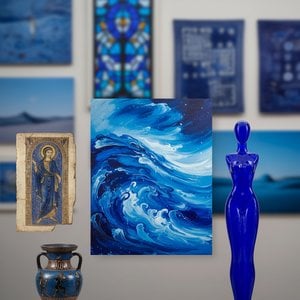
The Allure of Azure: Exploring the Symbolic & Aesthetic Depths of Blue in Art History
Explore the rich history of blue in art! Discover its symbolism, from ancient pigments to modern masterpieces by Kandinsky & Seurat. Uncover the psychological impact and cultural meanings behind this captivating hue.