

 购买版画
购买版画 分享
分享 分享
分享
 Details

 下载
下载
 相似作品
相似作品 X-Ray
X-Ray 幻灯片播放
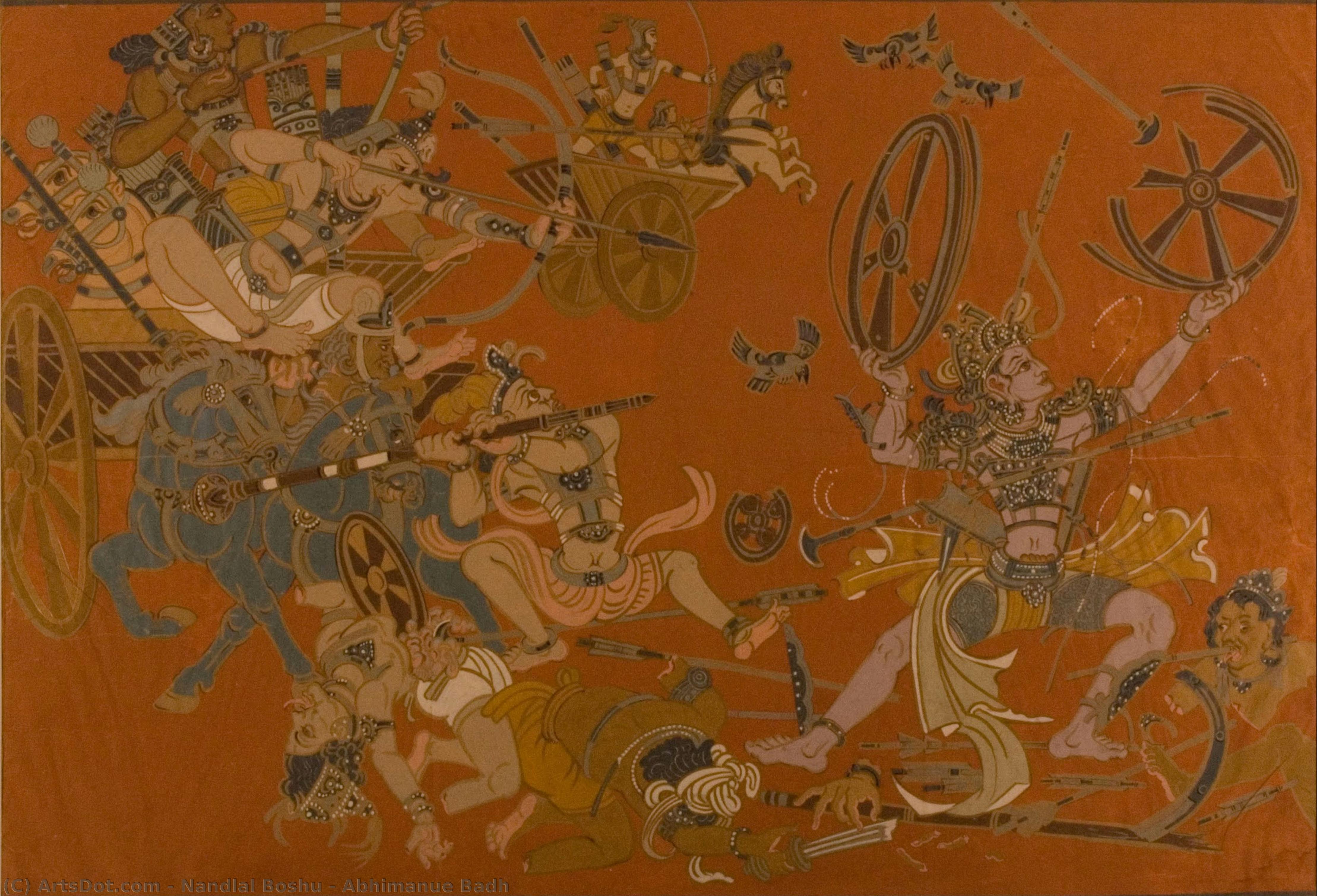
幻灯片播放Abhimanue Badh
 Indo-Islamic Style
 1947
1947- Modern
 1790.0 x 1300.0 cm
 国立现代艺术馆




P118B $10

P118H $10

P118W $10

P438Z $10

P508JH $12

P508YH $12

P805H $10

P805Z $10

P919BZ $10

P919G $10

P919XJ $10

P959ZH $10

P968JZ $12

W106C $8

W218G $10

W218JH $8

W218Y $10

W307PJ $10

W316G $10

W316PJ $8

W316Y $10

W398PJ $8

W4111J $10

W500HY $15

W500JH $15

W692G $12

W849H $8

W940BG $15

W953PJ $8




 了解更多
了解更多从与原作比例一致的预设尺寸中进行选择。

您可以输入自定义尺寸,以适配特定的画框或空间。如果所选尺寸与原图比例不符,我们将通过裁剪作品或添加手绘元素来扩展画面。数字样稿将在制作开始前发送给您确认。
请注意,屏幕预览无法准确反映实际的裁剪或扩展效果,只有样稿才能真实呈现最终的构图。
虽然我们提供定制尺寸服务,但为了保留原作比例,建议您从预设列表中选择尺寸。
下单后,ArtsDot.com 团队将通过电子邮件联系客户获取具体要求,并提供效果预览图。


 玻璃选项仅适用于110厘米以下的尺寸。

Abhimanue Badh
复制材质
复制品尺寸
-


最终总价
-
作品详情
A Heroic Tragedy in Gold and Ochre
In the heart of Nandalal Bose’s profound contribution to Indian modernism lies Abhimanue Badh, a work that breathes life into the ancient echoes of the Mahabharata. This masterpiece captures the tragic moment of the young hero Abhimanyu’s demise, an episode defined by both unparalleled bravery and heartbreaking injustice. As one of the most significant figures of the Bengal School, Bose does not merely illustrate a myth; he orchestrates a visual symphony of chaos and courage. The painting presents a dense, kinetic landscape where the boundaries between man and myth blur, inviting the viewer into a swirling vortex of combat that feels both timeless and urgently present.
The composition is a masterclass in controlled chaos. Within a crowded and energetic frame, the artist utilizes a flattened perspective reminiscent of classical Indian mural traditions to emphasize the sheer scale of the struggle. The eye is immediately drawn to the interplay of geometric precision—the sharp lines of spears, the circular strength of shields, and the rotating wheels of chariots—against the fluid, organic forms of the warriors' bodies. This tension between structure and movement creates a rhythmic pulse throughout the piece, ensuring that even in its most crowded moments, the painting maintains a sense of epic grandeur.
The Alchemy of Color and Line
Technically, Abhimanue Badh is an exploration of warmth and intensity. The palette is dominated by a luminous spectrum of oranges, golds, and deep ochres, creating an atmosphere that feels as though it is radiating heat from the very center of the battlefield. This monochromatic warmth serves to unify the disparate elements of the battle, casting a divine yet violent glow over the scene. Bose’s meticulous brushwork achieves a rich, layered texture that suggests the weight of history itself, giving the surface a tactile quality that invites close inspection.
The artist's lineage, deeply rooted in the study of the Ajanta cave murals and Mughal miniature traditions, is evident in his masterful use of line. Every contour of a muscle, every arc of a weapon, is defined with a precision that speaks to his disciplined training at Kala Bhavana. These lines do more than define shape; they direct the emotional flow of the piece, guiding the viewer from the frantic energy of the periphery toward the tragic epicenter of the hero's stand. For the collector or designer, this work offers a profound sense of movement and light that can serve as a commanding focal point in any sophisticated interior.
A Legacy of Cultural Revival
Beyond its aesthetic brilliance, this artwork stands as a testament to the revival of Indian visual identity. Created during a period of immense national transformation, Bose’s work reflects his commitment to a "new visual language"—one that drew strength from India's classical past to forge a modern future. The symbolism of the chariot and the heroic struggle serves as a metaphor for the indomitable human spirit in the face of overwhelming odds. To possess a reproduction of this work is to hold a piece of the soul of Indian modernism, bringing into one's space a narrative of resilience, artistry, and the eternal drama of the human condition.
相似艺术品


艺术家简介
早年生活与艺术生涯
Nandalal Bose 是一位享誉盛名的印度艺术家,于1882年12月3日出生在比哈尔邦门格尔县哈弗利卡拉格普尔的一个中产孟加拉家庭。尽管最初并未得到家人的认可,但他对艺术的热爱自幼便已萌芽,并最终将其转化为终身的职业追求。在加入加尔各答艺术学院后,Nandalal Bose 深受 阿旃陀石窟 壁画的启发,并由此跻身于一个致力于复兴印度古典文化的国际艺术家与作家圈层。这种深厚的文化联结也促使他投身于非暴力运动,其1930年创作的黑白亚麻油毡版画——描绘了圣雄甘地手持手杖行走的瞬间,成为了那个时代的深刻印记。艺术风格与卓越贡献
Nandalal Bose 的艺术风格以其独特的“印度风格”著称,这种风格巧妙地融合了传统的印度元素与波斯艺术的影响。他的作品通过细腻的笔触捕捉了印度神话场景、女性之美以及淳朴的乡村生活,这使他被公认为现代印度艺术的先驱之一。在 Nandalal Bose 的众多杰作中,以下作品尤为瞩目:- 狮子 (A Lion)(59 x 63 厘米,新德里国立现代艺术馆,蛋彩画)- [https://ArtsDot.com/@@/d3zhue-nandlal-boshu-a-lion](https://ArtsDot.com/@@/d3zhue-nandlal-boshu-a-lion)
- 鼓手 (Dhol Wala)(59 x 63 厘米,新德里国立现代艺术馆,蛋彩画)- [https://ArtsDot.com/@@/d3zgtg-nandlal-boshu-dhol-wala](https://ArtsDot.com/@@/d3zgtg-nandlal-boshu-dhol-wala)
- 致敬 (Pranam)(50 x 55 厘米,新德里国立现代艺术馆,蛋彩画)- [https://ArtsDot.com/@@/d3zgta-nandlal-boshu-pranam](https://ArtsDot.com/@@/d3zgta-nandlal-boshu-pranam)
传承与地位
Nandalal Bose 对印度艺术的贡献是无法估量的。他曾受命为《印度宪法》绘制插图,并于1976年被印度考古调查局誉为“九位艺术家”之一,其作品被视为名副其实的“艺术瑰宝”。时至今日,德里国立现代艺术馆仍珍藏着他的7,000多件作品。 重要链接:- Nandalal Bose 的维基百科传记 - [https://en.wikipedia.org/wiki/nandalal_bose](https://en.wikipedia.org/wiki/nandalal_bose)
- ArtsDot.com 上的 Nandlal Bose 艺术作品集 - [https://ArtsDot.com/@/nandlal-boshu](https://ArtsDot.com/@/nandlal-boshu)

南达拉尔·博斯
1882 - 1966 , 印度
艺术家简介
- Artistic Movement Or Style: 印度风格
- Artists Or Movements Influenced By This Artist: ['阿旃陀石窟壁画']
- Artists Who Influenced This Artist: ['阿班尼德拉纳特·塔戈尔']
- Date Of Birth: 1882年12月3日
- Date Of Death: 1966年4月16日
- Full Name: 南达拉尔·博斯
- Nationality: 印度
- Notable Artworks:
- 狮子
- 鼓手
- 致敬
- Place Of Birth: 印度,卡拉格普尔
相关文章

Echoes of Olympus: Mythological Narratives in Western Art Through the Ages
Explore the captivating history of mythological narratives in Western art! From ancient Greece to modern masterpieces, discover iconic artworks & symbolism. Expert analysis and high-quality reproductions at ArtsDot.


将个人叙事编织成象征形式:委托油画作为个体神话的表达
将您的个人故事转化为永恒的艺术珍品。ArtsDot提供高端定制油画服务,由专业艺术家倾力打造,赋予作品深刻象征意义与情感价值。咨询艺术专家,打造专属神话。

Raja Ravi Varma: Bridging Tradition & Modernity in 19th-Century Indian Art
Explore the life & art of Raja Ravi Varma, a pioneer who fused European techniques with Indian iconography. Discover his iconic paintings, lasting legacy, and influence on modern Indian art at ArtsDot.
Heritage Through Paintings: A Cultural Memory of Civilizations – From Ancient Murals to Modern Expressions
Explore the rich history of paintings & their role in preserving cultural heritage. Expert analysis, fascinating insights, and a journey through art from ancient murals to modern masterpieces. Discover the stories behind iconic artworks!

From Snapshot to Legacy: The Art of Commissioning a Hand-Painted Reproduction from Photography – Preserving Memories Through Oil Painting Techniques
Transform cherished photos into timeless oil paintings with skilled artists. Trusted for bespoke portraits & heirloom art. Discover the process, styles & lasting value – a legacy preserved.

