

 实景预览
实景预览
 分享
分享 分享
分享
 详情
详情 指南
指南

 下载作品
下载作品
 相似作品
相似作品 X射线
X射线 幻灯片播放
幻灯片播放 问答
问答 统计数据
统计数据Untitled


 展开全文
展开全文
艺术微喷/版画
博物馆级艺术微喷或帆布版画,制作高效,并提供多种饰面选择。 ( 订购纯手工绘制画作 切换至数字图像销售渠道)




































您可以从与原作比例一致的预设尺寸中进行选择。

请输入您所需的宽度和高度,以适配您的画框或墙面。由于印刷品只能进行裁剪,无法超出原图尺寸,因此若比例不一致,画面的一部分将会被裁切。在正式印刷之前,我们会为您发送一份数字效果图供您确认。本页面显示的图片并非最终裁剪后的效果——只有效果图才能展示真实的裁剪情况。


 玻璃选项仅适用于110厘米以下的尺寸。

Untitled
艺术微喷/版画
复刻品尺寸
-


最终结算价
¥ 422
相似作品


艺术家简介
Naiem Ismail: Weaver of Syrian Identity
Naiem Ismail (1930-1979) stands as a pivotal figure in the development of modern art within Syria, a pioneer who masterfully blended traditional Islamic aesthetics with the burgeoning currents of abstract expressionism. Born in Antakya, a city steeped in cultural crossroads between Turkey and Syria, his early life undoubtedly shaped his artistic vision – a synthesis of Eastern and Western influences that would become the hallmark of his distinctive style. Ismail’s journey from the rural landscapes of his birth to the vibrant, politically charged atmosphere of Damascus reflects not only his personal evolution but also the broader transformation occurring within Syrian art during the mid-20th century.
His formal artistic training began in Istanbul, a city renowned for its rich artistic heritage and diverse cultural influences. This initial exposure to European techniques provided a crucial foundation before he returned to Syria in the late 1950s. It was here that he truly began to forge his own unique voice, one deeply rooted in Syrian culture yet informed by global trends. Ismail’s early career saw him working as an artistic director for several prominent magazines, including “Jaish al-Shaab,” a publication dedicated to socialist ideals and national consciousness – a context profoundly impacting the themes and imagery of his work.
Geometric Abstraction and Islamic Roots
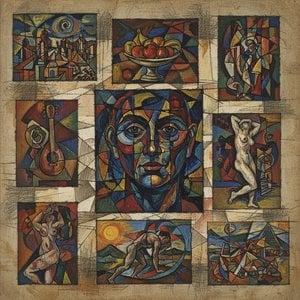
Ismail's artistic style is immediately recognizable by its striking geometric abstraction. He didn’t simply abandon representation; instead, he meticulously deconstructed everyday scenes—village life, domestic interiors, bustling marketplaces—and rebuilt them using a complex vocabulary of lines, shapes, and patterns. These motifs weren’t arbitrary choices; they were deeply informed by Islamic art traditions – the intricate geometries of mosaics, the rhythmic repetition of calligraphy, and the symbolic weight of geometric forms. He drew heavily on traditional Syrian textiles, particularly their vibrant colors, bold patterns, and layered textures, translating these visual elements onto canvas with remarkable skill.
His use of color was equally deliberate. He favored rich, saturated hues—deep blues, earthy reds, warm ochres—creating a sense of depth and spatial complexity that defied the limitations of two-dimensional space. This illusionistic quality – the suggestion of multiple planes and receding perspectives – is a key characteristic of his work, lending an almost theatrical quality to his compositions. It’s as if he were capturing not just a scene but also the very essence of Syrian life, its energy, its rhythms, and its inherent beauty.
A Reflection of National Identity
Ismail's art played a significant role in the burgeoning movement to cultivate a sense of national consciousness within Syria following independence from French mandate in 1944. His depictions of everyday life—a man resting on his doorstep, a veiled woman entering a scene—were not merely picturesque; they were imbued with symbolic meaning, reflecting Syrian values, traditions, and social dynamics. His brother, Adham Ismail, who tragically died young, was equally instrumental in this movement, pioneering the integration of calligraphy and abstraction into Syrian art.
His appointment as Director of Fine Arts within the Ministry of Culture in the 1970s further solidified his position as a leading figure in promoting artistic expression. During this period, he oversaw numerous public art projects, including the façade of the trade union building in Damascus and the front of the Euphrates Dam, demonstrating his commitment to using art as a tool for social engagement and national development.
Legacy and Recognition
Naiem Ismail’s influence on Syrian art is undeniable. His innovative approach to abstraction, combined with his deep respect for traditional Islamic aesthetics, paved the way for subsequent generations of artists. His work has been exhibited both domestically and internationally, including at prestigious venues such as the World Hall of Modern Art in Damascus and the Louvre-Lens in France. He received the State Prize of the Supreme Council of Arts in 1968, a testament to his artistic merit and contribution to Syrian culture.
Despite his untimely death in 1979, Ismail’s legacy continues to resonate within Syria and beyond. His paintings are now held in prominent collections, including those of the Barjeel Art Foundation and the Syrian National Museum, ensuring that his unique artistic vision will be remembered for years to come. He remains a crucial figure in understanding the evolution of modern art in the Middle East – an artist who skillfully blended tradition and innovation, creating works of enduring beauty and profound cultural significance.

Naiem Ismail
1930 - 1979 , Syrian Arab Republic
艺术家简介
- Full Name: Naiem Ismail
- Nationality: Syrian
- Date Of Birth: 1930
- Date Of Death: 1979
- Place Of Birth: Antakya, Syrian Arab Republic
- Notable Artworks:
- Village scene
- Untitled painting
- Artistic Movement Or Style: Abstract, Geometric
- Artists Who Influenced This Artist: ['Adham Ismail']
- Artists Or Movements Influenced By This Artist: ['Islamic geometric art']
相关文章

Raw Emotion & Bold Strokes: Top 10 Neo-Expressionism Masterpieces
Explore iconic Neo-Expressionist works by Basquiat and Kiefer. Discover museum-quality art at ArtsDot.com.

Mastering Abstraction: The Top 25 Essential Artworks by Wassily Kandinsky
Explore 25 iconic Wassily Kandinsky masterpieces. From Blue Rider to pure abstraction, discover the full collection on ArtsDot.com.

Defining Art Now: Top 10 Masterpieces of '08-Contemporary & Beyond | ArtsDot
Explore 10 defining masterpieces of contemporary art – from Jeff Koons to Yayoi Kusama. Discover the stories behind iconic paintings & sculptures, and find museum-quality reproductions for your home at ArtsDot.com. Explore the full collection online!
Cubist Expressionism's 10 Defining Masterpieces | Art for Your Home
Explore 10 defining Cubist Expressionism masterpieces by Picasso, Braque & more. Discover the stories behind these bold, geometric paintings and bring museum-quality art to your home with ArtsDot.com. Explore the full collection online.

The Unconventional Vision: Exploring the Characteristics, History & Enduring Appeal of Naïve Art
Explore the captivating world of naïve art! Discover its history, characteristics, key artists & collecting tips from ArtsDot's experts. Find your perfect piece today.