


图片将根据您的选择进行更新: , .
藏品详情
Admire Matthaeus Greuter’s ‘Globes,’ a stunning 17th-century depiction of knowledge & exploration. Hand-painted reproduction of a scholarly study, inspired by Rome's Biblioteca Statale.
艺术家简介
Explore Matthaeus Greuter's stunning maps & engravings from 16th-17th century Rome! Known for celestial globes, architectural prints & cartographic innovation.
 展开全文
展开全文
手工油画复制品
由我们的艺术家按需定制,为您提供您所选尺寸及画框的布面手工油画。 ( 切换至版画销售渠道 切换至数字图像销售渠道)
更多关于此画作的信息
 实景预览
实景预览
 分享
分享 分享
分享
 详情
详情 指南
指南

 下载作品
下载作品
 相似作品
相似作品 X射线
X射线 幻灯片播放
幻灯片播放 问答
问答 统计数据
统计数据只需简单四步,即可订购您的画作
请慢慢挑选。您可以随时更改任何选项;订单详情卡中的价格将随您的选择实时更新。
1 四步中的第一步
您想要哪种尺寸?
这些尺寸均保持了原画的比例。示意图展示了您所选尺寸在墙面上的效果,其位置位于一张两米宽的沙发上方。
或输入您自定义的尺寸
您可以从与原作比例一致的预设尺寸中进行选择。

请输入您需要的宽度和高度,以适配您的画框或墙面。由于作品为手工绘制,若选择不同比例的尺寸,艺术家可能会在画面边缘多画一些或稍作裁剪 —— 由您决定。在开始绘画之前,我们会为您发送一份数字效果图供您确认。本页面上展示的图片并非最终实物 —— 只有效果图才能反映真实结果。
2 四步中的第二步
您希望如何装裱:卷轴装、绷框装还是带框装?
以下价格对应您在第一步中所选的尺寸。
选择绷边画布的边缘样式
选择您的画框

白色边缘 ¥1

边缘晕染效果 ¥1

延展式 ¥1

P118B ¥10

P118H ¥10

P118W ¥10

P438Z ¥10

P508JH ¥12

P508YH ¥12

P805H ¥10

P805Z ¥10

P919BZ ¥10

P919G ¥10

P919XJ ¥10

P959ZH ¥10

P968JZ ¥12

W106C ¥8

W218G ¥10

W218JH ¥8

W218Y ¥10

W307PJ ¥10

W316G ¥10

W316PJ ¥8

W316Y ¥10

W398PJ ¥8

W4111J ¥10

W500HY ¥15

W500JH ¥15

W692G ¥12

W849H ¥8

W940BG ¥15

W953PJ ¥8

H24-GOLD ¥30

H24-SILVER ¥30

H36-GOLD ¥45

H36-SILVER ¥45
带框
边框材质: . 含框总尺寸: .
3 四步中的第三步
您想对画作进行任何修改吗?
大多数人的回答是否定的。由于每一幅画作都是手工绘制,我们的艺术家也可以为您进行定制。
下单后,ArtsDot.com 团队将通过电子邮件联系客户获取具体指令,并提供效果预览图
4 第四步(共四步)
几种饰面选项
所有选项均为可选。已选择的答案不会产生额外费用。
出自哪位艺术家之手?
像博物馆里的那样,配上一块铭牌?
青铜铭牌雕刻详情
This elegant plaque features the artist's name and the title of the artwork, finely engraved for a timeless presentation.
It is made from bronze with a refined, elegant finish. The text is precisely laser-engraved for a sharp and permanent result. Measuring 9x2 cm, the plaque is compact yet easy to read. It's built to be durable and scratch-resistant, offering a professional, museum-quality look. Mounting is simple thanks to the included adhesive backing.
透明亚克力铭牌详情
The plaque includes essential engraved details such as the artist's name, the title of the artwork, the date it was created, the type of media used-like oil on canvas or watercolor-a brief description of the piece, and a QR code that links to the complete artwork information.
It is crafted from clear acrylic, offering a sleek, modern appearance. The text is UV-engraved in black to ensure strong visual contrast. With a size of 10x15 cm, it ensures optimal readability. It comes equipped with two metal hooks for secure wall mounting. The plaque is designed to be weather-resistant, making it suitable for various environments, and it includes interactive features that work seamlessly with smartphone scanning.
黑色亚克力铭牌详情
This elegant plaque includes engraved information such as the artist's name, the title of the artwork, the date it was created, the type of media used (like oil on canvas or watercolor), a short description of the artwork, and a QR code for quick access to more information.
The plaque itself is made from refined black acrylic with a premium finish. The text is laser-engraved in white for high contrast and readability. Its size is 10x15 cm, designed to be easy to read. It comes with two metal hooks for professional mounting. The design is sleek and fits any interior style. It is also weather-resistant and durable, with built-in digital integration for mobile compatibility.
需要保护性光油吗?
您预计何时收到?
✓ 确认并下单
您的画作,正如您所订购的那样

Globes
复制品材质
复刻品尺寸
-

精选资深艺术家
更丰富的细节、更精湛的工艺以及更充裕的制作时间
-

复制画装裱选项
-
-
对于任何边长超过 105 厘米(约 41 英寸)的艺术品或复制品,画框将以拆解后的组件形式发货。此方法可确保安全送达并防止运输过程中的损坏。
需由专业人员组装 —— 本产品不适用于 DIY 操作。
该组件必须由经验丰富的专业装裱师进行组装及画布绷装,过程中需使用木工胶(不随附)、画布绷边钳以及夹具,以确保在胶水干燥期间保持内框方正。组装不当或画布张力不均可能会对艺术品造成永久性损坏,且此类情况不在我们的保修范围之内。
 对于任何边长超过 105 厘米(约 41 英寸)的艺术品或复制品,画框将以拆解后的组件形式发货。此方法可确保安全送达并防止运输过程中的损坏。
包含所有实木条,尺寸精确,便于组装。
使用随附的螺丝进行组装,另需准备用于角部连接的木工胶(本品不含木工胶),请由您的装裱师自行准备。
需另备专业工具(本套件不含):画布绷紧钳以及用于在胶水干燥过程中保持木条方正的夹具。
重要提示:
角部连接处需要使用木工胶,边框条必须使用夹具固定直至胶水完全干透,且在组装好的框架上绷紧画布需要用到画布拉伸钳。以上工具均不包含在套装内。请在订购此尺寸前,预先联系经验丰富的专业装裱师。

展品铭牌
-
-

保护性清漆
光泽清漆(提亮色彩,防光防潮)
-

定制我的艺术品
定制化示例:替换面部为客户照片;添加宠物(例如,将猫替换为狗);在背景中加入隐藏信息;更改背景风景或元素。
-

加急
全球配送()仅需 3-4 周即可送达,无需等待标准时效的 5 周。(8 November)。品质始终如一,绝不妥协。
-
极速达
全球配送(),预计 5 周送达。(15 November)。
已包含
最终结算价
¥ 1764
玻璃选项仅适用于110厘米以下的尺寸。
每份订单均包含
- 全球免运费特快专递服务
- 优质亚麻画布
- 全程运输保险
- 关税退款保证
- 色彩精准还原保证
- 100天退货保障(仅限制造缺陷)
- 100% 退款保证
- 多件购买优惠


相似作品


Matthaeus Greuter
1564 - 1638, Germany
艺术家简介
The Master of Light and Line: The Life of Matthaeus Greuter
In the twilight of the Renaissance and the burgeoning dawn of the Baroque era, few artists bridged the gap between scientific observation and aesthetic splendor as masterfully as Matthaeus Greuter. Born in the storied city of Strasbourg around 1564, Greuter emerged from a Germanic tradition steeped in meticulous craftsmanship. His early years were likely shaped by the rigorous discipline of the German Little Masters, a movement characterized by an almost obsessive devotion to detail and a profound command over chiaroscuro. This foundational training in engraving and etching provided him with the technical vocabulary necessary to translate the complexities of the physical world into the delicate, permanent language of ink and copper.
As his talent matured, Greuter’s journey led him away from the Rhine and toward the vibrant, intellectual heart of Europe: Rome. Arriving around 1603, he found himself immersed in a city that served as a crucible for both artistic innovation and scientific revolution. In Rome, Greuter was not merely an observer but a vital participant in the era's great dialogues. His presence within the papal court allowed him to engage with the most profound minds of his time, transforming his role from a simple printmaker into a visual chronicler of discovery. This period marked his transition into a pioneer of celestial cartography, where the boundaries between art and science began to dissolve under his steady hand.
A Cartographer of the Heavens and Earth
Greuter’s most enduring legacy lies in his ability to render the invisible visible. He possessed a rare gift for capturing the vast, often incomprehensible reaches of the cosmos through the precise medium of printmaking. His collaborations with scientific luminaries such as Galileo Galilei and Christoph Scheiner represent a pinnacle of interdisciplinary achievement. By painstakingly reproducing Galileo’s observations of sunspots, Greuter ensured that the revolutionary discoveries of the telescope were preserved with both scientific accuracy and artistic grace. His work served as a bridge, translating the raw data of astronomical observation into visually arresting engravings that could be studied and admired by scholars across the continent.
Beyond the celestial spheres, Greuter’s artistry extended to the terrestrial and the architectural. He possessed an uncanny ability to capture the grandeur of Roman monuments and the dynamic energy of urban life. His prints often featured:
- Architectural Precision: Detailed renderings of classical structures that celebrated the enduring legacy of Rome.
- Celestial Globes: Intricate maps of the stars and planets that functioned as both scientific tools and works of high art.
- Narrative Landscapes: Scenes such as horse racing in a Roman Hippodrome, which breathed life into the historical atmosphere of antiquity.
Legacy of an Engraved Era
The significance of Matthaeus Greuter extends far beyond the individual beauty of his prints. He was a pivotal figure in the evolution of book culture and the dissemination of knowledge. As both an engraver and a publisher, he played a crucial role in the "print revolution," making complex scientific and geographical information accessible to a wider intellectual audience. His work helped shape the visual language of the 17th century, influencing how subsequent generations would perceive the heavens and the earth.
Though his life ended in Rome in 1638, the precision of his lines and the clarity of his vision remain etched in history. Greuter’s ability to marry the meticulousness of German technique with the dramatic spirit of the Italian Baroque ensures his place as a master of the medium. To look upon a Greuter print is to witness a moment where the human eye, aided by the artist's hand, first truly began to grasp the infinite scale of the universe.
相关文章

Timeless Resonance: Exploring Classic Vibe in Art – A Historical & Aesthetic Analysis
Explore the rich history & enduring aesthetic of Classicism art! Discover key movements, iconic artists like Raphael & David, and its lasting influence on Western art. Deepen your appreciation today.

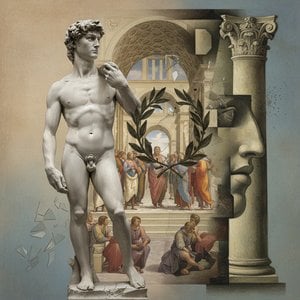
The Enduring Echo of Antiquity: Classical Ideals in Art from Renaissance to Modernism
Explore the lasting impact of classical ideals on art from the Renaissance to Modernism. Discover key movements, iconic artists & find museum-quality reproductions at ArtsDot.