


 实景预览
实景预览
 发送
发送 分享
分享
 详情
详情 指南
指南

 下载图片
下载图片
 相似作品
相似作品 X射线
X射线 幻灯片播放
幻灯片播放 统计数据
统计数据Thomas Jefferson
 Acrylic On Canvas
- WallArt
- Neoclassicism
 1786
1786 90.0 x 72.0 cm
 国家美术馆
国家美术馆
 阅读全文
阅读全文
手工油画复制品
由我们的艺术家按需定制,为您提供您所选尺寸及画框的布面手工油画。 ( 切换至版画销售渠道 切换至数字图像销售渠道)




P118B ¥10

P118H ¥10

P118W ¥10

P438Z ¥10

P508JH ¥12

P508YH ¥12

P805H ¥10

P805Z ¥10

P919BZ ¥10

P919G ¥10

P919XJ ¥10

P959ZH ¥10

P968JZ ¥12

W106C ¥8

W218G ¥10

W218JH ¥8

W218Y ¥10

W307PJ ¥10

W316G ¥10

W316PJ ¥8

W316Y ¥10

W398PJ ¥8

W4111J ¥10

W500HY ¥15

W500JH ¥15

W692G ¥12

W849H ¥8

W940BG ¥15

W953PJ ¥8




您可以从与原作比例一致的预设尺寸中进行选择。

请输入您需要的宽度和高度,以适配您的画框或墙面。由于作品为手工绘制,若您选择不同的尺寸比例,艺术家可能会在画面边缘多画一些或稍作裁剪 —— 由您决定。在开始绘画之前,我们会为您发送一份数字效果图供您确认。本页面上展示的图片并非最终实物 —— 只有效果图才能反映真实结果。
下单后,ArtsDot.com 团队将通过电子邮件联系客户获取具体要求,并提供效果预览图


 玻璃选项仅适用于110厘米以下的尺寸。

Thomas Jefferson
复制品材质
复刻品尺寸说明
-


总计金额
¥ 1769
A Portrait of Enlightenment: Mather Brown’s Likeness of Thomas Jefferson
The portrait of Thomas Jefferson by Mather Brown, completed in 1786, stands as an arresting emblem of the burgeoning neoclassical aesthetic within Britain during the late Enlightenment. More than simply a likeness—though remarkably accurate for its time—it embodies the intellectual currents that shaped America’s founding ideals and continues to resonate with collectors and art historians alike. Painted on canvas using oil paints, Brown's masterful technique captures Jefferson’s dignified countenance against a backdrop of rich crimson, skillfully employing linear perspective and textural brushstrokes to convey both physical presence and psychological depth.The Artist & His Context
Mather Brown (1761-1831), born in Boston, Massachusetts, represents a pivotal figure bridging the stylistic divide between Neoclassicism and Romanticism. Trained under John Singleton Copley—Boston’s foremost artist—Brown absorbed the meticulous precision of classical artistic principles, prioritizing order and balance as hallmarks of his oeuvre. His decision to relocate to London in 1790 solidified his position within the British art landscape, where he gained membership to the Royal Academy, securing a prominent role in shaping artistic discourse and production. The portrait reflects Brown’s engagement with European intellectual traditions—particularly the influence of Greek sculpture—demonstrating an awareness of the broader philosophical debates concerning reason versus emotion that characterized the era.Style & Technique: Neoclassical Precision
Brown's approach to Jefferson’s depiction exemplifies neoclassical ideals. Linear perspective dominates, creating a convincing illusion of three-dimensionality and anchoring Jefferson’s figure within a carefully constructed space. Geometric shapes—squares and rectangles defining Jefferson’s attire—underscore the compositional stability characteristic of the style. Texture is achieved through deliberate brushstrokes that imbue the fabric of Jefferson's coat and wig with palpable volume, mirroring the monumental grandeur favored by neoclassical painters. The dramatic lighting—originating from an unseen source above—casts strong shadows across Jefferson’s face, highlighting his features and conveying a subtle sense of introspection. These meticulous details underscore Brown’s commitment to capturing not merely appearance but also character—a testament to the artist's skill in translating philosophical concepts into visual form.Symbolism & Emotional Resonance
Beyond its technical brilliance, the portrait is laden with symbolic significance. The inclusion of a classical statue in the background serves as an explicit reference to reason and knowledge—values central to Enlightenment thought. Jefferson’s attire—reflecting his connection to European intellectual traditions—further reinforces this thematic dimension. However, Brown's portrayal transcends mere stylistic convention; it conveys a palpable emotional resonance. The gaze of Jefferson—direct yet contemplative—suggests a profound engagement with internal reflection, hinting at the complexities inherent in reconciling philosophical convictions with personal realities. This subtle melancholy contributes to the portrait’s enduring appeal, inviting viewers to contemplate themes of intellectuality, morality, and the burdens of leadership.A Legacy Enduring Through Reproduction
Today, reproductions of Brown's Jefferson offer art lovers and interior designers alike a captivating glimpse into a pivotal moment in American history and artistic innovation. The painting’s masterful technique—characterized by its luminous color palette and nuanced textural rendering—continues to inspire artists and collectors globally. Its enduring emotional impact—rooted in the portrayal of an intellectual titan wrestling with moral dilemmas—remains profoundly relevant, prompting contemplation on the intersection of reason and emotion within the human experience.问答详情
贯穿于马瑟·布朗 的《Thomas Jefferson》中的主导色调是什么?
“Thomas Jefferson”倾向于Golden Yellow Range色调。
"Thomas Jefferson" 的明暗对比是否强烈?
马瑟·布朗 的《Thomas Jefferson》 在明暗区域之间呈现出 Balanced 的对比度。
"Thomas Jefferson" 在 Neoclassicism 流派中有多高的知名度?
马瑟·布朗 的《Thomas Jefferson》 被归类为 Recognized,并属于 Neoclassicism 流派。
相关艺术品


艺术家简介
马瑟·布朗的跨大西洋传奇
马瑟·布朗(Mather Brown)宛如一座连接两个时代的迷人桥梁,其生平与作品深刻体现了18世纪末至19世纪初艺术潮流的变迁。这位于1761年出生于波士顿的画家,其艺术灵魂最初在殖民时期美国的知识熔炉中锻造,随后在伦敦宏伟的画室中找到了最终的表达。他的旅程不仅是一段个人的职业生涯,更映射了艺术理想从严谨、规整的新古典主义向情感充沛、充满戏剧性的浪漫主义转变的过程。正是这种转型,使布朗成为了一位多才多艺的叙事者,既能捕捉个人肖像中那份静谧的尊严,亦能描绘历史冲突中那股混沌的壮丽。
布朗精湛技艺的根基,可以追溯到他在传奇大师约翰·辛格顿·科普利(John Singleton Copley)门下的早期启蒙。在科普利的悉心指导下,布朗领悟了细致入微的细节处理之重要,并对古典形式有了深刻的理解。这种训练赋予了他足以在竞争激烈的欧洲艺术市场中立足的技术纪律。1790年移居伦敦时,他并非仅仅作为一个局外人到来,而是一位准备充分的专业人士,并迅速在享有盛誉的皇家艺术学院赢得了地位。这一成员身份是他职业生涯中的里程碑,标志着他已被接纳进英国艺术界的最高阶层,并为他提供了与那个时代最具影响力的人物进行交流的平台。
肖像画与历史叙事的大师
布朗的作品集展现了一种非凡的能力,能够根据题材的需求灵活调整其绘画技法。在肖像创作中,他拥有一种卓越的天赋,能够细腻地呈现人物性格与社会地位的微妙差异。通过对托马斯·杰斐逊(Thomas Jefferson)和本杰明·韦斯特(Benjamin West)等名流的描绘,他展现了对时代政治与社会潮流的敏锐洞察,赋予了画中人物一种永恒感与庄重感。无论是捕捉《带狗的女士》(Lady with a Dog)中的优雅风度,还是在《托马斯·洛顿》(Thomas Lowton)肖像中呈现的那种威严气场,布朗都巧妙地运用光影与质感,在画布上创造出栩栩如生、仿佛具有呼吸般的生命力。
除了肖像画这种亲密尺度的创作,布朗还试图捕捉史诗般的宏大场景。他是一位充满雄心的画家,经常将注意力转向那些需要驾驭复杂构图与戏剧性动态的历史题材画布。他的作品《尼罗河海战》(The Battle of the Nile)便是这种创作方法的巅峰之作;在其中,他告别了静止的古典形式,转而拥抱海战中那股旋涡般的能量与直击心灵的激烈感。在这些宏大作品中,我们可以窥见浪漫主义情感的萌芽——一种对崇高、力量以及历史事件变革本质的专注追求。
艺术意义与持久的影响力
马瑟·布朗的艺术价值在于他扮演了文化纽带的角色。通过将美国训练所带来的精准度与伦敦艺术界的风格创新相结合,他参与塑造了一个由革命与转型定义的时代的视觉语言。他在肖像画的规范要求与历史画的叙事需求之间游刃有余,这使他在英国与美国的艺术意识中都留下了深远的影响。
时至今日,他的作品依然是理解西方艺术演进的重要基石。透过他的画布,我们得以见证:
- 风格的交汇:新古典主义结构与浪漫主义情感的无缝融合。
- 历史的记录:对启蒙运动时期最重要人物容貌与遗产的保存。
- 技艺的巅峰:在织物、光影及人类表情刻画上的卓越成就,至今仍令现代观众为之倾倒。

马瑟·布朗
1761 - 1831 , 美国
快速概览
- Artistic Movement Or Style: 新古典主义/浪漫主义
- Artists Or Movements Influenced By This Artist: ['皇家艺术学院']
- Artists Who Influenced This Artist: ['本杰明·韦斯特']
- Date Of Birth: 1761年
- Full Name: 马瑟·布朗
- Nationality: 美国
- Notable Artworks:
- 罗密欧与朱丽叶
- 阿尔班·托马斯·格温牧师
- Place Of Birth: 美国波士顿
相关文章

American Realism's Defining Works: 10 Masterpieces for Your Home
Explore 10 defining American Realism masterpieces – Hopper, Homer & more. Discover the stories behind these iconic paintings and bring timeless art to your home with ArtsDot's museum-quality reproductions. Explore the full collection online.

美国地域主义:身份认同的熔炉——场所、劳工与社会评论探索
深入探索美国地域主义艺术运动:格兰特·伍德、保罗·雷诺兹等大师作品解读,洞察大萧条时代的文化反思与社会现实。ArtsDot.com提供高品质油画复制及定制服务,助您收藏经典。

Asher Brown Durand: Luminism, Landscape & the American Ideal – A Comprehensive Exploration
Explore the life & art of Asher Brown Durand, a founding member of the Hudson River School. Discover his masterful landscapes, Luminist techniques, and lasting impact on American painting. Learn about key works like 'Kindred Spirits' & collecting Durand today.

Grant Wood & American Regionalism: Identity, Myth & the Rural Landscape
Explore the world of Grant Wood & American Regionalism with ArtsDot. Discover the symbolism behind 'American Gothic', recurring themes, and the movement's lasting impact on art history. High-quality reproductions available.
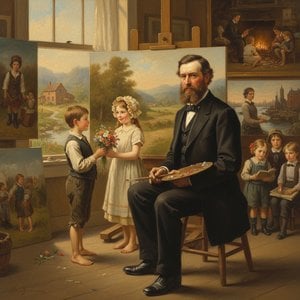
John George Brown: Capturing American Life & Sentiment in 19th-Century Genre Painting
Explore the captivating genre paintings of John George Brown, celebrated for his realistic depictions of 19th-century American life. Discover his legacy & find museum-quality reproductions at ArtsDot.