

 实景预览
实景预览
 分享
分享 分享
分享
 详情
详情 指南
指南

 下载作品
下载作品
 相似作品
相似作品 X射线
X射线 幻灯片播放
幻灯片播放 问答
问答 统计数据
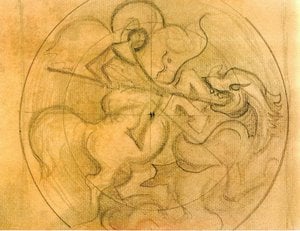
统计数据Discal Procession

- 78.0 x 63.0 cm

 展开全文
展开全文
艺术微喷/版画
博物馆级艺术微喷或帆布版画,制作高效,并提供多种饰面选择。 ( 订购纯手工绘制画作 切换至数字图像销售渠道)




































您可以从与原作比例一致的预设尺寸中进行选择。

请输入您所需的宽度和高度,以适配您的画框或墙面。由于印刷品只能进行裁剪,无法超出原图尺寸,因此若比例不一致,画面的一部分将会被裁切。在正式印刷之前,我们会为您发送一份数字效果图供您确认。本页面显示的图片并非最终裁剪后的效果——只有效果图才能展示真实的裁剪情况。


 玻璃选项仅适用于110厘米以下的尺寸。

Discal Procession
艺术微喷/版画
复刻品尺寸
-


最终结算价
¥ 423
相似作品



艺术家简介
The Architect of Abstraction: The Visionary Life of Manierre Dawson
In the bustling, industrial heart of Chicago at the dawn of the twentieth century, a quiet revolution was being drafted in paint and geometry. Manierre Dawson, born on December 22, 1887, emerged not merely as a painter, but as a pioneer who dared to dismantle the boundaries of representational art long before the movement gained widespread momentum in the United States. While history often reserves its brightest spotlights for European masters like Kandinsky or Picasso, Dawson’s contribution remains a profound and singular achievement, marking him as one of the earliest architects of American abstraction.
Dawson’s journey was shaped by a unique tension between technical precision and artistic intuition. Raised in a household where art was cherished as a refined pastime rather than a professional calling, he faced the quiet expectations of a family rooted in the legal profession. His father, George E. Dawson, was a respected lawyer, yet it was his mother, Eva Manierre Dawson, who provided the subtle artistic spark that would eventually ignite his career. This duality of influence—the structured world of law and the expressive world of aesthetics—would later manifest in his ability to marry mathematical rigor with boundless imagination.
Engineering the Canvas: Technique and Evolution
Perhaps the most defining characteristic of Dawson’s artistic DNA was his education at the Armour Institute of Technology. Enrolling in a civil engineering program in 1905, he gained a profound understanding of structural integrity, geometric principles, and spatial relationships. This technical foundation became the very scaffolding upon which his abstract visions were built. Rather than viewing engineering and art as opposing forces, Dawson utilized the logic of the engineer to explore the limitless possibilities of the canvas.
By 1908, a radical shift began to occur in his work. Moving away from traditional realism, he started experimenting with forms that predated many established modernist movements. His style became a sophisticated tapestry woven from various avant-garde threads:
- Cubist Structure: The fragmentation of objects into geometric planes to explore multiple perspectives simultaneously.
- Futurist Energy: A fascination with movement, dynamism, and the rhythmic pulse of modern life.
- Mathematical Precision: The application of geometric shapes—triangles, circles, and angular lines—to create a sense of organized complexity.
In masterpieces such as At Bath (1911), one can witness this breathtaking synthesis. Through the use of vibrant oranges, yellows, and bold brushstrokes, Dawson achieved a sense of kinetic energy that felt both grounded in structure and liberated by color.
A Legacy of Visionary Spirit
The historical significance of Manierre Dawson lies in his role as a precursor to the modern era. He was an artist who looked into the void of the unknown and saw not emptiness, but a new way of seeing. His work often bridged the gap between the tangible world and a more symbolic, dreamlike reality. In pieces like his 1920 Untitled composition, he utilized vibrant colors and enigmatic arrangements to invite viewers into a space of deep contemplation and mystery.
Though much of his later life was spent in Michigan, far from the urban epicenter of Chicago, his impact on the trajectory of American modernism remains indelible. He stood as a bridge between the nineteenth-century traditions of landscape and portraiture and the twentieth-century explosion of non-objective art. To study Dawson is to witness the moment when the American eye first began to look past the surface of things, seeking instead the underlying rhythms, structures, and truths that define our existence.

Manierre Dawson
1887 - 1969
艺术家简介
- Full Name: Manierre Dawson
- Nationality: American
- Date Of Birth: 1887
- Date Of Death: 1969
- Place Of Birth: Chicago, Illinois
- Notable Artworks:
- At Bath
- Untitled
- Blue Complex
- Artistic Movement Or Style: Abstract Art
- Artists Who Influenced This Artist:
- James Abbott McNeil Whistler
- Arthur Wesley Dow
- Artists Or Movements Influenced By This Artist:
- Wassily Kandinsky
- Marcel Duchamp