


 效果预览
效果预览
 购买印刷品
购买印刷品 分享
分享 分享
分享
 详情
详情

 下载
下载
 相似作品
相似作品 X射线
X射线 幻灯片播放
幻灯片播放Untitled


 展开详情
展开详情




































从与原作比例一致的预设尺寸中进行选择。

您可以输入自定义尺寸,以适配特定的画框或空间。如果所选尺寸与原图比例不符,我们将通过裁剪作品或添加手绘元素来扩展画面。数字样稿将在制作开始前发送给您确认。
请注意,屏幕预览无法准确反映实际的裁剪或扩展效果,只有样稿才能真实呈现最终的构图。
虽然我们提供定制尺寸服务,但为了保留原作比例,建议您从预设列表中选择尺寸。
下单后,ArtsDot.com 团队将通过电子邮件联系客户获取具体要求,并提供效果预览图。


 玻璃选项仅适用于110厘米以下的尺寸。

Untitled
复制材质
复制品尺寸
-


最终总价
$ 263


艺术家简介
The Cartography of Identity: The Life and Legacy of Joyce Kozloff
In the vibrant tapestry of late twentieth-century American art, few threads are as intricate or as politically resonant as those woven by Joyce Kozloff. Born in Somerville, New Jersey, in 1942, Kozloff emerged from a lineage shaped by the immigrant spirit, with family roots stretching back to Lithuania. Her journey into the heart of the avant-garde began with rigorous academic pursuits, studying at the prestigious Art Students League of New York and later earning her Master of Fine Arts from Columbia University in 1967. This period of intense formal training provided the foundation for an artistic voice that would eventually challenge the very boundaries of what was considered "high art," blending the decorative with the deeply political.
Kozloff’s early career was marked by a profound engagement with the burgeoning feminist art movements of the 1970s. As a founding member of the Heresies Collective and a participant in the Los Angeles Council of Women Artists, she stood at the forefront of a movement that demanded visibility for women within the institutional structures of the art world. Her work during this era was not merely an aesthetic pursuit but a form of activism, protesting the exclusion of female voices from major museum collections. This period of her life was characterized by a fierce commitment to social justice and the peace movement, themes that would later find subtle yet powerful expression in her complex visual narratives.
Pattern, Decoration, and the Politics of Ornament
One of Kozloff’s most significant contributions to art history is her role as a pioneer of the Pattern and Decoration (P&D) movement. In an era dominated by the austere, minimalist aesthetics of much of the mainstream art world, Kozloff and her contemporaries embraced the richness of ornament, texture, and pattern. By elevating motifs traditionally associated with "craft," textiles, and decorative arts—elements often dismissed as feminine or secondary—she staged a radical reclamation of aesthetic value. Her canvases became sites where the boundaries between fine art and decorative tradition were intentionally blurred, creating a lush, sensory experience that invited viewers to reconsider the hierarchies of visual culture.
As her career progressed into the 1990s, Kozloff’s focus underwent a fascinating evolution toward the study of cartography. She began to utilize maps not merely as navigational tools, but as complex layers of historical and political meaning. Through her exploration of maps, she examined how borders are drawn, how territories are claimed, and how much of our perceived reality is constructed through colonialist or imperialist lenses. Her work became a sophisticated dialogue between the beauty of intricate patterns and the heavy weight of geopolitical history, using the language of design to critique the way power is mapped onto the earth.
A Lasting Impact on Public and Political Art
The significance of Joyce Kozloff’s oeuvre lies in its ability to marry the ornamental with the monumental. Her work has moved beyond the confines of the gallery wall into the realm of public art, where her murals and large-scale installations engage directly with the urban landscape. These works serve as enduring reminders of the intersection between personal identity and global history. Her mastery of technique—often involving a meticulous layering of detail that rewards prolonged contemplation—ensures that her pieces remain deeply immersive.
Reflecting on her monumental achievements, several key pillars of her legacy stand out:
- Feminist Vanguard: Her instrumental role in organizing protests and collectives that reshaped the visibility of women in the American art canon.
- Aesthetic Revolution: The successful integration of decorative motifs into contemporary fine art, challenging the dominance of Minimalism.
- Cartographic Critique: The use of map-making as a medium to explore themes of colonialism, borders, and the construction of political identity.
- Interdisciplinary Vision: A seamless blending of historical research, social activism, and intricate craftsmanship.
Today, Joyce Kozloff remains a vital figure whose work continues to resonate in an era of shifting borders and renewed political discourse. Her ability to find the profound within the patterned, and the political within the decorative, ensures her place as one of the most influential voices in contemporary American art.

joyce kozloff
1942 - , United States of America
艺术家简介
- Artistic Movement Or Style: Pattern and Decoration, Feminist art
- Artists Or Movements Influenced By This Artist: Feminist art movements
- Date Of Birth: December 14, 1942
- Full Name: Joyce Kozloff
- Nationality: American
- Place Of Birth: Somerville, United States
相关文章

几何抽象艺术十大杰作:定义现代家居装饰的经典之作
探索几何抽象艺术的十大杰作!康定斯基、蒙德里安等大师作品,色彩构成与非具象之美。ArtsDot.com提供博物馆级艺术复制品,为您的家居带来现代艺术灵感。立即在线探索完整系列!

Beyond Form & Color: Geometric Abstraction's Evolution in 20th/21st Century Art
Explore the evolution of geometric abstraction from Cubism to contemporary art. Discover key artists like Malevich & Mondrian, investment insights, and expert collecting advice at ArtsDot.

Beyond Form & Color: Geometric Abstraction's Enduring Legacy in Art History
Explore the captivating world of geometric abstraction! Discover its origins, key artists like Malevich & Mondrian, and why this movement remains highly valued by art collectors today. Expert insights at ArtsDot.

Kandinsky's Masterpieces: 25 Paintings That Define Abstract Art | ArtsDot
Journey through Wassily Kandinsky's 25 most iconic abstract paintings. Explore his revolutionary use of color, form & spiritual expressionism. Find museum-quality Kandinsky reproductions and elevate your home decor with ArtsDot.com. Discover all masterpieces on ArtsDot.com!
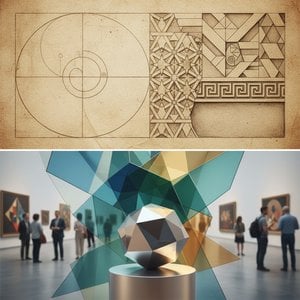
Geometric Design in Art: A Historical Survey & Contemporary Appeal for Collectors
Explore the enduring legacy of geometric abstraction! Discover key artists, historical movements & investment insights for discerning art collectors. Expert guidance from ArtsDot.

