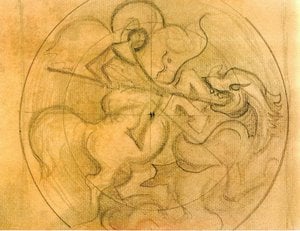
Untitled (976)
从与原作比例一致的预设尺寸中进行选择。
您可以输入自定义尺寸,以适配特定的画框或空间。如果所选尺寸与原图比例不符,我们将通过裁剪作品或添加手绘元素来扩展画面。数字样稿将在制作开始前发送给您确认。
请注意,屏幕预览无法准确反映实际的裁剪或扩展效果,只有样稿才能真实呈现最终的构图。
虽然我们提供定制尺寸服务,但为了保留原作比例,建议您从预设列表中选择尺寸。
下单后,ArtsDot.com 团队将通过电子邮件联系客户获取具体要求,并提供效果预览图。
Untitled (976)
复制材质
复制品尺寸
-
最终总价
$ 263
艺术家简介
James Gleeson: Architect of the Australian Surreal
James Timothy Gleeson (1915-2008) wasn’t merely an artist; he was a conjurer of landscapes, a weaver of nightmares and dreams, and arguably Australia's first true surrealist. Emerging from the post-war artistic landscape, Gleeson forged a singular vision—a world steeped in primal anxieties, echoing with the voices of mythology and psychoanalysis—that continues to resonate today. His work isn’t easily categorized; it’s a potent blend of Australian identity, European influences, and deeply personal symbolism, rendered in bold, impastoed canvases that demand attention and invite contemplation.
Born in Hornsby, New South Wales, Gleeson's early life was marked by a profound sense of displacement. His family’s hotel ownership provided a glimpse into the darker side of Australian society, while his artistic inclinations were nurtured through exposure to influential figures like May Marsden, who steered him towards painting as an outlet for his burgeoning anxieties. This formative period instilled in him a fascination with the subconscious and a desire to confront uncomfortable truths—a theme that would become central to his oeuvre. His initial training at East Sydney Technical College laid the groundwork, but it was his immersion in the works of Dalí, Masson, Freud, and Jung that truly ignited his surrealist sensibilities.
The Genesis of a Vision
Gleeson’s artistic journey began with a deliberate rejection of conventional representation. Influenced by the European Surrealists—particularly Dalí's exploration of dream imagery and masson’s organic abstraction—he sought to bypass the limitations of visual perception, aiming instead to capture the raw energy of the unconscious mind. His early works, such as “The Sower” (1944), already hinted at this ambition, presenting a distorted landscape populated by enigmatic figures that seemed to emerge from a swirling vortex of color and form. This marked a departure from traditional Australian art, which often focused on pastoral scenes and idealized landscapes; Gleeson was charting a distinctly different course.
The post-war era, with its anxieties surrounding fascism and the looming threat of global conflict, profoundly shaped his artistic concerns. He channeled these fears into powerful, apocalyptic imagery—vast, desolate landscapes dominated by towering rock formations, submerged figures, and unsettling juxtapositions. These weren’t simply depictions of nature; they were symbolic representations of humanity's precarious position within a chaotic universe. His work became a visual meditation on mortality, the fragility of existence, and the enduring power of primal instincts.
The Language of Symbolism
Gleeson’s paintings are rich in symbolism, drawing upon mythology, folklore, and psychoanalytic theory to create layered meanings. The recurring motif of the male nude—often depicted as a solitary figure emerging from turbulent waters or crumbling ruins—represents vulnerability, mortality, and the struggle for self-awareness. The use of ochre tones – reminiscent of the Australian outback – creates a sense of both familiarity and alienation, grounding his surreal visions in the landscape of his homeland while simultaneously evoking a timeless, almost biblical quality.
His later works, particularly the “Ubu” diptychs (1970s), exemplify this symbolic language. These monumental canvases depict submerged figures and decaying structures, suggesting the collapse of civilization and the inevitable return to primal chaos. Yet, amidst the devastation, there’s a strange beauty—a sense of resilience and enduring spirit—that speaks to the human capacity for survival and renewal.
Legacy and Recognition
James Gleeson's impact on Australian art is undeniable. He was a pioneer in establishing surrealism as a viable artistic movement within the country, challenging conventional notions of beauty and representation. His work continues to be studied and admired for its emotional intensity, symbolic depth, and unique visual language.
In 2004, the National Gallery of Australia mounted a comprehensive retrospective exhibition, “Beyond the Screen of Sight,” which cemented his place as one of Australia’s most important artists. The exhibition drew significant public attention to his work and highlighted its enduring relevance. His legacy extends beyond his paintings; he was also a respected art critic, lecturer, curator, and writer, contributing significantly to the development of Australian art history. His collection was donated to the National Gallery of Australia in 2007, ensuring that his visionary works will continue to inspire generations of artists and viewers.
A Lasting Impression
James Gleeson’s paintings are not merely beautiful images; they are profound statements about the human condition. They confront us with our fears, anxieties, and mortality, while simultaneously offering a glimpse into the hidden depths of the unconscious mind. His work remains a powerful testament to the enduring power of art to challenge, provoke, and ultimately, illuminate the mysteries of existence.
james gleeson
1915 - 2008 , Australia
艺术家简介
- Artistic Movement Or Style: Surrealism
- Artists Or Movements Influenced By This Artist:
- Robert Klippel
- Australian Surrealism
- Artists Who Influenced This Artist:
- Salvador Dalí
- Max Ernst
- Sigmund Freud
- Carl Jung
- Date Of Birth: November 21, 1915
- Date Of Death: October 20, 2008
- Full Name: James Timothy Gleeson
- Nationality: Australian
- Notable Artworks:
- Untitled (530)
- Untitled (723)
- Untitled (973)
- Place Of Birth: Sydney, Australia

玻璃选项仅适用于110厘米以下的尺寸。