

 实景预览
实景预览
 分享
分享 分享
分享
 详情
详情 指南
指南

 下载作品
下载作品
 相似作品
相似作品 X射线
X射线 幻灯片播放
幻灯片播放 问答
问答 统计数据
统计数据Self-Portrait

- 74.0 x 60.0 cm


 展开全文
展开全文
艺术微喷/版画
博物馆级艺术微喷或帆布版画,制作高效,并提供多种饰面选择。 ( 订购纯手工绘制画作 切换至数字图像销售渠道)




P118B ¥10

P118H ¥10

P118W ¥10

P438Z ¥10

P508JH ¥12

P508YH ¥12

P805H ¥10

P805Z ¥10

P919BZ ¥10

P919G ¥10

P919XJ ¥10

P959ZH ¥10

P968JZ ¥12

W106C ¥8

W218G ¥10

W218JH ¥8

W218Y ¥10

W307PJ ¥10

W316G ¥10

W316PJ ¥8

W316Y ¥10

W398PJ ¥8

W4111J ¥10

W500HY ¥15

W500JH ¥15

W692G ¥12

W849H ¥8

W940BG ¥15

W953PJ ¥8




您可以从与原作比例一致的预设尺寸中进行选择。

请输入您所需的宽度和高度,以适配您的画框或墙面。由于印刷品只能进行裁剪,无法超出原图尺寸,因此若比例不一致,画面的一部分将会被裁切。在正式印刷之前,我们会为您发送一份数字效果图供您确认。本页面显示的图片并非最终裁剪后的效果——只有效果图才能展示真实的裁剪情况。


 玻璃选项仅适用于110厘米以下的尺寸。

Self-Portrait
艺术微喷/版画
复刻品尺寸
-


最终结算价
¥ 423
The Enigmatic Gaze: Unveiling Hortense Haudebourt Lescot’s Self-Portrait
Hortense Haudebourt Lescot's 1825 “Self-Portrait” is not merely a likeness; it’s an intimate revelation, a carefully constructed tableau of introspection and quiet strength. Painted during a pivotal period in her career – a time when she was establishing herself as a significant figure within the French art scene – this oil on canvas offers a rare glimpse into the mind of an artist grappling with her own identity and artistic vision. The painting’s power lies not just in its technical mastery, but in the palpable sense of contemplation radiating from the subject's gaze, drawing the viewer into a silent dialogue across time.
(Image courtesy of the Web Gallery of Art)
A Classical Foundation, A Personal Touch
Rooted firmly in the classical traditions championed by her mentor, Guillaume Guillon Lethière, Haudebourt Lescot’s style is immediately recognizable. The composition adheres to a balanced symmetry, with the artist centrally positioned against a dramatic backdrop of deep, almost impenetrable black. This stark contrast—a hallmark of chiaroscuro—immediately directs the viewer's attention to her face, highlighting its delicate features and intense expression. Yet, despite this adherence to established forms, there’s an undeniable sense of personal voice woven throughout the work. The subtle variations in tone, the carefully rendered texture of her dress, and the directness of her gaze all speak to a deliberate effort to convey something deeply felt.
Decoding the Details: Technique and Symbolism
The artist’s skill is evident in every brushstroke. A meticulous attention to detail—particularly in capturing the nuances of fabric, the delicate folds of her dress, and the subtle sheen on her skin—demonstrates a profound understanding of material and light. The use of smooth, blended strokes creates an illusion of volume and depth, while strategically placed highlights draw the eye to key points of interest. The crossed arms, a gesture both poised and slightly defensive, invite interpretation. They suggest a quiet self-assurance, perhaps even a guardedness, hinting at the challenges faced by women artists navigating a male-dominated world.
A Window into an Era: Context and Legacy
Created in 1825, this “Self-Portrait” reflects the evolving role of women in the art world. Haudebourt Lescot’s journey from aspiring dancer to respected painter is a testament to her perseverance and talent. Her work, particularly her depictions of Italian peasant life, offered a fresh perspective on contemporary society, challenging conventional artistic subjects. Furthermore, her decision to paint herself—a relatively rare occurrence for women artists of the time—underscores her ambition and desire to be recognized as an individual creator. The painting’s inclusion in the Musée du Louvre stands as a powerful affirmation of her artistic merit, ensuring that her legacy continues to inspire generations of artists.
For those seeking a tangible connection to this remarkable work, meticulously crafted reproductions are available at ArtsDot.com. To delve deeper into the life and art of Hortense Haudebourt Lescot, we encourage you to visit the Musée du Louvre’s website for further insights into this extraordinary collection.
常见问题与解答
根据创作日期判断,"Self-Portrait" (1825) 属于 Hortense Haudebourt Lescot 艺术生涯的哪个阶段?
鉴于其创作于1825年,作品《Self-Portrait》属于Hortense Haudebourt Lescot的Mature Period时期。
Hortense Haudebourt Lescot 的《Self-Portrait》 的亮度是多少?
"Self-Portrait" 的色彩呈现出 Dark 的亮度。
哪里可以买到Hortense Haudebourt Lescot 的《Self-Portrait》的手绘复制品?
您可以在Hortense Haudebourt Lescot 的《Self-Portrait》的手工油画复刻页面直接订购其手绘复制品:亚麻画布手工油画复制品,按需定制。
相似作品


艺术家简介
A Life Captured in Light and Shadow
The story of Hortense Haudebourt-Lescot is one of profound observation and the courage to find beauty in the overlooked. Born Antoinette Cécile Hortense Viel in Paris in 1784, her journey from the daughter of a perfumer to a celebrated figure of the French Romantic era was paved with an extraordinary dedication to the nuances of human existence. Her early years were shaped by a precocious talent that caught the eye of the renowned history painter Guillaume Guillon-Lethière. Under his mentorship, she did not merely learn the mechanics of oil on canvas; she inherited a passion for the dramatic interplay of light and shadow, a technique that would later become her signature. This formative bond was more than academic; it was a gateway to the wider world, leading her to the Eternal City when Lethière was appointed director of the French Academy in Rome.
It was within the sun-drenched landscapes and vibrant streets of Italy, between 1808 and 1816, that Haudebourt-Lescot truly discovered her artistic soul. While many of her contemporaries sought the grandeur of mythological epics or the stiff formality of aristocratic portraiture, she found herself drawn to the rhythmic pulse of rural life. She became a chronicler of the Italian peasantry, capturing the intricate textures of their costumes, the warmth of their domestic rituals, and the quiet dignity of their daily labors. This period of immersion allowed her to develop a style that blended classical rigor with a burgeoning realism, transforming simple genre scenes into profound studies of human character.
The Mastery of Genre and Detail
As she returned to Paris, Haudebourt-Lescot began to make her mark on the prestigious Salon, exhibiting works that commanded attention for their psychological depth and technical brilliance. Her ability to employ chiaroscuro—the dramatic contrast between light and dark—served to illuminate not just the physical features of her subjects, but their very essence. In her celebrated self-portraits, such as the one from 1825, she presents an enigmatic gaze that invites the viewer into a silent dialogue, revealing an artist who was as much a philosopher of sight as she was a painter of form.
Her oeuvre is characterized by several defining elements:
- Meticulous Realism: A profound devotion to capturing the tactile reality of fabrics, skin, and domestic environments.
- Humanist Perspective: An empathetic approach to genre painting that elevated the lives of common people to the level of high art.
- Technical Sophistication: The seamless integration of classical composition with the emotive, atmospheric qualities of the Romantic movement.
Beyond her individual canvases, Haudebourt-Lescot’s influence extended into the very fabric of the Parisian art scene. Her home became a vibrant salon, a gathering place for the intellectual and artistic elite of the 19th century. As a teacher, she passed her rigorous standards of observation to a new generation of women artists, including Herminie Déhérain and Marie-Ernestine Serret, ensuring that her legacy of precision and empathy would endure.
A Lasting Legacy in French Art
The historical significance of Hortense Haudebourt-Lescot lies in her role as a pioneer. At a time when the boundaries for women in the fine arts were often strictly circumscribed, she navigated the complexities of the art world with grace and distinction. Her recognition by the Duchess of Berry, who appointed her as her personal painter, serves as a testament to her standing within the highest echelons of French society. Yet, despite this proximity to power, her heart remained tethered to the authentic, the rustic, and the real.
Today, her works reside in some of the world's most esteemed institutions, including the Louvre Museum, serving as enduring reminders of her ability to find the extraordinary within the ordinary. She remains a vital figure for anyone seeking to understand the transition from Neoclassicism to Romanticism, and her life stands as a testament to the power of the artist's eye to transform the fleeting moments of life into eternal masterpieces.

Hortense Haudebourt Lescot
1784 - 1845 , France
艺术家简介
- Full Name: Hortense Haudebourt-Lescot
- Nationality: French
- Date Of Birth: 1784
- Date Of Death: 1845
- Place Of Birth: Paris, France
- Notable Artworks:
- Self-Portrait
- Atelier À Paris
- Nude Model In The Artist’s Studio
- Artistic Movement Or Style: Genre realism
- Artists Who Influenced This Artist: ['Guillaume Guillon-Lethière']
- Artists Or Movements Influenced By This Artist: ['Neoclassicism']
相关文章

19th Century Masterpieces: 10 Paintings That Defined an Era | ArtsDot
Journey through 19th century art with ArtsDot! Explore 10 iconic paintings – from Monet & Renoir to Courbet – and discover the stories behind Romanticism, Realism & Impressionism. Find museum-quality reproductions for your home decor. Explore the full collection online!
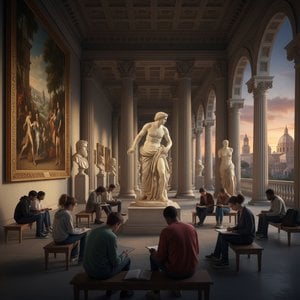

The Enduring Legacy of Oil on Canvas: Technique, History & Aesthetic Impact
Explore the rich history & techniques of oil painting – from Renaissance masters to Impressionism. Discover pigments, layering methods, and why this timeless medium endures. Expert insights for artists & art enthusiasts.

Neo-Classicism's Greatest Hits: 10 Masterpieces for Your Home |
Journey through Neo-Classicism's finest! Explore 10 iconic masterpieces by David, Ingres & Canova. Discover art history, techniques & timeless beauty – perfect for inspiring your home decor. Find museum-quality reproductions at

Oil on Canvas: A Historical & Technical Exploration of a Timeless Artistic Medium
Explore the rich history & enduring techniques of oil painting on canvas. Discover the science behind its longevity, conservation practices, and contemporary relevance. Expert insights for art enthusiasts.