
 实景预览
实景预览
 切换至版画销售渠道
 分享
分享 分享
分享
 详情
详情 指南
指南

 下载作品
下载作品
 相似作品
相似作品 X射线
X射线 幻灯片播放
幻灯片播放 问答
问答 统计数据
统计数据Avatar

- 102.0 x 128.0 cm


 展开全文
展开全文
获取远超网页预览效果的印刷级文件。我们销售的每一张数字图像均源自库存数据库中的高分辨率母版——宽度通常在 5,000 至 15,000 像素之间——因此您可以放心地进行大幅打印、局部裁剪或还原细腻的细节。
每一件作品在离开我们的工作室前都经过了精心的处理。数字影像专家会对照原作核对色彩,并在必要时进行校正,随后利用专业修图工具提升清晰度与细节表现——且始终忠实于艺术家的笔触与风格。最终呈现的图像宛如原作本身,而非仅仅是一张加了滤镜的扫描件。
您可以在最终定稿前进行审核:我们的专家将在 72 小时内通过电子邮件向您发送图像以供审阅。如果不满意?您可以要求改进或修正;若质量未达预期,亦可申请退款。
这也是出版商、设计工作室、画廊及印刷厂所信赖的品质。
每份数字图像订单均包含的内容
专业级数字交付,品质保障
选择 ArtsDot.com,您获得的不仅仅是一张图像——您收到的是经过专业级增强、精雕细琢的数字艺术作品,并享有满意保证。以下是您的订单中自动包含的所有内容:

邮件即时送达
您的高分辨率数字图像文件将在下单后 72 小时内通过电子邮件发送给您 —— 即可立即使用。

AI 增强型数字文件
您的艺术品经过专业优化,结合先进的 AI 技术与人工修饰,确保呈现极致的细节、清晰度与色彩准确度。

终身免费重发服务
不小心删除了文件或找不到了?没关系——我们将随时为您免费重发。

无需进口税费,始终如一
即刻拥有您的艺术作品,无需支付任何关税、税费或运费——数字下载始终免税。

色彩精准保障
我们通过专业工具与色彩管理技术,确保您的数字图像尽可能真实地还原原作色彩。

100天满意保证
如果您对所购数字图像不满意,我们将在100天内为您进行修改或提供100%的全额退款——无需任何理由。

100% 退款保证
不满意?在收到数字文件后的100天内,您可以申请全额退款——无需任何理由。

批量订购优惠
购买 3 张享 10% 折扣 - 购买 5 张享 15% 折扣 - 购买 10 张以上享 20% 折扣。非常适合创意项目、画廊及机构使用。
A Vision of Ethereal Unity
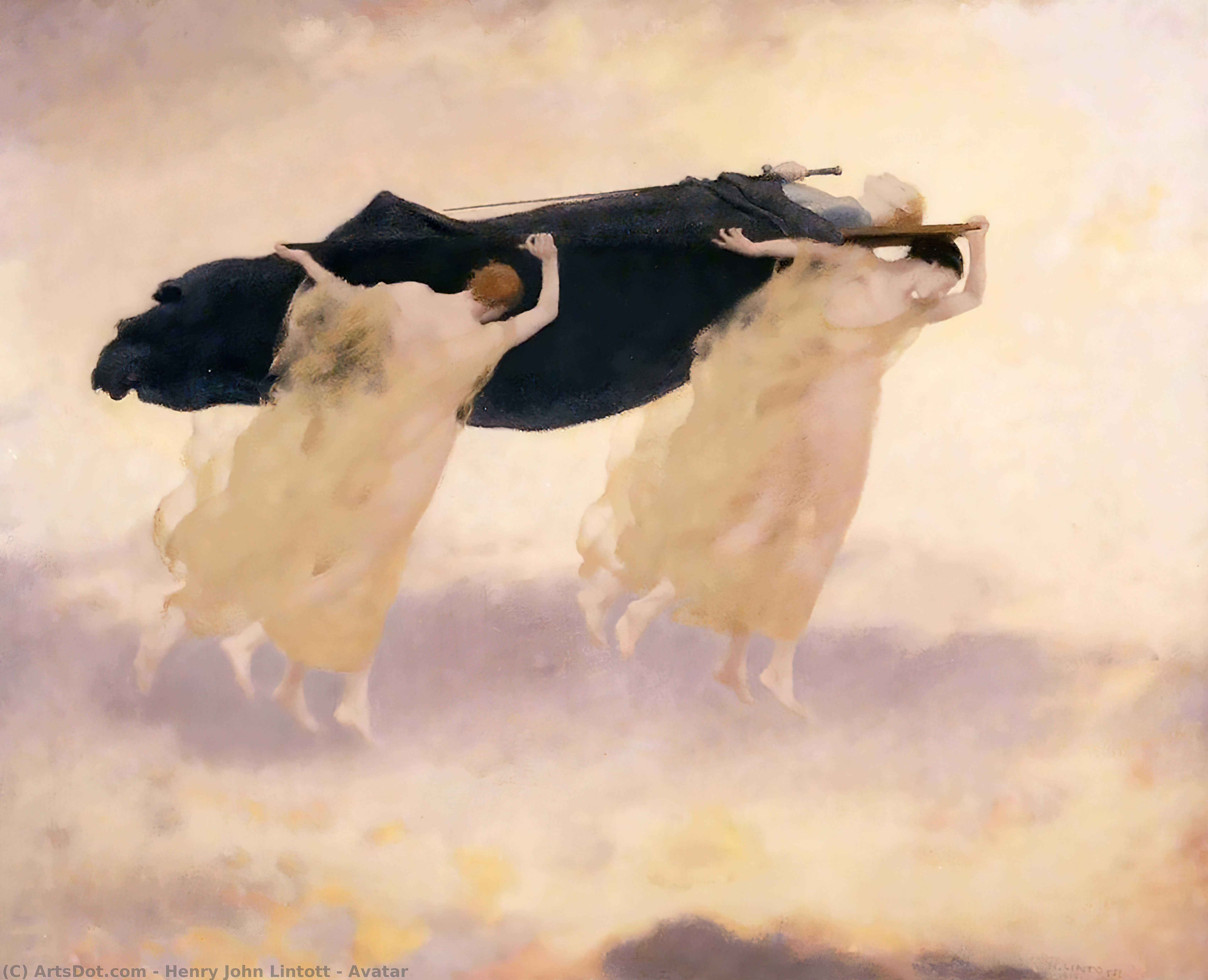
In the vast, misty corridors of art history, few works manage to bridge the gap between the tangible world and the realm of the spirit as gracefully as Henry John Lintott’s 1916 masterpiece, "Avatar." This captivating oil on canvas is not merely a painting; it is a window into a dreamscape where the boundaries of form and shadow dissolve. At its heart, the composition presents three female figures, positioned with a deliberate, rhythmic balance that guides the eye across a landscape of uncertainty. They appear to be engaged in a shared, sacred task, bearing a large, dark, boat-like object that anchors the ethereal scene. There is an undeniable sense of weight and purpose in their movement, yet they seem to glide through a hazy, atmospheric void, as if caught in a moment of suspended animation between heaven and earth.
The style of "Avatar" is a profound dialogue between Symbolism and Romanticism. Lintott eschews the sharp, clinical lines of realism in favor of soft, curvilinear forms and a palette of pale yellows, muted blues, and ghostly whites. The brushwork is loose and evocative, creating a textured surface where light does not strike objects so much as it permeates them. This technique produces a diffused, glowing effect, making the clouds appear to swirl with a life of their own. For the discerning collector or interior designer, this piece offers a sophisticated layer of depth; its lack of rigid boundaries allows it to integrate seamlessly into spaces that value atmosphere and mood, providing a focal point that invites quiet contemplation rather than demanding loud attention.
Symbolism and the Strength of Connection
Beyond its visual beauty, "Avatar" serves as a powerful allegory for human resilience and collective endeavor. The central theme is one of unity. The way the three women work in concert to carry their mysterious burden symbolizes the strength found in solidarity—the idea that even the most daunting journeys through life's shadows are made possible through cooperation. The dark, enigmatic object they carry acts as a profound symbol; it could represent the heavy responsibilities of existence, or perhaps a vessel for the soul navigating the turbulent currents of fate. This tension between the lightness of the angelic figures and the gravity of their task creates an emotional resonance that is both melancholic and deeply inspiring.
Historically, this work reflects Lintott’s position within the Scottish art scene and his exposure to the burgeoning Symbolist movements in London and Paris. As a prominent figure at the Royal Scottish Academy, Lintott was a master of capturing the struggle between light and darkness. In "Avatar," this struggle is not depicted through violent contrast, but through a subtle, atmospheric haze that suggests the ephemeral nature of life itself. To possess a reproduction of this work is to bring a piece of this historical introspection into a modern home—a reminder of the enduring power of connection and the beauty found in the pursuit of common goals.
An Invitation to the Sublime
For those seeking to curate an environment of peace, mystery, or intellectual depth, "Avatar" offers unparalleled inspiration. The painting’s shallow perspective and flattened space create an intimate experience, drawing the viewer into a world where the physical laws of gravity seem secondary to the emotional laws of the spirit. It is a piece that rewards repeated viewing, revealing new nuances in its layered glazes and soft shadows each time the light hits it. Whether placed in a grand gallery-style living room or a quiet study, this reproduction serves as a testament to the timeless allure of the sublime, making it an exquisite choice for anyone looking to infuse their surroundings with a sense of poetic grace and historical significance.
常见问题与解答
“Avatar”在艺术史上的地位如何?
Henry John Lintott 的《Avatar》 属于 Modern 时期的 Symbolism 流派。两者共同确立了该作品在艺术史上的地位。
"Avatar" 的作者及创作年份是?
Henry John Lintott 于 1916 年创作了《Avatar》。
Henry John Lintott 的《Avatar》 的色彩饱和度如何?
Henry John Lintott 的《Avatar》 的色彩饱和度为 Subtle Color。
相似作品


艺术家简介
Henry John Lintott: A Weaver of Scottish Dreams
Henry John Lintott (1877-1965) wasn’t a name that dominated the art world during his lifetime, yet within the rich tapestry of 20th-century British painting, particularly in Scotland, he remains a quietly significant figure. More than simply a painter, Lintott was an educator and a mentor, shaping the artistic trajectories of generations through his tenure at the Edinburgh College of Art. His work—a captivating blend of portraiture, landscape, and allegorical scenes—offers a glimpse into a world where observation is paramount, emotion subtly rendered, and the ethereal intertwines with the everyday.
Born in Brighton, Lintott’s artistic journey began with formal training at the local school. He then broadened his horizons, studying in London and Paris – experiences that undoubtedly exposed him to the burgeoning currents of Impressionism and Symbolism. It was a move north to Edinburgh in 1902 that proved pivotal, establishing a long and influential career within Scotland’s artistic heartland. He quickly ascended to a position of respect, becoming one of the initial staff members at the College, where he spent over four decades nurturing talent and refining his own practice.
The Language of Light and Shadow
Lintott's style is immediately recognizable—a deliberate eschewing of bold, assertive brushstrokes in favor of a meticulously layered technique. He favored soft, diffused light, often employing a muted palette dominated by blues, greens, and browns, creating an atmosphere of quiet contemplation. His landscapes aren’t merely depictions of scenery; they are imbued with a dreamlike quality, as if viewed through a hazy memory or a half-remembered vision. This is particularly evident in works like “St Bernard’s Crescent from Studio Window,” where the urban scene dissolves into a wash of atmospheric color, suggesting both familiarity and an underlying sense of mystery.
His portraits are equally compelling. Lintott avoided the conventional formality often associated with portraiture, instead capturing his subjects with a gentle intimacy. He seemed to seek not just likeness but also something deeper—a hint of personality, emotion, or inner life. The “Self Portrait,” for instance, reveals an older man reflecting on his own journey, his gaze imbued with a quiet dignity and perhaps a touch of melancholy.
Influences and Artistic Circle
Lintott’s artistic development was undoubtedly shaped by the prevailing movements of his time – Impressionism and Symbolism. However, he forged his own distinctive voice, blending these influences with a distinctly Scottish sensibility. He was part of The Society of Eight, a group of artists who shared a commitment to exploring subjective experience and challenging conventional artistic norms. This circle fostered a spirit of experimentation and collaboration, contributing significantly to the vibrant artistic scene in Edinburgh.
His influence extended far beyond his immediate colleagues. He mentored a remarkable cohort of young Scottish artists, including Anne Redpath, John Maxwell, and William MacTaggart—artists who went on to achieve considerable recognition in their own right. Lintott’s emphasis on observation, sensitivity, and the exploration of inner landscapes undoubtedly played a role in shaping their artistic visions.
Legacy and Enduring Appeal
Henry John Lintott may not have achieved widespread fame during his lifetime, but his work continues to resonate with viewers today. His paintings possess a quiet beauty and emotional depth that transcends time. They invite us to slow down, to observe closely, and to contemplate the subtle nuances of light, color, and form. The National Galleries of Scotland recognize Lintott’s importance, describing him as “a painter of portraits, landscapes and allegorical subjects,” whose method was “slow and meticulous” and his style “often soft and dream-like.”
His legacy lies not only in the works he created but also in the artists he nurtured. Lintott’s influence can be seen throughout the Scottish art landscape, a testament to his skill as an educator and his profound understanding of the power of visual language. His paintings remain a poignant reminder that true artistry often resides in the quiet moments—the subtle shifts in light, the unspoken emotions, and the enduring beauty of the everyday world.

Henry John Lintott
1877 - 1965
基本信息
- Artistic Movement Or Style: British Impressionism/Post-Impressionism
- Artists Or Movements Influenced By This Artist: ['Scottish School']
- Artists Who Influenced This Artist:
- Anne Redpath
- John Maxwell
- William MacTaggart
- Date Of Birth: 1877
- Date Of Death: 1965
- Full Name: Henry John Lintott
- Nationality: British
- Notable Artworks:
- Avatar
- Self Portrait
- St Bernard’s Crescent
- Place Of Birth: Brighton, UK