

 实景预览
实景预览
 分享
分享 分享
分享
 详情
详情 指南
指南

 下载作品
下载作品
 相似作品
相似作品 X射线
X射线 幻灯片播放
幻灯片播放 问答
问答 统计数据
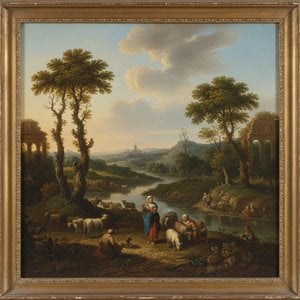
统计数据Classical Landscape

- 49.0 x 73.0 cm


 展开全文
展开全文
艺术微喷/版画
博物馆级艺术微喷或帆布版画,制作高效,并提供多种饰面选择。 ( 订购纯手工绘制画作 切换至数字图像销售渠道)




P118B ¥10

P118H ¥10

P118W ¥10

P438Z ¥10

P508JH ¥12

P508YH ¥12

P805H ¥10

P805Z ¥10

P919BZ ¥10

P919G ¥10

P919XJ ¥10

P959ZH ¥10

P968JZ ¥12

W106C ¥8

W218G ¥10

W218JH ¥8

W218Y ¥10

W307PJ ¥10

W316G ¥10

W316PJ ¥8

W316Y ¥10

W398PJ ¥8

W4111J ¥10

W500HY ¥15

W500JH ¥15

W692G ¥12

W849H ¥8

W940BG ¥15

W953PJ ¥8




您可以从与原作比例一致的预设尺寸中进行选择。

请输入您所需的宽度和高度,以适配您的画框或墙面。由于印刷品只能进行裁剪,无法超出原图尺寸,因此若比例不一致,画面的一部分将会被裁切。在正式印刷之前,我们会为您发送一份数字效果图供您确认。本页面显示的图片并非最终裁剪后的效果——只有效果图才能展示真实的裁剪情况。


 玻璃选项仅适用于110厘米以下的尺寸。

Classical Landscape
艺术微喷/版画
复刻品尺寸
-


最终结算价
¥ 422
相似作品


艺术家简介
The Master of the Roman Light: The Life and Art of Hendrik Frans van Lint
In the golden age of the Grand Tour, when travelers from across Europe flocked to the sun-drenched ruins and majestic piazzas of Italy, few artists captured the ephemeral magic of the landscape as poignantly as Hendrik Frans van Lint. Born in Antwerp in 1684, Van Lint carried the meticulous traditions of his Flemish heritage into the heart of Rome, where he would spend the most transformative years of his life. While his roots lay in the industrious artistic circles of Belgium, his soul became inextricably linked to the luminous atmosphere of the Roman Campagna. His journey was not merely a geographical migration but an artistic evolution, moving from the structured training of his youth toward a profound mastery of veduta—the art of the detailed, panoramic view.
Van Lint’s early years were steeped in the rigorous discipline of the Flemish Baroque. As the son of the painter Peter van Lint and a pupil to masters such as Peter van Bredael, he inherited a foundational respect for compositional clarity and technical precision. However, it was his move to Rome that truly ignited his creative spirit. Upon arriving in the eternal city, he joined the Schildersbent, a celebrated society of Netherlandish painters. It was within this vibrant community of expatriate artists that he earned the affectionate nickname "Studio"—a testament to his incredibly meticulous technique and his ability to render architectural details with such fidelity that they seemed almost etched by hand.
A Symphony of Architecture and Atmosphere
The work of Van Lint is characterized by a breathtaking duality: the rigid, structural permanence of classical architecture set against the soft, fleeting qualities of light and air. He was deeply influenced by the pioneering vedutismo of Caspar van Wittel, whose topographical accuracy provided a blueprint for capturing the essence of Italian urbanity. Yet, Van Lint refused to be bound by mere documentation. He drew immense inspiration from the classical ideal landscapes of Claude Lorrain, often imbuing his scenes with a nostalgic, Arcadian beauty that transcended simple topography.
His canvases frequently present a spectrum of views, ranging from the strictly accurate to the beautifully imagined. In his depictions of places like Caprarola or the Roman outskirts, one can observe a masterful use of light—a warm, golden glow that seems to breathe life into stone and foliage alike. His landscapes often feature:
- Architectural Grandeur: The precise rendering of villas, palaces, and ancient ruins that anchor the composition.
- Atmospheric Depth: A sophisticated use of perspective and haze to create a sense of vast, receding space.
- Genre Elements: Small, delicate figures—often peasants or travelers—that provide scale and a sense of lived reality to the sweeping vistas.
This ability to blend the topographical with the poetic made his work the ultimate souvenir for the 18th-century aristocrat. To own a Van Lint was to possess a window into the Roman ideal, a piece of the sun-soaked Italian dream captured with unparalleled grace.
Legacy and Historical Significance
The historical significance of Hendrik Frans van Lint lies in his role as a bridge between the meticulous Northern tradition and the emotive, light-driven sensibilities of the Southern Baroque. He did not merely record what he saw; he interpreted the atmosphere of an era. His paintings found homes in some of the most prestigious collections in Europe, including the Doria Pamphilj in Rome and the Palazzo Bianco in Genoa, ensuring that his vision of Italy would endure long after the era of the Grand Tour had faded.
Today, Van Lint is remembered as a virtuoso of the veduta style, an artist whose work remains a vital record of the aesthetic aspirations of the 18th century. His legacy persists in every brushstroke that captures the way light dances upon a Roman piazza or settles softly over a distant hill, reminding us of a time when art was the primary vessel for exploring the wonders of the wider world.

Hendrik Frans Van Lint
1684 - 1763 , Belgium
艺术家简介
- Full Name: Hendrik Frans van Lint
- Nationality: Belgian
- Date Of Birth: 1684
- Date Of Death: 1763
- Place Of Birth: Antwerp, Belgium
- Notable Artworks:
- Giacomo van Lint
- An extensive Italianate wooded landscape
- A classical river landscape with figures on a path and a palace in the distance
- Artistic Movement Or Style: Veduta Painting
- Artists Who Influenced This Artist: Caspar van Wittel
- Artists Or Movements Influenced By This Artist: Italian Baroque
相关文章

Dutch Baroque Masters: 10 Paintings That Shaped an Era | ArtsDot
Journey through the Golden Age with our guide to the Top 10 Dutch Baroque masterpieces! Explore iconic paintings by Rembrandt, Vermeer & Frans Hals. Find museum-quality art reproductions and elevate your home decor at ArtsDot.com.

Evoking Tranquility: A Study of Serene Beauty in Visual Art Across Historical Movements
Explore the history of serene art & discover how landscape paintings evoke tranquility across movements. Find inspiration for calming home decor & museum-quality reproductions at ArtsDot.

Scenes of Daily Life: A Comprehensive Exploration of Genre Painting Through History
Explore the rich history of genre painting! Discover Dutch Masters & European artists who captured everyday life with stunning realism. Learn about symbolism, techniques & lasting influence.

阿姆斯特丹国立博物馆25幅杰作:艺术、历史与家居灵感 | ArtsDot
探索阿姆斯特丹国立博物馆25幅传世杰作!深入了解伦勃朗、维米尔等大师的艺术故事与精湛技艺。在家欣赏巴洛克风格油画,提升家居品味。ArtsDot.com提供高品质艺术复制品及室内装饰灵感。立即探索完整系列!
Nicolaes Berchem: Dutch Golden Age Pastoralism & the Evolution of Landscape Painting
Explore the captivating world of Nicolaes Berchem, a leading Dutch Golden Age painter. Discover his idyllic landscapes, masterful technique & lasting influence on art history. Learn more at ArtsDot.