
- 首页

- 帆布打印
- gianfranco baruchello
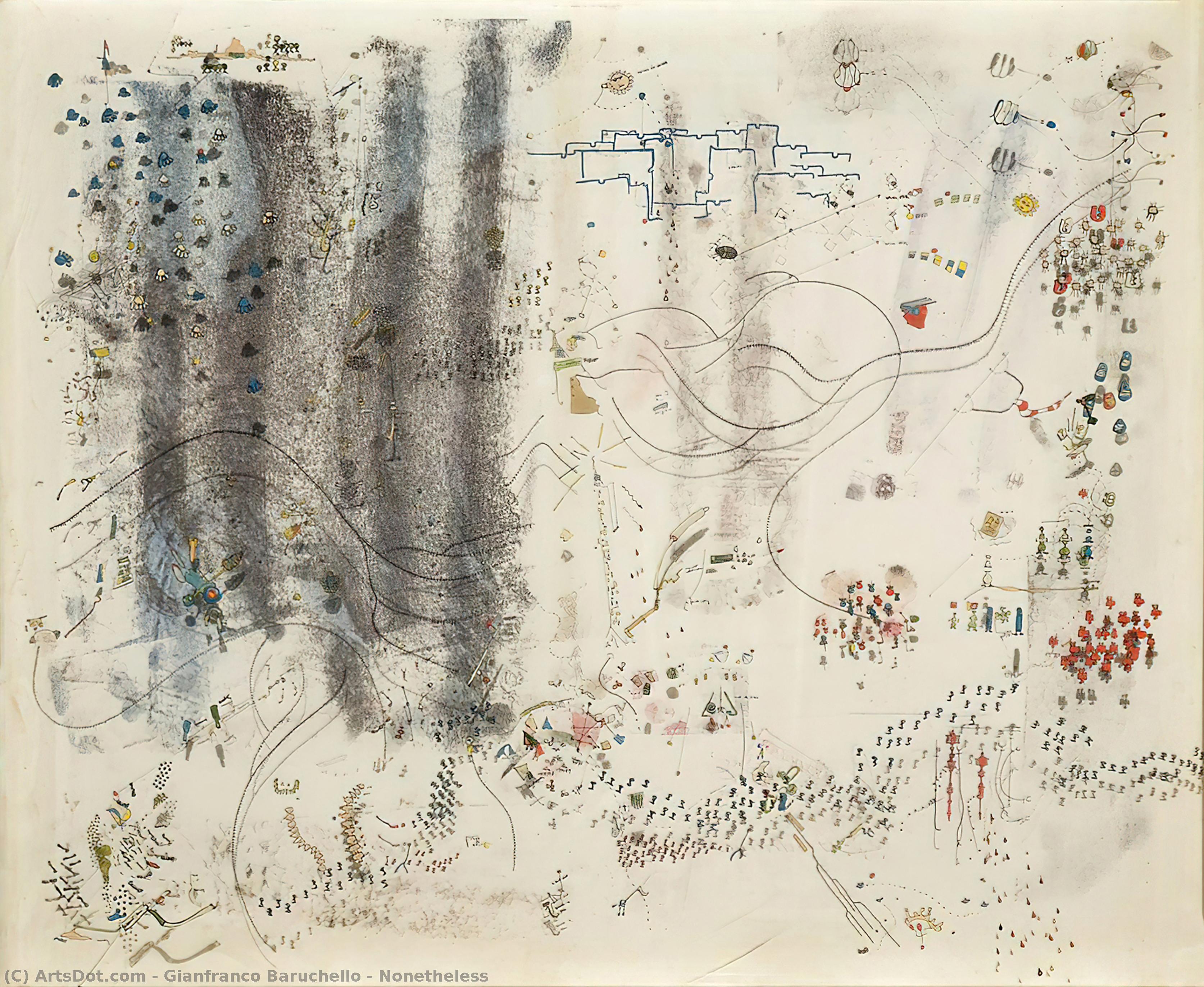
- Nonetheless
 Preview
 定制手绘复刻品
 分享
分享 分享
分享
 详情
详情

 下载
下载
 相似作品
相似作品 X射线
X射线 幻灯片播放
幻灯片播放Nonetheless
 1964
1964 46.0 x 56.0 cm
 展开详情
展开详情




































从与原作比例一致的预设尺寸中进行选择。

您可以输入自定义尺寸,以适配特定的画框或空间。如果您选择的尺寸与原图比例不符,我们将对作品进行裁剪,或通过镜像填充/纯色填充边缘的方式来扩展图像。在开始制作之前,我们会向您发送一份数字效果图供您确认。
请注意,屏幕上的预览并不能反映实际的裁剪或扩展效果。只有效果图才能准确展示最终的构图。
虽然我们提供定制尺寸,但为了保持原图比例,我们建议您从预设列表中选择尺寸。


 玻璃选项仅适用于110厘米以下的尺寸。

Nonetheless
艺术微喷/版画
复制品尺寸
-


最终总价
-
相似艺术品


艺术家简介
Gianfranco Baruchello: Architect of the Unseen
Gianfranco Baruchello’s life and art represent a profound, almost hermetic engagement with the complexities of modern existence – a relentless interrogation of language, perception, and the very nature of representation. Born in Livorno, Italy, in 1924, into a family steeped in both legal and industrial tradition, Baruchello’s early years were shaped by the turbulent backdrop of post-war Italy and the lingering shadow of Fascism. His father, a prominent figure in the General Fascist Confederation for Italian Industry, instilled in him a critical awareness of societal structures, while his mother's role as an elementary school teacher fostered a deep appreciation for the power of communication. This confluence of influences would profoundly shape Baruchello’s artistic trajectory, leading him to develop a uniquely challenging and intellectually rigorous practice. Early experimentation in the late 1950s saw Baruchello navigating the currents of informal and neo-Dada movements, exploring themes of word, object, and painting – all within the context of burgeoning dialogues between art and everyday life. He moved fluidly between Rome, Paris, and New York, immersing himself in a vibrant intellectual landscape populated by writers like Calvino and Sanguineti, philosophers such as Lyotard, and artists including Marcel Duchamp, Roberto Matta, and Alan Jouffroy. The encounter with Duchamp proved particularly transformative, establishing a foundational relationship built on shared skepticism towards traditional artistic conventions and a fascination with the conceptual underpinnings of art itself. This period laid the groundwork for Baruchello’s distinctive approach – one characterized by a deliberate blurring of boundaries between disciplines and a constant questioning of established systems. A pivotal moment in his career arrived in 1962, when he was invited to participate in “New Realists,” a landmark exhibition at Sidney Janis Gallery in New York. This inclusion marked Baruchello’s entry onto the international stage and solidified his position within the burgeoning movement that sought to redefine the role of art in a rapidly changing world. The exhibition showcased his early explorations with black stripes, canvases imbued with fragmented symbols and seemingly random geometric lines – works that reflected a deep engagement with the anxieties and uncertainties of the era. Simultaneously, he began a series of ambitious projects, most notably *Artiflex* (1968), a fictitious company designed to expose the mechanics of the art market and challenge conventional notions of authorship and ownership. Through this provocative undertaking, Baruchello critiqued consumerism, industrial production, and the commodification of artistic labor – themes that would continue to resonate throughout his career. Baruchello’s practice extended far beyond painting, encompassing film, literature, happenings, and even agricultural experimentation. His 1973 establishment of *Agricola Cornelia SpA* on the outskirts of Rome represents a particularly fascinating chapter in his artistic journey. This venture wasn't merely a foray into farming; it was a meticulously constructed allegory – a microcosm reflecting broader societal concerns about land ownership, economic systems, and the relationship between humanity and nature. The farm became a site for experimentation, critique, and ultimately, a profound meditation on the complexities of existence. He described his work as “to make sense of the *use*and *maintenance*of concepts starting from the *percepti*, considering the error and the loss of quality as a *motif*for the discovery of the diversity.” In later years, Baruchello shifted his focus to architecture and living spaces, culminating in the creation of gardens and forests – environments that served as extensions of his artistic investigations. His work consistently prioritized the exploration of uncertainty, embracing ambiguity and challenging viewers to actively engage with the inherent contradictions within his creations. Gianfranco Baruchello’s legacy lies not simply in a collection of artworks, but in a profound philosophical approach to art-making – one that continues to inspire artists and thinkers today. He died in 2023 at the age of ninety-eight, leaving behind a body of work characterized by its intellectual rigor, emotional depth, and unwavering commitment to challenging conventional modes of thought.
gianfranco baruchello
1924 -
艺术家简介
- Artistic Movement Or Style: Surrealism, experimental art
- Artists Or Movements Influenced By This Artist:
- Neo-Dada
- Pop Art
- Artists Who Influenced This Artist:
- Marcel Duchamp
- John Cage
- Date Of Birth: August 24, 1924
- Date Of Death: January 14, 2023
- Full Name: Gianfranco Baruchello
- Nationality: Italian
- Notable Artworks:
- Zero Has No Counterpart
- Chateau-Le-Moi
- The Much Beloved Brother
- Place Of Birth: Livorno, Italy

