


 实景预览
实景预览
 发送
发送 分享
分享
 详情
详情 指南
指南

 下载图片
下载图片
 相似作品
相似作品 X射线
X射线 幻灯片播放
幻灯片播放 统计数据
统计数据High Life
 Drawing
- WallArt
- Contemporary Art
 2013
2013- Contemporary
 124.0 x 108.0 cm
 Nasher Museum of Art at Duke University
 阅读全文
阅读全文
手工油画复制品
由我们的艺术家按需定制,为您提供您所选尺寸及画框的布面手工油画。 ( 切换至版画销售渠道 切换至数字图像销售渠道)




P118B $10

P118H $10

P118W $10

P438Z $10

P508JH $12

P508YH $12

P805H $10

P805Z $10

P919BZ $10

P919G $10

P919XJ $10

P959ZH $10

P968JZ $12

W106C $8

W218G $10

W218JH $8

W218Y $10

W307PJ $10

W316G $10

W316PJ $8

W316Y $10

W398PJ $8

W4111J $10

W500HY $15

W500JH $15

W692G $12

W849H $8

W940BG $15

W953PJ $8




您可以从与原作比例一致的预设尺寸中进行选择。

您可以输入自定义尺寸,以适配特定的画框或空间。如果所选尺寸与原图比例不符,我们将通过裁剪作品或添加手绘元素来扩展画面。数字样稿将在制作开始前发送给您确认。
请注意,屏幕预览无法准确反映实际的裁剪或扩展效果,只有样稿才能真实呈现最终的构图。
虽然我们提供定制尺寸服务,但为了保留原作比例,建议您从预设列表中选择尺寸。
下单后,ArtsDot.com 团队将通过电子邮件联系客户获取具体要求,并提供效果预览图


 玻璃选项仅适用于110厘米以下的尺寸。

High Life
复制品材质
复刻品尺寸说明
-


总计金额
$ 263
相关艺术品


艺术家简介
The Ghostly Echoes of American Culture
Born in the vibrant, complex landscape of New York City on April 14, 1964, Gary Simmons Jr. has emerged as one of the most profound voices in contemporary art. His practice is not merely an aesthetic pursuit but a deep, investigative journey into the very fabric of American identity. Through a multidisciplinary approach that spans painting, sculpture, and installation, Simmons interrogates the intersections of race, class, and social stereotypes. He possesses a rare ability to take the familiar—the icons of popular culture, the remnants of childhood education, and the artifacts of mass media—and transform them into haunting reflections on how history is constructed, remembered, and often deliberately obscured.
Simmons’s artistic formation was rooted in the rigorous intellectual environments of the late 1980s. After earning his BFA from the School of Visual Arts in 1988, he moved to CalArts to pursue his MFA, graduating in 1990. During this pivotal period, he studied under the guidance of influential figures such as Charles Gaines, Michael Asher, and Catherine Lord. These mentors helped shape a conceptual foundation that would allow him to move beyond traditional representation. His early studio practice was uniquely shaped by his physical environment; establishing himself in a former school building in New York City, he found inspiration in the literal debris of pedagogy—the chalkboards, the slate, and the remnants of classroom instruction. This connection to the materiality of education became a cornerstone of his work, allowing him to use the tools of learning to critique the much darker lessons of racial inequality.
The Poetics of Erasure
Perhaps the most defining element of Simmons’s oeuvre is his revolutionary "erasure drawing" technique. This method serves as a powerful metaphor for the fragility of memory and the persistence of prejudice. To create these works, Simmons often begins with a surface reminiscent of a chalkboard—slate-colored panels or canvases onto which he applies white chalk or oil paint. He meticulously recreates imagery drawn from 20th-century American pop culture, including cartoons, film stills, and advertisements that frequently reference the racist traditions of minstrelsy from the 1930s and 40s. However, the true transformation occurs through a deliberate act of negation: he smudges and smears the pigment with his hands.
This process of blurring and obscuring does more than create a unique visual texture; it functions as a profound commentary on the nature of visibility. As Simmons has noted, the erasure represents an attempt to confront the traces of racial pain that linger in the collective consciousness. By partially deleting the image, he forces the viewer to confront what remains—the ghostly outlines and the indelible marks left behind by history. This technique allows him to explore how stereotypes are etched into our culture and how they continue to haunt the present, even when we attempt to wipe them away. The resulting works are both beautiful and unsettling, capturing a sense of evaporation and loss.
A Legacy of Critical Inquiry
The significance of Gary Simmons Jr.’s work lies in its ability to bridge the gap between personal experience and global political discourse. His career has been marked by a consistent evolution, moving from the heavy, geometric wood assemblages of his early sculptural period—such as the Erasure Chair—to the more ethereal, atmospheric qualities of his later paintings. Throughout this development, his thematic focus has remained steadfast: the investigation of how identity is constructed through the lens of power and media.
His contributions to the art world are characterized by several key achievements:
- Conceptual Innovation: The development of a signature aesthetic language that uses physical destruction (erasure) as a tool for social critique.
- Cultural Interrogation: A fearless engagement with the problematic histories embedded in American popular imagery, particularly regarding Black identity and minstrelsy.
- Multidisciplinary Mastery: An expansive practice that successfully integrates sculpture, installation, and painting to create immersive environments of reflection.
- Historical Resonance: Creating a body of work that serves as a vital archive of the tensions between personal memory and the official narratives of history.
Today, Simmons stands as a pivotal figure in contemporary art, recognized for his ability to make the invisible visible. His work continues to challenge viewers to look closely at the smudged edges of our shared reality, reminding us that what is erased from the record often leaves the deepest scars on the soul of a nation.

gary a. simmons jr.
1964 - , United States of America
快速概览
- Artistic Movement Or Style: Erasure Drawings
- Artists Or Movements Influenced By This Artist:
- Minimalism
- Conceptual Art
- Artists Who Influenced This Artist:
- Charles Gaines
- Michael Asher
- Date Of Birth: April 14, 1964
- Full Name: Gary A. Simmons Jr.
- Nationality: American
- Notable Artworks:
- Wall of Eyes
- Piano Man
- Place Of Birth: New York City, United States
相关文章
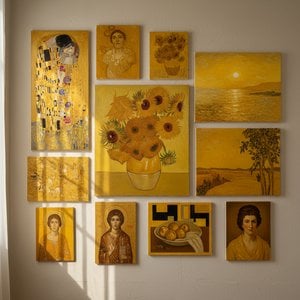
Golden Hues: Top 10 Paintings Dominated by Yellow Ochre |
Explore 10 iconic paintings bathed in golden yellow ochre! From Van Gogh's sunflowers to Monet’s haystacks, discover the stories behind these masterpieces. Find museum-quality art reproductions & elevate your home decor on .

The Golden Hue: Exploring Symbolism & Emotion in Yellow Art
Explore the rich symbolism & emotional power of yellow in art history! From Van Gogh to Kandinsky, discover how artists used this vibrant hue. Expert analysis & high-quality reproductions at ArtsDot.

Golden Hues: 10 Masterpieces Dominated by Chrome Yellow | ArtsDot
Immerse yourself in golden light! Explore 10 famous paintings dominated by 'Chrome Yellow', from Van Gogh’s Sunflowers to Monet's Haystacks. Discover the stories behind these iconic Impressionist & Post-Impressionist masterpieces and find museum-quality art reproductions at ArtsDot.com.

The Nuances of Graphite: Exploring Emotional Depth & Technical Mastery in Pencil Drawing
Explore the captivating world of graphite drawing! Discover its rich history, master essential techniques like chiaroscuro, and learn how artists evoke emotion through this timeless medium. Expert insights for art enthusiasts.

Echoes of Time: Nostalgia, Technique & Cultural Significance in Vintage Paintings
Explore the captivating world of vintage paintings! Discover key styles, cultural significance & collecting tips from art experts at ArtsDot. Find authentic reproductions and elevate your home décor.