


 效果预览
效果预览
 购买印刷品
购买印刷品 分享
分享 分享
分享
 详情
详情

 下载
下载
 相似作品
相似作品 X射线
X射线 幻灯片播放
幻灯片播放Désolation

 展开详情
展开详情




































从与原作比例一致的预设尺寸中进行选择。

您可以输入自定义尺寸,以适配特定的画框或空间。如果所选尺寸与原图比例不符,我们将通过裁剪作品或添加手绘元素来扩展画面。数字样稿将在制作开始前发送给您确认。
请注意,屏幕预览无法准确反映实际的裁剪或扩展效果,只有样稿才能真实呈现最终的构图。
虽然我们提供定制尺寸服务,但为了保留原作比例,建议您从预设列表中选择尺寸。
下单后,ArtsDot.com 团队将通过电子邮件联系客户获取具体要求,并提供效果预览图。


 玻璃选项仅适用于110厘米以下的尺寸。

Désolation
复制材质
复制品尺寸
-


最终总价
$ 263
相似艺术品


艺术家简介
Espérance Léon Broquet: A Painter of WWI’s Echoes
Espérance Léon Broquet (1869-1935) was a French landscape painter whose work stands as a poignant testament to the impact of World War I on rural France. Born in Paris, his artistic journey began with a formal training at the École des Beaux-Arts, yet it was his experiences during the conflict and subsequent travels that profoundly shaped his distinctive style and subject matter. Broquet’s paintings aren't merely depictions of landscapes; they are imbued with a melancholic beauty, capturing the devastation and resilience of a nation grappling with loss and transformation. He developed a unique approach, blending elements of Impressionism, Post-Impressionism, and Symbolism to create images that resonate with both visual power and emotional depth.Early Life and Artistic Beginnings
Léon Broquet’s early life offered little indication of the profound artistic talent he would later cultivate. He initially pursued a career as a clerk before dedicating himself fully to painting in his late twenties. This deliberate shift reflects a desire for creative fulfillment, a yearning to translate the world around him onto canvas with an intensity that office work could never provide. His initial training at the École des Beaux-Arts provided him with foundational skills, but it was through independent study and experimentation that he began to forge his own artistic voice. Early works often featured urban scenes and portraits, demonstrating a technical proficiency but lacking the distinctive emotional resonance that would characterize his later landscapes.The Influence of Travel and War
A pivotal moment in Broquet’s artistic development occurred during his travels through Spain and Portugal in the late 1890s. These journeys exposed him to a radically different visual landscape – sun-drenched hillsides, dramatic coastlines, and a vibrant color palette that profoundly influenced his approach to painting. However, it was the outbreak of World War I that truly ignited his creative fire. Serving as a military observer, Broquet witnessed firsthand the widespread destruction and human suffering inflicted by the conflict. This experience became the bedrock of his artistic output during and after the war years. He began to focus almost exclusively on depicting the ravaged landscapes of France – the scarred fields, abandoned villages, and desolate roads—transforming them into powerful symbols of loss and remembrance.A Distinctive Style: Symbolism and Atmospheric Depth
Broquet’s artistic style is immediately recognizable for its atmospheric depth and evocative use of color. He eschewed bright, cheerful palettes in favor of muted tones – ochres, browns, grays, and blues—that perfectly capture the somber mood of his subjects. His brushwork is often loose and expressive, creating a sense of movement and instability that mirrors the turbulent emotional landscape he portrays. Crucially, Broquet employed Symbolist techniques to imbue his landscapes with deeper meaning. He frequently included subtle symbolic elements – a solitary tree, a crumbling farmhouse, or a distant figure—to suggest themes of loss, memory, and the enduring spirit of humanity in the face of adversity. His paintings are not simply representations of places; they are meditations on the human condition.Major Works and Legacy
Among Broquet’s most celebrated works are *La Vallée de la Drole* (1918), a haunting depiction of a ravaged valley in the Somme region, and *Le Chemin de Fer Abandonné* (1920), which portrays an abandoned railway line as a metaphor for shattered lives. These paintings, along with many others, became powerful emblems of France’s wartime experience. Broquet's work gained recognition during his lifetime, though he never achieved widespread fame. He was part of the *Société des Artistes Indépendants*, a prominent group that championed innovative artistic practices. Today, Espérance Léon Broquet is recognized as a significant figure in French landscape painting, particularly for his unflinching portrayal of WWI’s impact on the French countryside and his masterful use of symbolism to convey profound emotional truths. His paintings continue to resonate with viewers, offering a poignant reminder of the enduring power of art to bear witness to history and explore the complexities of human experience.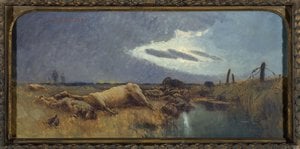
espérance léon broquet
1869 - 1935
艺术家简介
- Artistic Movement Or Style: Post-Impressionism
- Artists Or Movements Influenced By This Artist: ['French landscape art']
- Artists Who Influenced This Artist: ['Impressionists']
- Date Of Birth: 1869
- Date Of Death: 1935
- Full Name: Espérance Léon Broquet
- Nationality: French
- Notable Artworks:
- WWI Landscapes
- Rural war scenes
- Place Of Birth: Paris, France
相关文章

Ferdinand Guillaumin: Impressionism’s Lyrical Landscapes & the French Countryside
Explore the captivating landscapes of Ferdinand Guillaumin, a key figure in Impressionism. Discover his vibrant color palettes, symbolic style & lasting legacy with ArtsDot.

Léon Augustin L'Hermitte: Capturing the Soul of French Rural Life
Discover the captivating realist paintings of Léon Augustin L'Hermitte, masterfully depicting French rural life. Explore his technique, influences & legacy – a cornerstone of 19th-century art.
印象派风景画的十部巨作:定义艺术与家的和谐之境
探索印象派风景画的十部经典巨作!从莫奈到雷诺阿,揭秘大师们的技法与灵感。ArtsDot.com为您呈现高清油画复制和精选艺术品,点亮您的家居空间。立即发现更多艺术珍宝!

The Subdued Palette: Exploring Emotional Resonance & Aesthetic Impact in Muted Artworks
Explore the power of muted colors in art! Discover the history, psychology & techniques behind serene palettes. Find inspiration & expert advice for creating emotionally resonant spaces with ArtsDot.

Oil on Canvas Masters: 10 Paintings That Redefined Art History |
Journey through art history with our guide to 10 legendary oil on canvas masterpieces! Explore iconic works by Van Gogh, Monet & Rembrandt. Find museum-quality reproductions and elevate your home decor at . Discover all masterpieces online.

