

 效果预览
效果预览
 购买手绘画作
 分享
分享 分享
分享
 详情
详情

 下载
下载
 相似作品
相似作品 X射线
X射线 幻灯片播放
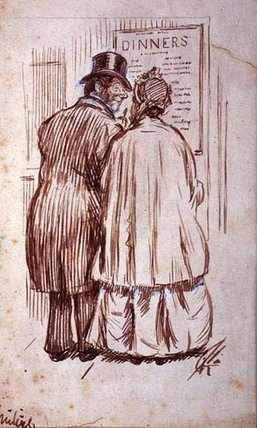
幻灯片播放Dinners
 展开详情
展开详情




































从与原作比例一致的预设尺寸中进行选择。

您可以输入自定义尺寸,以适配特定的画框或空间。如果您选择的尺寸与原图比例不符,我们将对作品进行裁剪,或通过镜像填充/纯色填充边缘的方式来扩展图像。在开始制作之前,我们会向您发送一份数字效果图供您确认。
请注意,屏幕上的预览并不能反映实际的裁剪或扩展效果。只有效果图才能准确展示最终的构图。
虽然我们提供定制尺寸,但为了保持原图比例,我们建议您从预设列表中选择尺寸。


 玻璃选项仅适用于110厘米以下的尺寸。

Dinners
艺术微喷/版画
复制品尺寸
-


最终总价
$ 62


艺术家简介
Early Life and Artistic Beginnings
Charles Samuel Keene, born in Hornsey, Middlesex on August 10, 1823, emerged as a significant figure in Victorian illustration, though his path to artistic renown was initially shaped by circumstance. Following the untimely death of his father, young Charles’s inherent artistic inclinations were fostered by his mother, who recognized and nurtured his talent. This early encouragement proved pivotal, setting the stage for a career that would beautifully capture the nuances of 19th-century British life. His first known work, the illustrations for *The Adventures of Dick Boldhero* (1842), signed simply as Chas. Keene, hinted at the observational skill and delicate draftsmanship that would become hallmarks of his style. This early success wasn’t a sudden leap; it was preceded by an apprenticeship to a wood engraver – a crucial period where he honed his technical abilities and gained invaluable insight into the mechanics of visual reproduction. Though initially destined for a legal career, followed by a brief stint in architecture, Keene's artistic calling proved too strong to ignore, leading him towards the vibrant world of illustration and ultimately, to lasting recognition.Ascension with *Punch* Magazine
Keene’s breakthrough arrived in December 1851 when his work first appeared in *Punch*, the iconic British satirical magazine. This marked not merely an employment opportunity but a pivotal moment of artistic validation. Nine years of consistent contributions followed, demonstrating his dedication and growing skill, culminating in a coveted position on the *Punch* staff. It was within these pages that Keene truly flourished, developing a unique visual language characterized by subtle humor, meticulous detail, and a keen eye for social observation. He wasn’t a caricaturist in the bombastic style of some contemporaries; instead, his strength lay in capturing the quiet moments, the everyday interactions, and the gentle ironies of Victorian society. His work resonated with readers precisely because it reflected their own world back at them – not distorted or exaggerated, but observed with affectionate wit. This period also saw a blossoming of collaboration, most notably with Joseph Crawhall, whose anecdotal observations provided Keene with a wealth of inspiration for over 250 successful drawings in the latter part of his career with *Punch*.A Master of Observation and Social Commentary
Keene’s artistic prowess extended beyond mere technical skill; he possessed an exceptional ability to imbue his illustrations with social commentary. Works like *Storming of Malakoff* demonstrate a capacity for capturing dramatic scenes, while pieces such as *Public Reception* reveal his talent for conveying complex emotions through visual storytelling. He didn't simply depict what he saw; he interpreted it, offering subtle critiques of Victorian customs and societal norms. His illustrations weren’t overtly political or inflammatory, but rather gently persuasive, prompting viewers to reflect on the world around them. This nuanced approach distinguished him from many of his contemporaries and contributed to his enduring appeal. He excelled at portraying scenes of middle-class life – domestic interiors, social gatherings, and everyday encounters – imbuing these seemingly mundane moments with a sense of charm and understated humor. His illustrations weren’t about grand narratives or heroic deeds; they were about the small joys, quiet anxieties, and subtle absurdities of ordinary existence.Later Years and Lasting Legacy
In his later years, Keene relocated to 239 Kings Road, Chelsea, continuing to produce work for *Punch* while also overseeing the publication of a collection of his drawings in *Our People* (1881). Despite facing health challenges – dyspepsia and rheumatism gradually taking their toll – he remained dedicated to his craft until his passing on January 4, 1891. His legacy extends far beyond the pages of *Punch*. Keene’s illustrations offer a valuable window into Victorian England, providing insights into its social customs, fashion, and daily life. He wasn't merely an illustrator; he was a chronicler of his time, capturing its essence with wit, sensitivity, and remarkable artistic skill. His influence can be seen in the work of subsequent generations of illustrators, who admired his ability to blend technical precision with insightful observation. Today, his works are celebrated for their historical significance, aesthetic beauty, and enduring charm, ensuring that Charles Samuel Keene remains a beloved figure in the history of British art.Key Works and Collections
- Storming of Malakoff: A powerful depiction showcasing Keene’s skill in capturing dramatic historical events.
- Public Reception: An insightful illustration that highlights his ability to convey complex emotions and social dynamics.
- A man reading the 'Lancet' in a gentleman's club: A satirical woodcut offering commentary on Victorian society and intellectual pursuits.
- Two women dressing for a ball in inflatable crinoline dresses: A charming illustration capturing the fashion and social customs of the era.

Charles Samuel Keene
1823 - 1891 , United Kingdom
艺术家简介
- Artistic Movement Or Style: Victorian illustration
- Date Of Birth: August 10, 1823
- Date Of Death: January 4, 1891
- Full Name: Charles Samuel Keene
- Nationality: British
- Notable Artworks:
- Storming of Malakoff
- Public Reception
- A man reading the 'Lancet'
- Two women dressing for a ball
- Place Of Birth: Hornsey, UK

