


 实景预览
实景预览
 发送
发送 分享
分享
 详情
详情 指南
指南

 下载图片
下载图片
 相似作品
相似作品 X射线
X射线 幻灯片播放
幻灯片播放 统计数据
统计数据River kordonka
 阅读全文
阅读全文
艺术微喷/版画
博物馆级艺术微喷或帆布版画,制作高效,并提供多种饰面选择。 ( 订购此收藏品的纯手工复刻画作 切换至数字图像销售渠道)




































您可以从与原作比例一致的预设尺寸中进行选择。

您可以输入自定义尺寸,以适配特定的画框或空间。如果您选择的尺寸与原图比例不符,我们将对作品进行裁剪,或通过镜像填充/纯色填充边缘的方式来扩展图像。在开始制作之前,我们会向您发送一份数字效果图供您确认。
请注意,屏幕上的预览并不能反映实际的裁剪或扩展效果。只有效果图才能准确展示最终的构图。
虽然我们提供定制尺寸,但为了保持原图比例,我们建议您从预设列表中选择尺寸。


 玻璃选项仅适用于110厘米以下的尺寸。

River kordonka
艺术微喷/版画
复刻品尺寸说明
-


总计金额
$ 62
相关艺术品


艺术家简介
Andrei Petrovich Ryabushkin: A Painter of Forgotten Russia
Andrei Petrovich Ryabushkin (1861-1904) remains a compelling, if somewhat enigmatic, figure in the history of Russian art. Born in the small village of Stanichnaya sloboda in Tambov province, his early life was steeped in the traditions of icon painting – his father and brother were skilled artisans who instilled in him a deep respect for craftsmanship and the visual language of religious imagery. This formative experience would profoundly shape his artistic vision, leading him to meticulously recreate scenes from 17th-century Russian life, offering a rare glimpse into a world largely forgotten by mainstream art history. Ryabushkin’s journey wasn't one of grand salons or revolutionary fervor; instead, it was a quiet pilgrimage through the heartland of Russia, seeking truth and authenticity in the faces and routines of its ordinary people.Early Influences and Artistic Training
Ryabushkin’s artistic development began unexpectedly. A chance encounter with Alexander Preobrazhensky, a student of Vasily Perov at the Moscow School of Painting, Sculpture and Architecture, proved pivotal. Impressed by the young boy's raw talent – evidenced in his sketches – Preobrazhensky took him under his wing, securing his place at the prestigious institution. Ryabushkin’s time at Moscow was marked by a rigorous apprenticeship under Perov and Illarion Pryanishnikov, both key figures of the *Peredvizhniki* (Wanderers) movement, known for their commitment to depicting Russian life with unflinching realism. However, the rigid academic demands of the school ultimately proved stifling. He quickly developed a distinct style, one characterized by painstaking detail and an almost obsessive attention to historical accuracy. This departure from the prevailing artistic trends would later define his unique contribution.A Journey into Russia’s Past
Following his time in Moscow, Ryabushkin moved to Saint Petersburg, seeking further refinement at the Imperial Academy of Arts. Yet, he found the academy's emphasis on idealized historical narratives and formal techniques deeply unsatisfying. Instead of pursuing a diploma work – a traditional path to recognition – he embarked on an extraordinary journey across ancient Russian towns: Novgorod, Kiev, Moscow, Uglich, and Yaroslavl. This deliberate choice was not merely a nostalgic exercise; it was a profound act of research. Ryabushkin sought to understand the past by immersing himself in its tangible remnants—the weathered facades of medieval churches, the worn fabrics of peasant clothing, the tools of their trades, and most importantly, the faces of the people themselves. He meticulously documented these details, transforming them into his primary subjects. His travels were not just a visual survey; they were an attempt to reconstruct a vanished world, one painstakingly rendered in oil paint.Key Works and Artistic Style
Ryabushkin’s most celebrated works are deeply rooted in the 17th century. “Peasant Wedding” (1880), purchased by Pavel Tretyakov, marked his initial success and established his reputation for meticulous realism. However, it was his later paintings that truly showcased his artistic maturity. "In a Village. Going to Liturgy" (1903) exemplifies his style—a quiet tableau of rural life, imbued with a sense of solemnity and timelessness. The muted palette, the subtle lighting, and the carefully observed details create an atmosphere of profound stillness. Similarly, “In the Village” (1902) captures a moment of communal activity – a young man breaking into a girls’ dance—with remarkable sensitivity and psychological insight. His work on the mosaics for Saint Sophia Cathedral in Novgorod and the frescoes for the Church of the Savior on Blood in Saint Petersburg further demonstrated his mastery of decorative arts, blending historical accuracy with artistic skill.Legacy and Historical Significance
Despite his undeniable talent and dedication to authenticity, Ryabushkin’s work was largely misunderstood during his lifetime. His paintings, depicting the everyday lives of ordinary Russians, lacked the dramatic flair or social commentary favored by many contemporary critics and patrons. He didn't fit neatly into the established artistic categories of his time. His commitment to historical accuracy, coupled with a lack of emotional engagement, resulted in rejection from the *Peredvizhniki* movement and limited recognition within the art establishment. However, Ryabushkin’s legacy has grown steadily over the years. Today, he is recognized as a significant figure in Russian realist painting, offering a valuable window into a forgotten era. His meticulous depictions of 17th-century Russia—its customs, its crafts, and its people—provide a unique and enduring testament to a vanishing world. His work serves as a poignant reminder that true art often lies not in grand gestures or dramatic narratives, but in the quiet observation of everyday life. He died young, at the age of 42, leaving behind a body of work that continues to fascinate and inspire.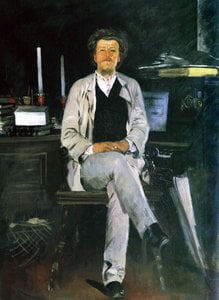
andrei petrovich ryabushkin
1861 - 1904 , Russia
快速概览
- Artistic Movement Or Style: Historical genre
- Artists Who Influenced This Artist:
- Vasily Perov
- Illarion Pryanishnikov
- Pavel Chistyakov
- Date Of Birth: 1861-10-29 (Tambov, Russia)
- Date Of Death: 1904-05-10
- Full Name: Andrei Petrovich Ryabushkin
- Nationality: Russian
- Notable Artworks:
- Peasant Wedding
- In a Village. Going to Liturgy
- In the Village
- Place Of Birth: Tambov, Russia