

 实景预览
实景预览
 分享
分享 分享
分享
 详情
详情 指南
指南

 下载作品
下载作品
 相似作品
相似作品 X射线
X射线 幻灯片播放
幻灯片播放 问答
问答 统计数据
统计数据Leda


 展开全文
展开全文
艺术微喷/版画
博物馆级艺术微喷或帆布版画,制作高效,并提供多种饰面选择。 ( 订购纯手工绘制画作 切换至数字图像销售渠道)




P118B ¥10

P118H ¥10

P118W ¥10

P438Z ¥10

P508JH ¥12

P508YH ¥12

P805H ¥10

P805Z ¥10

P919BZ ¥10

P919G ¥10

P919XJ ¥10

P959ZH ¥10

P968JZ ¥12

W106C ¥8

W218G ¥10

W218JH ¥8

W218Y ¥10

W307PJ ¥10

W316G ¥10

W316PJ ¥8

W316Y ¥10

W398PJ ¥8

W4111J ¥10

W500HY ¥15

W500JH ¥15

W692G ¥12

W849H ¥8

W940BG ¥15

W953PJ ¥8




您可以从与原作比例一致的预设尺寸中进行选择。

请输入您所需的宽度和高度,以适配您的画框或墙面。由于印刷品只能进行裁剪,无法超出原图尺寸,因此若比例不一致,画面的一部分将会被裁切。在正式印刷之前,我们会为您发送一份数字效果图供您确认。本页面显示的图片并非最终裁剪后的效果——只有效果图才能展示真实的裁剪情况。


 玻璃选项仅适用于110厘米以下的尺寸。

Leda
艺术微喷/版画
复刻品尺寸
-


最终结算价
¥ 422
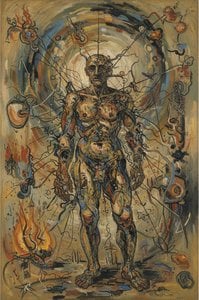
A Descent into Myth: Exploring Masson's "Leda"
André Masson’s 1947 work, “Leda,” is far more than a depiction of a classical myth; it's an intensely personal and psychologically charged exploration of desire, transformation, and the unsettling power dynamics inherent in the story of Leda and Zeus. The Greek myth recounts how Zeus, disguised as a swan, seduced or raped Leda, resulting in the birth of Helen of Troy and other children. Masson doesn’t offer a literal representation of this narrative. Instead, he channels the myth's emotional core through a powerful visual language rooted in Surrealism and Abstract Expressionism. This piece invites viewers to confront not just the story itself, but also the complex feelings it evokes – vulnerability, powerlessness, and the unsettling beauty that can emerge from chaos.Style & Technique: Automatic Drawing and Surrealist Expression
Masson was a pivotal figure in the Surrealist movement, deeply involved with its exploration of the unconscious mind. “Leda” exemplifies his embrace of *automatic drawing*, a technique championed by André Breton and other Surrealists aimed at bypassing conscious control to access raw, unfiltered creativity. The artwork is rendered entirely in shades of gray and black ink on paper, creating a striking monochromatic effect that amplifies the intensity of the swirling lines. The dense, scribbled application of these lines isn’t merely decorative; it's integral to the work's expressive power. It creates a palpable texture, almost as if one could feel the artist's hand moving across the surface. The style blends Surrealism’s dreamlike imagery with Abstract Expressionism’s emphasis on spontaneous gesture and emotional expression, resulting in a unique visual language that is both unsettling and captivating.Symbolism & Emotional Impact
The distorted forms of Leda and the swan are key to understanding the artwork's symbolic weight. The intertwining figures lack clear boundaries, suggesting a blurring of identities and a loss of control – central themes within the myth itself. The chaotic lines evoke feelings of anxiety, desire, and transformation. The absence of a defined background further intensifies this sense of disorientation, drawing the viewer into the swirling emotional vortex at the heart of the piece. While the swan traditionally represents beauty and grace, in Masson’s hands, it becomes an instrument of unsettling power, its form distorted and integrated with Leda's own, creating a complex visual metaphor for vulnerability and violation. The monochromatic palette reinforces this sense of unease, stripping away any potential for comforting color or light.Historical Context & Masson's Artistic Journey
Created in 1947, “Leda” reflects the post-war climate of existential questioning and psychological exploration that characterized much of Abstract Expressionism. Having witnessed the horrors of World War II, many artists sought to express profound emotional truths beyond traditional representational forms. Masson’s work, deeply rooted in Surrealist principles, aligns with this impulse. His early training encompassed Cubism, but his association with Surrealism led him to experiment extensively with automatic techniques and altered states of consciousness – all evident in the raw energy and psychological depth of “Leda.” His exploration of mythology wasn't merely academic; it was a means of delving into universal human experiences like desire, power, and transformation.相似作品


艺术家简介
安德烈·马松:超现实主义的先驱与艺术探索者
安德烈·马松(André Masson,1896-1987)是一位法国画家、雕塑家和版画家,被誉为超现实主义运动的关键人物之一。他的艺术生涯充满了对传统边界的挑战和对内心世界的深刻探索。马松的作品以其大胆的实验性、强烈的象征意义以及对潜意识主题的关注而闻名于世,对后来的抽象表现主义等艺术流派产生了深远的影响。
早年生活与艺术启蒙
1896年1月4日,安德烈·马松出生在法国巴拉尼-苏尔-泰兰。他幼年时期便展现出对绘画的热情,十一岁时进入布鲁塞尔皇家美术学院学习,师从康斯坦特·蒙塔尔德。这段早期的学院派训练为他日后的艺术探索奠定了坚实的基础。起初,马松的作品受到立体主义的影响,他对毕加索和勃拉克等立体主义大师的创新手法表现出浓厚的兴趣,并尝试将其融入自己的创作中。然而,这种影响只是他艺术旅程的起点,很快,他便开始寻求更加自由、更加个人化的表达方式。
超现实主义时期与自动绘画
20世纪20年代,马松积极投身于超现实主义运动。在安德烈·布勒东等人的影响下,他开始深入研究弗洛伊德的精神分析理论,并将其应用于艺术创作中。自动绘画成为马松最具代表性的技法之一。这种技法强调摆脱理智的控制,让潜意识自由地引导画笔,在画布上留下无拘束、充满象征意义的线条和图案。他试图通过这种方式揭示人类内心深处的欲望、恐惧和幻想。马松与安东南·阿尔托、米歇尔·莱里斯、胡安·米罗、乔治·巴塔耶、让·杜比菲以及乔治·马尔金等超现实主义艺术家保持着密切的合作关系,共同推动了这场艺术运动的发展。
风格演变与战争经历
到了20世纪30年代末,马松逐渐远离了纯粹的超现实主义。他开始尝试更加结构化的绘画风格,受到安德烈·德兰等画家的影响,他的风景画变得更加写实和细腻。然而,这种转变并非完全的背离,而是他对艺术表现形式的一种新的探索。第二次世界大战期间,马松的作品被纳粹政权视为“堕落”艺术而遭到谴责。为了逃避迫害,他于1940年逃往美国,并在纽约得到了瓦里安·弗莱的帮助。这段经历对他的创作产生了深刻的影响,同时也为美国的抽象表现主义艺术家提供了重要的灵感和启发,特别是杰克逊·波洛克。
晚期作品与艺术遗产
战后,马松回到法国,定居在艾克斯-普罗旺斯。他将更多的精力投入到风景画的创作中,并逐渐形成了自己独特的风格。他的晚期作品更加注重对自然光线和色彩的表现,以及对绘画材料本身的探索。 安德烈·马松的作品不仅具有高度的艺术价值,更蕴含着深刻的思想内涵。他通过对潜意识主题的关注、对传统边界的挑战以及对艺术表现形式的创新,为现代艺术的发展做出了重要的贡献。他的作品至今仍然激励着无数艺术家不断探索新的可能性,并继续影响着当代艺术的进程。
- 代表作:《超越》、《岩石风景》、《恋人的变形》、《皮格马利翁》等。

安德烈·马松
1896 - 1987 , 法國
艺术家简介
- 代表作品:
- 超越
- 岩石风景
- 恋人的变形
- 皮格马利翁
- 出生地: 法国巴拉尼-叙尔泰兰
- 出生日期: 1896年1月4日
- 受其影响的艺术家/流派:
- 杰克逊·波洛克
- 抽象表现主义
- 国籍: 法国
- 姓名: 安德烈·马松
- 影响他的艺术家: ['安德烈·德兰']
- 艺术运动或风格: 超现实主义,立体主义
- 逝世日期: 1987年
相关文章

Georges Braque: Pioneering Cubism & the Evolution of Modern Form
Explore the revolutionary art of Georges Braque, a pioneer of Cubism alongside Picasso. Discover his artistic evolution, key works, and lasting impact on modern art. A guide for discerning collectors.

超现实主义运动:从达达主义废墟中崛起,探索潜意识的艺术哲学
深入探索超现实主义运动的起源、理论与大师作品。了解达达主义的影响,弗洛伊德精神分析的贡献,以及如何收藏和鉴赏超现实主义艺术。ArtsDot.com为您提供专业的艺术咨询服务。
André Masson: Automatism, Surrealism & Primal Expression in 20th-Century Art
Explore the revolutionary art of André Masson – pioneer of automatism & Surrealist expression. Discover his powerful imagery, innovative techniques, and lasting influence on modern art. Learn more at ArtsDot.

Beyond Sight: Exploring Tactile Dimensions and Illumination in Abstract Painting
Explore the captivating world of tactile abstraction! Discover impasto techniques, influential artists like Richter & Hoyland, and expert insights for collecting textured art. Elevate your space with museum-quality pieces.

形而上绘画的启示:乔治·德·基里科早期影响与现实之 Veil 之外的探索
深入探索乔治·德·基里科形而上绘画的起源、哲学影响与对超现实主义的深远启示。专业艺术解读,助您理解经典作品背后的神秘世界,提升艺术鉴赏力。