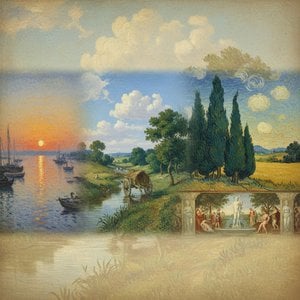
A Life Formed by Light and Landscape
Born in Mistelbach within the Austrian Empire, Wilhelm Bernatzik did not initially set out to capture the world through a brush. At his father's insistence, he began his adult years as a law student. This academic path was eventually set aside for the study of light and form. Between 1873 and 1875, he attended the Special School for Landscape Painting at the Academy of Fine Arts in Vienna, learning under Eduard Peithner von Lichtenfels. His education was not confined to his home soil; he moved through the Kunstakademie Düsseldorf and eventually reached Paris, where he refined his technique under Léon Bonnat.
The movement of his career followed a path of expanding horizons. By 1880, he had joined the Vienna Künstlerhaus, establishing himself within the local art community. His early successes were marked by formal recognition, such as receiving the Golden Füger-Medal in 1875 and later earning a second-class medal at the 1894 World Exhibition in Antwerp. These honors reflected a growing command over his medium.
The Impressionist Influence and the Secession
Bernatzik’s approach to painting was deeply shaped by his time in France, where he absorbed the sensibilities of Impressionism. He became a painter who preferred the immediacy of en plein air work, often seeking out the specific atmospheres of Vienna and Lower Austria. While his landscapes were his primary focus, his repertoire also included genre paintings and symbolic imagery that captured more complex human or spiritual narratives.
His role in the Viennese art scene was significant during a period of intense transition. In 1897, he became a founding member of the Vienna Secession. His leadership within this group was formalised when he served as its president from 1902 to 1903. However, the shifting alliances of the era eventually led him away from the movement; in 1905, alongside a group associated with Gustav Klimt, he departed the Secession.
Final Years and Lasting Works
The later years of his life were spent amidst the landscapes that had so often been his subject. He passed away in Hinterbrühl at the home of his brother, Marx. Following his death in 1906, a retrospective exhibition was held at the Galerie Miethke in Vienna in 1907, allowing the public to reflect on a body of work that ranged from the quietude of a pond to more profound religious visions.
His paintings remain noted for their ability to capture specific moods and settings. Some of his notable works include:
- The Vision of St Bernhard (1882), painted in the Gothic atmosphere of Heiligenkreuz Abbey.
- Corridor approaching Dürnstein (1881).
- The Messenger of Salvation – Versehgang (1887).
- Winter (1888).
- Pond (1900).
Питання та відповіді
Які псевдоніми або інші імена має Wilhelm Bernatzik?
Wilhelm Bernatzik також відомий/відома під іменами Вильгельм Бернатцик.
Чи можу я переглянути роботи Wilhelm Bernatzik за художніми напрямами?
Мистецькі напрями, у яких працював(ла) Wilhelm Bernatzik, можна переглянути на сторінці Усі художні напрями, де твори згруповані за напрямами.
Як я можу простежити за творчістю Wilhelm Bernatzik рік за роком?
Сторінка Хронологія творів митця представляє роботи Wilhelm Bernatzik, впорядковані за датою, рік за роком.
Чи можу я переглянути роботи Wilhelm Bernatzik за ключовими словами?
Сторінка За ключовими словами митця Wilhelm Bernatzik групує його роботи за ключовими словами.