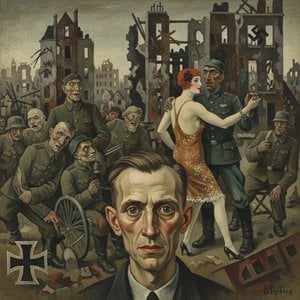
Early Life, Family and Training
Oskar Sädek enters the world on 12 August 1906 in Türi. He is born into a carpenter family, a background defined by manual craft and the shaping of raw materials. In 1914, the family moves to Tallinn, shifting the landscape of his upbringing from the rural surroundings of Türi to the urban environment of the Estonian capital.
Life in Tallinn follows a structured path. He completes a 6-class evening school, navigating the requirements of formal education while the city evolves around him. This period of schooling provides the foundation for his transition into the specialized world of fine arts.
The trajectory of his life shifts decisively between 1927 and 1931. He enters the Ants Laikmaa Atelier School to receive formal art education. Within the walls of this studio, the son of a carpenter begins the technical transformation into a professional painter. This training period marks the end of his formative years and the beginning of his professional identity.
Artistic Career and Themes
The years between 1931 and 1941 mark a period of constant exhibition for Sädek. Every year, he presents works centered on domestic motifs, labor, or the War of Independence. His focus shifts toward the historical weight of the Estonian nation. In 1935, this preoccupation with the past reaches a peak when he wins a prize for his painting "Viiking" during a competition themed around the War of Independence.
Professional recognition follows his thematic consistency. He joins the Estonian Artists' Union in 1934. By 1938, he is a member of the Estonian Association of Fine Artists. His work remains anchored in the struggle for independence and the broader contours of Estonian history, often depicting the soldiers and the atmosphere of the 1918–1920 conflict.
Notable Works and Mediums
Sädek’s technical range spans from the soft texture of pastel on paper to the heavy application of oil. In the 1930s, he produced Northern Coast, a pastel work that captures the specific light of the coastline. His command of oil is evident in Natüürmort redistega, a 1930 composition currently held by the Art Museum of Estonia. He frequently returned to the themes of Estonian history, often translating the gravity of the War of Independence into visual form.
The weight of national history appears in his 1939 painting, which depicts various Estonian soldiers from the War of Independence (1918–1920), including officers, non-commissioned officers, cavalrymen, and gunners. This focus on the human and landscape elements of the Estonian identity extends to his depictions of the natural world and individual subjects. His Saaremaa maastik is part of the collection at the Tartu Art Museum, while the portrait Erna Brinkmanni resides in the Estonian History Museum.
- Untitled (1933)
Later Years and Death
The trajectory of his life shifts in 1936. He adopts the name Oskar Funk, a departure from the identity he had established through his involvement with the Estonian Artists' Union and the Estonian Association of Fine Artists. This period of transition occurs as the geopolitical landscape of Europe begins to fracture.
The outbreak of the Second World War brings a sudden, violent end to his career. Mobilized as a German soldier, he is sent to the front lines. He dies in 1942 near Leningrad. The conflict claims him on the battlefield, cutting short a life defined by the depiction of Estonian history and the struggles of the War of Independence.
Where to See the Works Today
The physical legacy of Oskar Sädek remains anchored within the institutional memory of Estonia. Six of his works are currently preserved in Estonian public collections, distributed across the country's primary repositories of national art. These pieces offer a tangible connection to his specific visual language and his engagement with the historical themes of his era.
The Art Museum of Estonia maintains a presence of his works within its holdings. Similarly, the Tartu Art Museum preserves his paintings, ensuring his contributions to the Estonian art scene remain accessible to researchers and the public. His output also finds a home in the Estonian History Museum, where his depictions of national subjects are held.
Питання та відповіді
Як я можу переглянути всі роботи Oskar Sädek?
З усіма роботами Oskar Sädek на цей сайт можна ознайомитися на сторінці Усі роботи митця митця.
Де можна знайти роботи Oskar Sädek, згруповані за кольоровою палітрою?
Роботи Oskar Sädek можна переглянути за кольоровою палітрою на сторінці митця: За кольоровою палітрою
Де можна переглянути роботи Oskar Sädek, згруповані за технікою виконання?
Сторінка За технікою виконання групує роботи Oskar Sädek за технікою виконання.
Скільки творів Oskar Sädek представлено в каталозі?
Ви можете переглянути 3 творів мистецтва творів Oskar Sädek на сторінці Усі роботи митця.