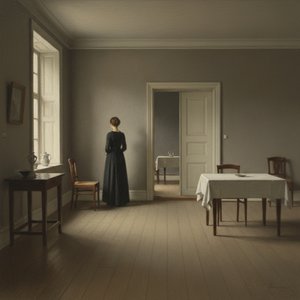
A Life Shaped by Danish Tradition
Born in Glumsø, Denmark, in 1924, Niels Andersen grew up in a landscape that would eventually find its way onto his canvases. His early years in the Danish countryside provided a foundation for a life dedicated to visual expression. He did not merely observe the world; he sought to translate its structures through both painting and graphic design. This dual focus allowed him to approach composition with a designer's precision and a painter's sensitivity to light and form.
His formal training took him into the studios of influential mentors. Under the guidance of Aksel Jørgensen and Holger J. Jensen, Andersen learned the technical rigors required to master his craft. These teachers helped him refine his ability to handle oil on canvas, a medium he would use to capture the quiet essence of the Danish landscape and its many moods.
The Language of Form and Light
Andersen's work often reflects a deep connection to specific places, capturing the atmosphere of the Danish coast and islands. His technique relies on a careful balance of color and structure, often focusing on how light interacts with the natural environment. His ability to translate a sense of place into a static image is a hallmark of his practice.
Throughout his career, his artistic development was marked by several key elements:
- A focus on the interplay between landscape and light.
- The application of graphic design principles to fine art compositions.
- A commitment to the traditions of Danish painting.
One of his notable works, Fra Hven, created in 1961, demonstrates his ability to handle oil on canvas to depict the character of the Danish islands. This piece, held in the collection of the Statens Museum for Kunst, shows his capacity to move beyond simple representation into a more thoughtful study of space and color.
A Lasting Presence in Danish Art
The significance of Andersen's work lies in its quiet strength and its place within the broader history of Danish art. He remained a steady presence in the art world, contributing to the visual language of his country through his paintings and his graphic work. His pieces are not loud, yet they hold a certain weight that commands attention through their clarity and composition.
By bridging the gap between the functional world of graphic design and the expressive realm of painting, he developed a unique perspective on the visual world. His legacy is found in the way he captured the subtle shifts of the Danish landscape, preserving a specific sense of place for those who view his work today.
Питання та відповіді
Де я можу переглянути роботи Niels Andersen у хронологічному порядку?
Перегляньте хронологію робіт Niels Andersen: на сторінці Хронологія творів твори митця впорядковані за датою створення.
Чи є хронологічний опис творчого шляху Niels Andersen?
Хронологічний опис творчості Niels Andersen представлений на сторінці Хронологія творчого шляху, де за розділами, у порядку їх створення, зібрані всі роботи митця.
Чи можу я переглянути роботи Niels Andersen за технікою виконання?
Роботи Niels Andersen можна переглянути за технікою виконання на сторінці митця За технікою виконання.
Чи можу я відсортувати роботи Niels Andersen за кольором?
Роботи Niels Andersen можна переглянути за кольором на сторінці Колірний спектр митця.