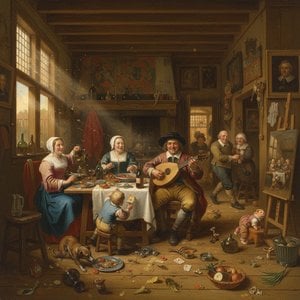
A Life in Antwerp
Jan Mertens the Younger lived his life within the bustling, industrious streets of Antwerp. Born in 1470, he was the son of a sculptor named Jan Mertens the Elder, whose family roots were tied to Tournai. Growing up in a household shaped by the physical demands of sculpture, Jan likely understood the importance of form and structure from a young age. By 1505, he had entered the studio of the painter Jan Gossaert as an apprentice, a move that would define the trajectory of his career. He eventually achieved the status of a master within the Antwerp painters' guild in 1509, establishing himself as a significant figure in the local artistic community.
His personal life was deeply intertwined with the artistic circles of the time. He was the father-in-law of Pieter Coecke van Aelst, who married his daughter Anna before 1526. Through these family connections, Mertens became a central figure in a lineage of painters. His second daughter married Jan van Amstel, a man often identified as The Brunswick Monogrammist, and later Gillis van Coninxloo. These ties suggest a man who was not merely a solitary painter, but a cornerstone of a growing artistic dynasty in the Burgundian Netherlands.
Artistic Style and Identity
The work of Jan Mertens the Younger emerged during the transition from Early Netherlandish painting toward the more expressive Antwerp Mannerism. While the era was characterized by sharp focus and exaggerated poses, his hand was marked by a specific set of qualities:
- A sense of structural clarity in his compositions.
- A delicate approach to his painting style.
- The use of brilliant color to define his subjects.
- A thoughtful, deliberate method of arranging scenes.
There is a persistent debate among historians regarding his true identity. Some suggest he may be the Master of 1518, an artist named after a specific date found on the wings of an altarpiece in Lübeck. This connection is based on the stylistic similarities between his known work and the pieces attributed to that master. Whether he is the Master of 1518 or a distinct individual, his influence on the development of South Netherlandish painting remains clear.
Legacy and Influence
Mertens died in Antwerp around 1527, leaving behind a legacy that moved through his children and students. His ability to blend the traditional precision of the North with a new sense of movement helped shape the visual language of his successors. He was a bridge between the old ways of the early masters and the evolving tastes of the sixteenth century. His presence in the Antwerp guild and his family's subsequent marriages into the art world ensured that his influence would be felt long after his death.
Питання та відповіді
До якого історичного періоду належить творчість Jan Mertens the Younger?
Jan Mertens the Younger працював у період Renaissance. Цей період визначає місце творчості митця в історії.
Де можна знайти роботи Jan Mertens the Younger, згруповані за художніми напрямами?
Сторінка Усі художні напрями групує твори Jan Mertens the Younger за художніми напрямами.
Де я можу побачити колірну палітру робіт Jan Mertens the Younger?
Геном палітри Jan Mertens the Younger — це сторінка, що представляє колірний профіль усього творчого дорослого цього митця.