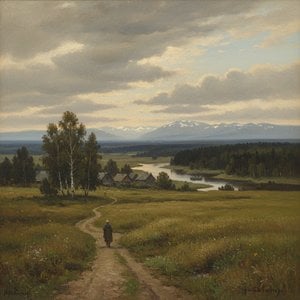
The Quiet Precision of Ignaz Ellminger
To look at the work of Ignaz Ellminger is to witness a specific, disciplined approach to the Austrian landscape. He was not a painter of grand, sweeping gestures, but rather a man of detail and observation. His training at the Academy of Fine Arts in Vienna provided the technical foundation for a career defined by steady, professional competence. He moved through the art world of the late nineteenth century with a quiet authority, eventually earning a place as a member of the Vienna Künstlerhaus. His output was not about chasing trends, but about capturing the specificities of his surroundings through oil on canvas and precise draftsmanship.
His professional life was split between the studio and the classroom. While he maintained a presence as a freelance artist, he also held a position as a drawing professor at the Kommunal-Realgymnasium in Vienna's second district. This dual identity as both a creator and a teacher suggests a mind deeply concerned with the mechanics of form and line. He was a man of letters as well, working as a dialect poet, a fact that points to a deep connection to the local culture and language of his time.
A Record of Observation
Ellminger’s catalog reveals a consistent interest in the intersection of nature and human labor. His paintings often focus on the functional aspects of rural and riverbank life, avoiding unnecessary sentimentality in favor of structural clarity. His subjects include:
- Village scenes and rural idylls
- The movement of horses along riverbanks
- The social atmosphere of local taverns
- The heavy labor of towing boats
His technique relied on a clear understanding of light and composition. In works like Sunday in the Weinviertel, he captures a specific moment in the landscape, using oil to define the weight of the environment. Even his smaller works, such as Besuch beim Heurigen, demonstrate a commitment to documenting the social textures of 19th-century Austria. He did not seek to idealize; he sought to record.
The Weight of a Legacy
The significance of Ellminger lies in his role as a chronicler of a vanishing way of life. He documented the mechanics of transport and the quiet rhythms of the Austrian countryside before the rapid shifts of the coming century altered them forever. His work provides a factual, visual anchor to the period. Even his name remains etched into the geography of Vienna, with Ellmingergasse named in his honor in the Erlaa district. He remains a figure of technical substance, a painter who understood that the true value of a landscape lies in its specific, unvarnished details.
Питання та відповіді
До якого історичного періоду належить творчість Ignaz Ellminger?
Ignaz Ellminger працював у період 19th Century. Цей період визначає місце творчості митця в історії.
Чи можу я відсортувати роботи Ignaz Ellminger за кольором?
Колірний спектр для Ignaz Ellminger — це сторінка, на якій роботи митця впорядковані за кольорами.
Чи можу я переглянути роботи Ignaz Ellminger за ключовими словами?
Роботи Ignaz Ellminger можна переглянути за ключовими словами на сторінці митця За ключовими словами. Кожне ключове слово об'єднує відповідні витвори мистецтва.
Скільки творів Ignaz Ellminger представлено в каталозі?
Ви можете переглянути 3 творів мистецтва творів Ignaz Ellminger на сторінці Усі роботи митця.