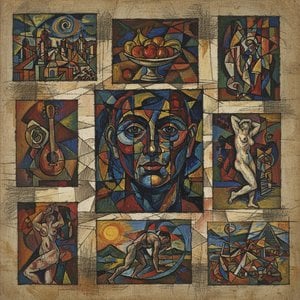
The Weight of the Human Condition
Born in Havana, Cuba, Antonia Eiriz developed a visual language that was deeply personal and often unsettling. Her work emerged from a period of profound political and social transformation, shaped by the shifting tides of the Cuban Revolution. Rather than focusing on the idyllic, she turned her gaze toward the friction of existence. Her canvases often addressed the machinations of power and the quiet, persistent suffering of the individual. There was a certain wryness in her approach, a way of looking at the world that refused to look away from its complexities.
Her style was rooted in expressionism, using form and texture to convey internal states rather than mere external likeness. She did not seek to decorate; she sought to reveal. This commitment to truth, however uncomfortable, defined her output during her most productive years.
Themes and Form
The imagery in Eiriz's work often functioned as a critique of social structures and the psychological toll of propaganda. She explored how individuals are positioned within larger, often crushing, systems. Her compositions frequently dealt with the tension between the individual and the collective, often using the human figure to represent broader societal struggles.
Several key themes recur throughout her body of work:
- The mechanics of political power and its impact on the psyche.
- The experience of waiting and the stagnation of the human spirit.
- The intersection of personal rebellion and social conformity.
- The physical and emotional manifestations of human suffering.
A Life in Transition
Eiriz's life was marked by movement, reflecting the very themes of displacement and transition found in her art. After her early years in Cuba, she eventually settled in Miami, Florida, where she continued to navigate the complexities of identity and memory. Her work remained a constant, a way of processing the world through a lens of intense scrutiny. She was a painter who understood that the most profound truths are often found in the shadows of the everyday.
Питання та відповіді
Чи є хронологічна лінія творів Antonia Eiriz?
Твори Antonia Eiriz можна переглянути в хронологічному порядку на сторінці Хронологія творів митця.
Чи можна відвідати віртуальний 3D-тур роботами Antonia Eiriz?
Твори Antonia Eiriz можна побачити в 3D-галереї на сторінці митця 3D-музей.
Де можна знайти роботи Antonia Eiriz, згруповані за ключовими словами?
Сторінка За ключовими словами митця Antonia Eiriz групує його роботи за ключовими словами.
Як мені знайти роботи Antonia Eiriz у певній кольоровій гамі?
Роботи Antonia Eiriz можна переглянути за кольоровою палітрою на сторінці митця: За кольоровою палітрою