
- Додому

- Репродукція картини олією
- Томас Роландсон
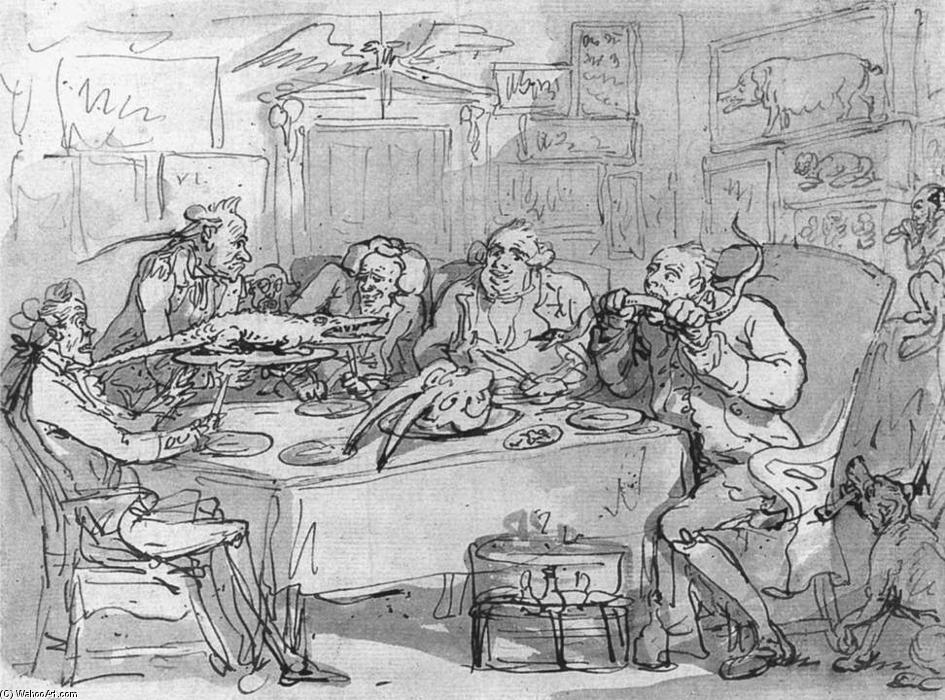
- The Fish Dinner
 Замовити друк Купити цифрове зображення
 Надіслати
 Поділитися
 Details
 Додати до улюблених

 Завантажити
 Схожі вироби
 X-Ray
X-Ray
 Слайд-шоу
The Fish Dinner
 Ink On Paper
- Other
- Late 18th Century Satire
 1788
1788 160.0 x 213.0 cm
 Тейт Галерея
Олійная репродукція ручної роботи
Написана вручну олією на полотні у вашому розмірі та рамі, виготовлена на замовлення нашими художниками.




































 Читати далі
Обирайте з наших стандартних розмірів, що відповідають оригінальним пропорціям твору мистецтва.

Ви можете вказати власні розміри, щоб репродукція підійшла до конкретної рами або інтер'єру. Якщо вибраний вами розмір не відповідає пропорціям оригіналу, ми або обріжемо полотно, або доповнимо картину додатковими елементами, промальованими вручну. Цифровий макет буде надіслано вам на затвердження перед початком виробництва.
Зверніть увагу, що попередній перегляд на екрані не відображає фактичне обрізання або розширення зображення. Тільки макет точно покаже остаточну композицію.
Хоча ми можемо виготовити виріб у нестандартному розмірі, для збереження оригінальних пропорцій рекомендуємо обирати варіанти зі встановленого списку.
Після оформлення замовлення команда ArtsDot.com зв'яжеться з клієнтом електронною поштою для отримання інструкцій та надасть попередній макет
Доставка по всьому світу () за 3–4 тижні замість стандартних 5 тижнів. (1 Липень). Без жодних компромісів у якості.

Безкоштовна експрес-доставка по всьому світу

Високоякісне лляне полотно

Повне страхове покриття доставки

Гарантія відшкодування митних зборів

Гарантія точного відтворення кольорів

Політика повернення протягом 60 днів (лише у разі виявлення дефектів)

Гарантія повернення 100% коштів

Знижка на багатоелементні замовлення
 Скляний варіант доступний лише для розмірів до 110 см

The Fish Dinner
Матеріал репродукції
Розмір репродукції
-


Підсумкова ціна
-
Опис твору
A Glimpse into Georgian Satire: Thomas Rowlandson’s “The Fish Dinner”
Thomas Rowlandson's "The Fish Dinner," painted in 1788, isn’t merely a depiction of a convivial gathering; it’s a meticulously crafted slice of Georgian society viewed through the discerning and often critical lens of a master satirist. This remarkable monochrome illustration, rendered in ink on paper with an extraordinary command of cross-hatching and stippling, captures a scene brimming with boisterous energy and subtle social commentary – a testament to Rowlandson’s unparalleled ability to expose the follies and vanities of his era.
Rowlandson, born into modest circumstances in London, quickly established himself as a leading figure in the burgeoning world of caricature. His work wasn't simply about humor; it was a pointed critique of the upper classes, their excesses, and the prevailing social norms. “The Fish Dinner” exemplifies this perfectly, presenting a scene of apparent merriment that subtly reveals the underlying chaos and indulgence characteristic of Georgian high society. The crowded dining table, dominated by a large fireplace and surrounded by figures engaged in animated conversation and feasting, immediately establishes a sense of controlled pandemonium.
The Language of Line: Technique and Style
What truly sets this work apart is Rowlandson’s masterful technique. He abandons the conventions of color, relying entirely on tonal variations achieved through an intricate network of cross-hatching and stippling to create a remarkably rich and textured image. The varying densities of lines delineate forms with astonishing precision – from the folds of fabric draped across the table to the expressive features of the assembled guests. Notice how the loose, sketchy lines contribute to the overall feeling of spontaneity and movement; it’s as if we're witnessing a fleeting moment captured in ink.
The deliberate flatness of the composition, achieved through the absence of strong perspective and diffused lighting, further emphasizes the satirical intent. Rowlandson deliberately avoids creating a sense of depth, instead focusing on capturing the immediate impression of the scene – a snapshot of overindulgence and social awkwardness. The use of grey tones also lends the work a timeless quality, allowing it to resonate with viewers across centuries.
Symbolism and Social Commentary
Beyond its technical brilliance, “The Fish Dinner” is laden with symbolic meaning. The abundance of food, the boisterous behavior of the guests, and their exaggerated expressions all point towards a critique of the extravagance and moral laxity prevalent in Georgian society. Rowlandson’s caricatured figures – their faces contorted in laughter, gestures overly dramatic – are not meant to be admired but rather scrutinized. They represent a broader commentary on the superficiality and self-absorption that characterized the upper classes.
The inclusion of the fireplace mantel, a common feature of domestic interiors at the time, adds another layer of meaning. It serves as a backdrop to the revelry, suggesting both warmth and potential for destructive indulgence. The scene subtly suggests a warning – a reminder of the dangers of unchecked pleasure and social excess.
A Timeless Masterpiece: Reproduction Possibilities
ArtsDot is proud to offer meticulously hand-painted reproductions of Thomas Rowlandson’s “The Fish Dinner.” Our skilled artists recreate the intricate details, expressive lines, and nuanced tonal variations of the original with exceptional fidelity. Whether you're an art collector seeking a unique addition to your collection or an interior designer looking for a striking piece to enhance a space, our reproduction captures the essence of this iconic work of satire. The choice of monochrome allows it to seamlessly integrate into diverse décor styles, adding a touch of wit and historical depth.
Consider commissioning a custom size – from a compact statement piece to a grand-scale artwork for a formal setting. Each reproduction is created with the same care and attention to detail as the original, ensuring that you receive a truly exceptional work of art that will be treasured for generations to come. Explore our options today and bring this captivating glimpse into Georgian society into your home.
Схожі витвори мистецтва


Біографія митця
A Life Etched in Satire: The World of Thomas Rowlandson
Thomas Rowlandson, a name synonymous with Georgian England’s sharpest wit and most biting satire, emerged from the bustling streets of London as a defining voice of his era. Born on July 13th, 1757 – baptized later that month – in Old Jewry, he inherited not just a surname but also a legacy of artistic talent nurtured by his family’s struggles and his uncle’s support. His early life was marked by financial hardship, a move to Richmond, North Yorkshire, and a childhood spent honing his observational skills and sketching with remarkable precision. This foundation would prove crucial in shaping his distinctive style – one that blended delicate draughtsmanship with audacious exaggeration, transforming the mundane into the absurd and holding a mirror up to the follies of society. Rowlandson’s journey wasn't merely about documenting his time; it was an act of critical engagement, a deliberate challenge to the established order through the power of visual commentary.Early Years and Artistic Training
Rowlandson’s formal artistic education began at the Royal Academy in 1772, where he spent six formative years refining his skills under the tutelage of various masters. This period was further enriched by a brief sojourn to Paris, where he studied under Jean-Baptiste Pigalle, absorbing continental techniques and broadening his artistic horizons. However, it’s important to note that Rowlandson's training wasn't solely confined to formal institutions; his early talent manifested itself in the margins of his schoolbooks – playful sketches capturing the personalities of his teachers and classmates. This innate ability to observe and depict human character foreshadowed a career dedicated to visual storytelling with a mischievous edge, establishing him as an artist who understood the power of subtle detail and expressive gesture. The influence of artists like Peter Paul Rubens and Thomas Gainsborough undoubtedly shaped his early style, providing a foundation upon which he would build his own unique satirical voice.The Rise of Caricature and Collaboration
Rowlandson’s transition from portraiture to caricature was not merely a pragmatic response to financial pressures following his aunt's death; it represented a profound artistic awakening. He recognized the potential of exaggeration and distortion to expose hypocrisy, challenge authority, and provoke laughter – all while offering insightful commentary on the social landscape. This shift led him to collaborate with Rudolph Ackermann, a prominent publisher and art dealer, forging a partnership that proved remarkably fruitful. Together, they produced some of Rowlandson’s most celebrated works, including *The Schoolmaster's Tour* (1809), a series of plates accompanied by verses from Dr. William Combe, and the iconic *Tour of Dr. Syntax in Search of the Picturesque* (1812). These collaborative ventures showcased Rowlandson’s ability to seamlessly blend visual artistry with narrative storytelling, creating works that were both humorous and thought-provoking. The *Dr. Syntax* series, with its subsequent installments – *Dr. Syntax in Search of Consolation* (1820) and *The Third Tour of Dr. Syntax in Search of a Wife* (1821) – captivated audiences with their whimsical scenarios and Rowlandson’s masterful illustrations, solidifying his reputation as a leading artist of the era.Satirical Themes and Social Commentary
Rowlandson's art wasn't simply about creating amusing images; it was a deliberate act of social critique. His caricatures targeted politicians, aristocrats, merchants, and everyday citizens alike, exposing their vanity, corruption, and moral failings with unflinching honesty. He fearlessly lampooned the excesses of the wealthy, the pretensions of the elite, and the follies of popular culture. His work reflected a deep understanding of the political climate and social customs of Georgian England, offering a sharp-eyed perspective on the challenges and contradictions of his time. Beyond the overtly satirical, Rowlandson also produced a wealth of illustrations for novels and topographical works, demonstrating his versatility as an artist and his ability to adapt his style to different genres and subject matters. His legacy lies not only in his humorous depictions but also in his astute observations about human nature – tendencies towards vanity, hypocrisy, and absurdity that remain remarkably consistent across centuries.A Lasting Legacy
Thomas Rowlandson’s influence extends far beyond the immediate popularity of his works during his lifetime. His art is preserved in numerous museum collections worldwide, offering a valuable glimpse into Georgian society through the eyes of a keen observer and skilled satirist. His caricatures continue to resonate with audiences today, reminding us of the enduring power of humor as a tool for social commentary. The delicate color washes and precise reed-pen outlines that characterized his style are instantly recognizable, solidifying his place in art history as one of the most important satirical artists of the 18th century. Exploring Rowlandson’s work is not merely an exercise in appreciating artistic skill; it's an invitation to engage with a complex and fascinating era – an era defined by both its grandeur and its follies, its triumphs and its shortcomings. His art serves as a testament to the power of visual storytelling and the enduring relevance of satire as a means of challenging authority and provoking thought.
Томас Роландсон
1756 - 1827 , Великобританія
Короткі факти
- Artistic Movement Or Style: Карикатура, сатира
- Artists Or Movements Influenced By This Artist:
- Діллі Рей
- Акерман
- Artists Who Influenced This Artist:
- Рубенс
- Гейнсборо
- Date Of Birth: 13 лип 1757
- Date Of Death: 21 квіт 1827
- Full Name: Thomas Rowlandson
- Nationality: Британський
- Notable Artworks:
- Школаря́й Тур
- Доктор Сінтакс
- Зневага
- Place Of Birth: Лондон, Велика Британія
Пов'язані статті
The Subtleties of Shade: Exploring Black, White & Gray Abstraction in Modern Interior Design
Explore the power of black, white & gray abstraction in modern interior design. Discover how minimalist art impacts spatial perception & creates sophisticated hotel spaces. Expert insights for designers.


John Leech: Satirical Visions of Victorian Society – A Comprehensive Examination of His Art & Influence
Explore the satirical world of John Leech, Victorian England's master caricaturist! Discover his iconic work for Punch magazine, illustrations with Dickens, and lasting impact on social commentary & art history. A comprehensive analysis.

Monochrome Visions: Exploring the Aesthetic & Historical Significance of Black & White Photography
Explore the rich history & artistic power of black and white photography. From early techniques to iconic masters like Ansel Adams, discover why monochrome continues to captivate art lovers today. Expert insights for collectors.
Chromatic Absence: Exploring the Aesthetic Power of Black & White Art
Explore the captivating world of monochrome art! Discover its rich history, influential artists like Malevich & Klein, and profound emotional impact. Expert insights for collectors & design enthusiasts.
Монохромна Елегантність: Перетворіть Ваші Спогади на Вічні Шедеври
Перетворіть ваші фотографії на витончені монохромні шедеври з ArtsDot! Ручна робота, майстри-художники та гарантія якості. Замовте унікальне відтворення для дому чи подарунок, що стане сімейною спадщиною.


