


 Переглянути в інтер'єрі
 Надіслати як листівку
 Поділитися
 Детальніше

 Завантажити
 Схожі експонати
 Рентгенівське дослідження
 Слайд-шоу
Music
 Oil On Canvas
- WallArt
- Academic Art
 1890
1890- 19th Century
 64.0 x 77.0 cm
 Newark Town Hall Museum And Art Gallery
 Читати далі
Олійная репродукція ручної роботи
Написана вручну олією на полотні у вашому розмірі та рамі, виготовлена на замовлення нашими художниками. ( Замовити принт Купити цифрове зображення)




P118B $10

P118H $10

P118W $10

P438Z $10

P508JH $12

P508YH $12

P805H $10

P805Z $10

P919BZ $10

P919G $10

P919XJ $10

P959ZH $10

P968JZ $12

W106C $8

W218G $10

W218JH $8

W218Y $10

W307PJ $10

W316G $10

W316PJ $8

W316Y $10

W398PJ $8

W4111J $10

W500HY $15

W500JH $15

W692G $12

W849H $8

W940BG $15

W953PJ $8




Обирайте з наших стандартних розмірів, що відповідають оригінальним пропорціям твору мистецтва.

Ви можете вказати власні розміри, щоб репродукція ідеально підійшла до конкретної рами або інтер'єру. Якщо вибраний вами розмір не відповідає пропорціям оригіналу, ми або обріжемо полотно, або доповнимо картину додатковими елементами, промальованими вручну. Цифровий макет буде надіслано вам на затвердження перед початком виробництва.
Зверніть увагу, що попередній перегляд на екрані не відображає фактичне обрізання або розширення зображення. Тільки макет точно покаже остаточну композицію.
Хоча ми можемо виготовити виріб у нестандартному розмірі, для збереження оригінальних пропорцій рекомендуємо обирати варіанти зі встановленого списку.
Після оформлення замовлення команда ArtsDot.com зв'яжеться з клієнтом електронною поштою для отримання інструкцій та надасть попередній макет
Доставка по всьому світу () за 3–4 тижні замість стандартних 5 тижнів. (26 Серпень). Без жодних компромісів у якості.

Безкоштовна експрес-доставка по всьому світу

Високоякісне лляне полотно

Повне страхове покриття доставки

Гарантія відшкодування митних зборів

Гарантія точного відтворення кольорів

Політика повернення протягом 60 днів (лише у разі виявлення дефектів)

Гарантія повернення 100% коштів

Пропозиція на оптові замовлення
 Скляний варіант доступний лише для розмірів до 110 см

Music
Матеріал репродукції
Розмір репродукції
-


Підсумкова вартість
$ 263
Опис твору
The Resonance of Melody: An Encounter with Sir William Nicholson's "Music"
To stand before "Music" is to be enveloped in a moment suspended between sound and silence. This exquisite portrait, dating from 1890, captures not merely the act of playing, but the very essence of musical creation itself. The composition draws the viewer into an intimate scene where artistry meets contemplation. On the left, the violinist is depicted with a focused grace, his posture suggesting deep immersion in the melody flowing through him. His presence anchors the narrative, drawing our eye toward the source of this beautiful outpouring.
Composition and Symbolism: A Study in Harmony
The arrangement of elements within the canvas speaks volumes about the nature of art. To the right of the musician rests an open book, a silent repository of notes and knowledge, upon which the violin itself seems to rest, its bow poised as if awaiting the next breath of inspiration. This juxtaposition—the physical instrument against the written score—creates a beautiful dialogue between theory and practice. Adding subtle touches of still life interest are the two apples nestled in the upper left corner; these humble fruits often carry symbolic weight, suggesting themes of knowledge or perhaps even the sweetness inherent in artistic endeavor. The inclusion of a chair in the background adds depth, grounding this ethereal performance within a tangible, lived-in space.
Technique and Artistic Context
Sir William Nicholson’s handling of paint here showcases a mastery characteristic of late Victorian academic painting, yet infused with a modern sensibility. While rooted in established traditions, the work possesses an immediacy that belies its age. The technique allows for both meticulous detail—visible in the texture of the wood and the folds of clothing—and soft, atmospheric transitions that give the scene a dreamlike quality. Considering Nicholson’s background, this piece reflects a period where art was navigating the transition from rigid academicism toward more personal, evocative expression. It is a testament to his ability to capture human emotion through carefully observed detail.
Emotional Resonance for the Modern Collector
Owning a reproduction of "Music" is inviting a continuous source of inspiration into your home or studio. This painting does not shout its beauty; rather, it whispers it, encouraging moments of quiet reflection. For those who appreciate the confluence of culture, intellect, and emotion, this piece serves as a profound focal point. It speaks to the universal human need for beauty, for narrative, and for the transcendent power that art—whether played on strings or captured on canvas—can bestow upon our daily lives.
Схожі твори мистецтва


Біографія митця
Early Life and Artistic Beginnings
Sir William Newzam Prior Nicholson, born on February 5, 1872, in Newark-on-Trent, Nottinghamshire, emerged from a background that skillfully blended the pragmatic realities of industrial life with a deep appreciation for artistic tradition. His father, William Newzam Nicholson, was a successful engineer and a prominent Conservative Member of Parliament representing Newark; this instilled within young William a strong sense of discipline and responsibility. Simultaneously, his mother’s lineage connected him to the artistic heritage of Oxfordshire, specifically to the traditions of landscape painting rooted in the work of Sir Joshua Reynolds. From a remarkably early age, Nicholson demonstrated an innate talent for art, nurtured by private drawing lessons with William Cubley, a local painter who himself traced his artistic roots back to the esteemed Sir Joshua Reynolds. This formative exposure laid the groundwork for a career that would span diverse mediums and styles – from striking woodcuts and posters to elegant portraits and evocative landscapes. A brief but pivotal period at Hubert von Herkomer’s art school in Bushey proved instrumental, not only honing his technical skills but also introducing him to Mabel Pryde, who would become his wife and a crucial collaborator in shaping his artistic journey. Through Mabel, he met her brother, James Pryde – a partnership that would soon redefine the landscape of British graphic design.The Beggarstaffs and a Revolution in Poster Art
The collaboration between William Nicholson and James Pryde, known collectively as “J. & W. Beggarstaff,” represents a watershed moment in British visual culture. Rejecting the ornate, heavily detailed aesthetic that dominated Victorian poster design, they forged a radically new style characterized by bold silhouettes, flat planes of color, and a deliberate rejection of traditional perspective. Their posters weren’t merely advertisements; they were carefully constructed graphic statements – powerful, instantly recognizable images that captured the public's imagination with remarkable efficiency. Designs for productions like Don Quixote (originally intended for Sir Henry Irving’s 1895 production but never used on the hoardings), Harper’s Magazine (1895), and Rowntree’s Elect Cocoa (1896) became iconic symbols of their era, influencing a generation of artists and designers. The Beggarstaff partnership wasn't simply about commercial art; it was fundamentally about redefining how visual communication functioned – stripping away unnecessary embellishment to deliver a direct, impactful message. Their work challenged established conventions, paving the way for modern graphic design and firmly establishing Nicholson’s reputation as an innovator and a pioneer of contemporary style. The influence of their approach extended beyond posters, subtly shaping illustration and even painting with its emphasis on strong form and deliberate composition.From Woodcuts to Portraits: A Developing Style
Following the dissolution of the Beggarstaff partnership – a relatively short but intensely productive period – Nicholson embarked on a crucial phase of stylistic exploration and refinement. He turned his considerable talents towards woodcut and wood-engraving, techniques that allowed him to further develop his mastery of line, form, and texture. This period was profoundly influenced by the guidance of James McNeill Whistler, who recognized Nicholson’s potential and encouraged him to explore the expressive possibilities of these mediums. Under Whistler's mentorship, Nicholson embraced woodcuts with a renewed sense of purpose, producing intricate and evocative prints that showcased his growing artistic maturity. These works demonstrated an extraordinary ability to distill complex ideas into their essential forms – a characteristic that would become a defining feature of his style throughout his career. Simultaneously, Nicholson began to establish himself as a portrait painter, receiving commissions from a diverse range of prominent figures in British society. His portraits weren’t merely photographic likenesses; they were insightful studies of character, revealing the inner lives and personalities of his subjects through subtle nuances of expression, gesture, and pose. Works such as *Lady in Furs* exemplify this skill, capturing not just physical appearance but also a sense of social standing, personality, and even mood – elevating the portrait from a simple representation to a profound artistic statement.Still Life, Landscape, and Lasting Legacy
In the later stages of his career, Nicholson increasingly focused on still life and landscape painting, continuing to refine his techniques and deepen his artistic vision. His still lifes, such as *The Lowestoft Bowl*, are celebrated for their exquisite attention to detail, harmonious color palettes, and a quiet sense of intimacy – inviting viewers into a world of subtle beauty and contemplation. He imbued everyday objects with a poetic quality, elevating them beyond mere representation to become symbols of elegance, craftsmanship, and the fleeting nature of time. His landscapes, often depicting scenes from his travels in Spain and Italy, reveal a sensitivity to light, atmosphere, and the inherent poetry of the natural world – capturing the essence of place with remarkable skill and evocative power. Throughout his prolific career, Nicholson remained a remarkably versatile artist, constantly experimenting with new techniques and approaches, always seeking to expand the boundaries of his artistic expression. He authored children’s books, designed for theatrical productions, and continued to produce prints alongside his paintings, demonstrating an unwavering commitment to his craft. Sir William Nicholson's influence extends far beyond his own impressive body of work; he inspired generations of artists with his dedication to craftsmanship, his innovative spirit, and his ability to find beauty in the most unexpected places. His legacy remains a testament to the power of art to illuminate the human experience and transform our perception of the world around us – a vibrant reminder that even the simplest objects can hold profound meaning. He died in 1949, leaving behind a rich artistic legacy that continues to resonate with audiences today.Useful Links

Саймон Ніколсон
1872 - 1949 , Великобританія
Короткі факти
- Artistic Movement Or Style: Натюрморти, портрети
- Artists Or Movements Influenced By This Artist: ['J. & W. Beggarstaff']
- Artists Who Influenced This Artist: ['Джеймс Макнейл Уістлер']
- Date Of Birth: 5 лютого 1872
- Date Of Death: 16 травня 1949
- Full Name: Sir William Newzam Prior Nicholson
- Nationality: Британський
- Notable Artworks:
- Lady in Furs
- The Lowestoft Bowl
- Place Of Birth: Ніуарк, Великобританія
Пов'язані статті

Топ-10 шедеврів XIX століття: мистецтво та історія для вашого дому
Пориньте у світ мистецтва XIX століття! Від Моне до Ван Гога – відкрийте 10 шедеврів імпресіонізму, реалізму та романтизму. Репродукції картин преміум-якості для вашого дому на ArtsDot.com. Дослідіть колекцію онлайн!
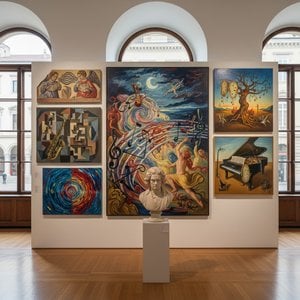
Harmonies on Canvas: Exploring the Visual Representation of Music in Art History
Explore the fascinating history of music's visual representation in art! From ancient symbolism to modern abstraction, discover how artists have captured sound and emotion on canvas. Expert insights & stunning examples.

The Enduring Legacy of Oil on Canvas: Technique, History & Aesthetic Impact
Explore the rich history & techniques of oil painting – from Renaissance masters to Impressionism. Discover pigments, layering methods, and why this timeless medium endures. Expert insights for artists & art enthusiasts.

Oil on Canvas: A Historical & Technical Exploration of a Timeless Artistic Medium
Explore the rich history & enduring techniques of oil painting on canvas. Discover the science behind its longevity, conservation practices, and contemporary relevance. Expert insights for art enthusiasts.

The Enduring Power of Painting: A Historical & Contemporary Exploration of Form and Emotion
Explore the rich history & enduring techniques of oil painting with ArtsDot. Discover masterpieces, learn about art collecting, and find authentic handmade reproductions crafted by skilled artists.


