


 Переглянути в інтер'єрі
 Надіслати
 Поділитися
 Деталі

 Завантажити
 Схожі експонати
 Рентгенівське дослідження
 Слайд-шоу
Extreme Unction
 Etching
- Rococo
 1755
1755- Early Modern
 57.0 x 44.0 cm
 Лос-Анджелесский музей округа Лос-Анджелеса
 Читати далі
Гікле / Художній принт
Музейна якість друку جيкле або на полотні з оперативним виготовленням та різноманітними варіантами фінішної обробки. ( Перейти до замовлення ручного розпису Перейти до зображення)




P118B $10

P118H $10

P118W $10

P438Z $10

P508JH $12

P508YH $12

P805H $10

P805Z $10

P919BZ $10

P919G $10

P919XJ $10

P959ZH $10

P968JZ $12

W106C $8

W218G $10

W218JH $8

W218Y $10

W307PJ $10

W316G $10

W316PJ $8

W316Y $10

W398PJ $8

W4111J $10

W500HY $15

W500JH $15

W692G $12

W849H $8

W940BG $15

W953PJ $8




Обирайте з наших стандартних розмірів, що відповідають оригінальним пропорціям твору мистецтва.

Ви можете вказати власні розміри, щоб репродукція ідеально підійшла до конкретної рами або інтер'єру. Якщо обраний вами розмір не відповідає пропорціям оригіналу, ми або обріжемо полотно, або розширимо зображення за допомогою дзеркального відображення чи суцільної заливки країв. Перед початком виробництва вам буде надіслано цифровий макет для затвердження.
Будь ласка, зверніть увагу, що попередній перегляд на екрані не відображає фактичне обрізання або розширення. Тільки макет точно покаже фінальну композицію.
Хоча можливість замовлення індивідуальних розмірів доступна, ми рекомендуємо обирати формат із попередньо визначеного списку, щоб зберегти оригінальні пропорції.
Доставка по всьому світу () за 2 тижні замість стандартних 4/5 тижнів. (8 Серпень)

Безкоштовна експрес-доставка по всьому світу

Високоякісне лляне полотно

Повне страхове покриття доставки

Гарантія відшкодування митних зборів

Гарантія точного відтворення кольорів

Політика повернення протягом 60 днів (лише у разі виявлення дефектів)

Гарантія повернення 100% коштів

Знижка на оптові замовлення
 Скляний варіант доступний лише для розмірів до 110 см

Extreme Unction
Гікле / Художній принт
Розмір репродукції
-


Загальна вартість
$ 62
Опис колекційного експоната
A Somber Glimpse into Venetian Devotion
In the quiet, shadowed corners of eighteenth-century Venice, life was often defined by its most profound transitions. Pietro Longhi’s 1755 etching, Extreme Unction, serves as a hauntingly beautiful window into these private moments of mortality and faith. Unlike the grand, sweeping canvases of his contemporaries that celebrated the triumphs of gods and heroes, Longhi turned his gaze toward the intimate, often heavy atmosphere of the Venetian domestic sphere. This particular work captures the solemnity of the Last Rites, a sacred ritual where a priest administers the final sacraments to the departing soul. Through the delicate medium of etching, Longhi masterfully orchestrates a scene that is as much about the presence of the divine as it is about the palpable weight of human grief.
The composition draws the viewer into a room thick with tension and reverence. At the heart of the narrative lies the bed, where the patient rests in a state of vulnerability, surrounded by the witnesses of their final journey. The priest, an elder figure draped in heavy, traditional robes, stands as the bridge between the earthly and the eternal. Longhi’s ability to render texture through fine, etched lines allows us to feel the weight of the liturgical garments and the stillness of the air. Scattered throughout the room are the humble artifacts of daily life—cups, bowls, and vases—which, in this context, take on a symbolic significance. These objects, mundane in any other setting, become silent participants in the ritual, grounding the spiritual event in the tangible reality of a Venetian household.
Mastery of Line and Emotional Resonance
Technically, this etching showcases Longhi’s profound command over light and shadow, a skill honed during his early training under Antonio Balestra. The monochromatic palette of the etching does not strip the scene of its depth; rather, it enhances the dramatic chiaroscuro effect, pulling focus to the central figures while allowing the periphery to recede into a mysterious, atmospheric gloom. The interplay of light hitting the surfaces of the ceramic bowls and the metallic glint of a cup creates a sense of three-dimensional space that invites the collector to step directly into the room. For the discerning eye, the precision of the linework reveals a master who understood that the smallest detail—the fold of a sleeve or the tilt of a head—could communicate the deepest complexities of human emotion.
For art lovers and interior designers alike, Extreme Unction offers more than just historical interest; it provides a profound emotional anchor for a curated space. The piece possesses a timeless, melancholic elegance that complements sophisticated, classical interiors. It is a work that demands contemplation, making it an ideal centerpiece for a study, a library, or a gallery wall dedicated to the mastery of printmaking. Owning a high-quality reproduction of this etching allows one to preserve the somber beauty of Longhi’s vision, bringing a sense of historical gravity and quiet, reflective grace into the modern home.
Схожі твори мистецтва


Біографія митця
A Venetian Chronicler of Daily Life
Pietro Longhi, born Pietro Falca in Venice on November 5th, 1701, wasn’t painting grand historical narratives or mythological scenes; he was capturing the quiet dramas unfolding within the city's elegant homes and bustling streets. He became renowned for his witty genre paintings – intimate glimpses into the lives of 18th-century Venetians, a departure from the prevailing artistic trends of his time. The son of Alessandro Falca, a silversmith, Longhi’s early training began under the Veronese painter Antonio Balestra, who recognized and nurtured the young artist's talent. This foundation in traditional technique would later serve as a subtle counterpoint to the innovative spirit he brought to his chosen subject matter. He adopted the surname “Longhi” upon beginning his artistic career, a symbolic shedding of his father’s trade for the pursuit of painting.From Religious Scenes to Venetian Interiors
Longhi's initial works reflected the expectations of the era: altarpieces and religious themes dominated his early portfolio. His 1732 altarpiece for the church of San Pellegrino demonstrates a skillful command of traditional techniques, showcasing broken brushwork and vibrant color glazes characteristic of Venetian painting. These masterful compositions hark back to the glories of Renaissance art, yet Longhi subtly infused them with a Venetian sensibility—a luminous palette and an attention to atmospheric perspective that distinguished him from many of his contemporaries. However, it was in the late 1730s that Longhi truly found his voice, shifting towards the small-scale genre scenes that would define his legacy. This transition wasn’t merely a change in subject matter; it represented a deliberate engagement with the burgeoning social and cultural shifts of the time. The 18th century witnessed a growing fascination with the private lives of the bourgeoisie, a focus on domesticity and everyday rituals. Longhi masterfully captured this shift, offering viewers a window into Venetian society that was both charming and subtly satirical. He married Caterina Maria Rizzi in 1732, and together they had eleven children, though only three survived to adulthood. This personal life, while not directly reflected in his art, undoubtedly shaped his understanding of the domestic sphere he so frequently depicted.The “Venetian Hogarth” and a Satirical Eye
Longhi quickly earned the moniker "the Venetian William Hogarth," a testament to his ability to infuse seemingly innocuous scenes with layers of social commentary. Like Hogarth, Longhi didn’t shy away from depicting human foibles and societal contradictions. However, while Hogarth's satire was often pointed and moralizing, Longhi’s tended to be more nuanced, imbued with a gentle irony. His paintings are populated with masked figures – a nod to the exuberant Carnival celebrations of Venice – engaged in various activities, from gambling and flirtation to clandestine meetings and dubious transactions. The Concert portrays a richly decorated salon scene where characters engage in polite conversation and subtle gestures of social maneuvering. Longhi’s meticulous attention to detail—the textures of fabrics, the expressions on faces—reveals his profound understanding of human psychology. He wasn't simply recording life as it was; he was offering a sly commentary on its complexities and contradictions. His ability to capture these subtleties is what sets him apart, elevating his genre scenes beyond mere documentation into insightful social observations.Technique, Influence, and Lasting Legacy
Longhi’s technique was as distinctive as his subject matter. He favored small canvases, meticulously rendered with a delicate touch and a keen eye for detail. His interiors are bathed in soft light, creating an atmosphere of intimacy and realism. He possessed a remarkable ability to depict textures – the sheen of silk, the roughness of wood, the delicate folds of fabric – adding depth and authenticity to his scenes. He drew inspiration from earlier Venetian masters like Giuseppe Maria Crespi, whose use of color and expressive brushwork foreshadowed Longhi’s own stylistic innovations. Yet, unlike Crespi, Longhi achieved a remarkable level of psychological realism, capturing not just appearances but also the unspoken emotions that underpinned human behavior. His work resonated with contemporary audiences, who appreciated his ability to capture the spirit of their time. He even served as Director of the Academy of Drawing and Carving from 1763, furthering Venetian artistic tradition. Longhi passed away on May 8th, 1785, leaving behind a body of work that continues to captivate and intrigue viewers today. He remains a vital figure in the history of Venetian art, celebrated for his unique blend of observation, wit, and technical skill – a true chronicler of 18th-century life. ## Notable Works- The Tailor (Gallerie dell'Accademia, Venice)
- The Baptism (Fondazione Querini Stampalia, Venice)
- Painter in his Studio (Ca’ Zenobio, Venice)
- Duck Hunters on the Lagoon

Пietro Longhi
1701 - 1785 , Італія
Досьє митця
- Artistic Movement Or Style: Венеціанське живописство, Рококо
- Artists Or Movements Influenced By This Artist: ['Вільям Хоґарт']
- Artists Who Influenced This Artist:
- Антоній Бальєста
- Джованні Маріо Креспо
- Date Of Birth: 5 листопада 1701
- Date Of Death: 8 травня 1785
- Full Name: Pietro Longhi
- Nationality: Італійський
- Notable Artworks:
- Португалець
- Хрещення
- Маляр у студії
- Place Of Birth: Венеція, Італія
Схожі статті

Pietro Longhi's Venetian Scenes: A Study of Rococo Society & Domestic Life
Explore the captivating world of Pietro Longhi's Venetian scenes! Discover insightful analysis of his Rococo masterpieces & social commentary on 18th-century life. Learn about this 'Venetian Hogarth' and his lasting artistic legacy.

Топ-10 легендарних офортів, що змінили мистецтво: від Рембрандта до Гойї | ArtsDot
Відкрийте для себе 10 легендарних офортів Рембрандта, Гойї та інших майстрів! Історія мистецтва в кожній гравюрі. Купуйте високоякісні репродукції офортів для вашого дому на ArtsDot.com.

Etching: A Historical Survey of Technique, Aesthetic Qualities & Enduring Artistic Significance
Explore the rich history of etching, from its origins to Rembrandt's masterful innovations. Discover the technique, aesthetic qualities & enduring legacy of this captivating art form. Expert insights for collectors and enthusiasts.

The Intricate World of Etching: A Historical Survey of Technique, Aesthetic Evolution, and Enduring Artistic Impact
Explore the rich history of etching, from its origins to modern practice. Discover techniques, key artists like Rembrandt, and insights for collectors. A comprehensive guide by ArtsDot.
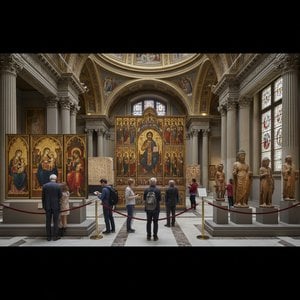
Sacred Narratives Embodied: A Comprehensive Exploration of Religious Iconography in Art History
Explore the rich history of religious iconography in art! Discover symbolism, movements & masterpieces from Byzantine to Renaissance periods. Expert insights for collectors and enthusiasts at ArtsDot.

