


 Переглянути в інтер'єрі
 Надіслати
 Поділитися
 Деталі
 Посібник

 Завантажити
 Схожі предмети колекціонування
 Рентгенівське дослідження
 Слайд-шоу
 Статистика переглядів
St Lucy Altarpiece
 Oil On Panel
- Renaissance
 1532
1532- Renaissance
 243.0 x 237.0 cm
 Читати далі
Гікле / Художній принт
Музейна якість друку جيкле або на полотні з оперативним виготовленням та різноманітними варіантами фінішної обробки. ( Купити картину ручної роботи Перейти до цифрових зображень)




P118B $10

P118H $10

P118W $10

P438Z $10

P508JH $12

P508YH $12

P805H $10

P805Z $10

P919BZ $10

P919G $10

P919XJ $10

P959ZH $10

P968JZ $12

W106C $8

W218G $10

W218JH $8

W218Y $10

W307PJ $10

W316G $10

W316PJ $8

W316Y $10

W398PJ $8

W4111J $10

W500HY $15

W500JH $15

W692G $12

W849H $8

W940BG $15

W953PJ $8




Обирайте з наших стандартних розмірів, що відповідають оригінальним пропорціям твору мистецтва.

Ви можете вказати власні розміри, щоб репродукція ідеально підійшла до конкретної рами або інтер'єру. Якщо обраний вами розмір не відповідає пропорціям оригіналу, ми або обріжемо полотно, або розширимо зображення за допомогою дзеркального відображення чи суцільної заливки країв. Перед початком виробництва вам буде надіслано цифровий макет для затвердження.
Будь ласка, зверніть увагу, що попередній перегляд на екрані не відображає фактичне обрізання або розширення. Тільки макет точно покаже фінальну композицію.
Хоча можливість замовлення індивідуальних розмірів доступна, ми рекомендуємо обирати формат із попередньо визначеного списку, щоб зберегти оригінальні пропорції.
Доставка по всьому світу () за 2 тижні замість стандартних 4/5 тижнів. (25 Вересень)

Безкоштовна експрес-доставка по всьому світу

Високоякісне лляне полотно

Повне страхове покриття доставки

Гарантія повернення митних зборів

Гарантія точного відтворення кольорів

Політика повернення протягом 100 днів (лише у разі виявлення дефектів)

Гарантія повернення 100% коштів

Знижка на оптові замовлення
 Скляний варіант доступний лише для розмірів до 110 см

St Lucy Altarpiece
Гікле / Художній принт
Розмір репродукції
-


Загальна вартість
$ 62
A Vision of Devotion: The St Lucy Altarpiece
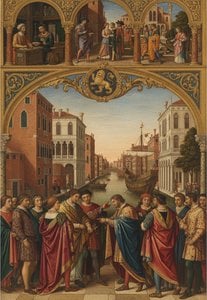
In the grand tapestry of the Italian Renaissance, few works capture the profound intersection of human emotion and divine presence as exquisitely as Lorenzo Lotto’s St Lucy Altarpiece. Painted in 1532, this masterpiece serves as a window into a world where the sacred and the terrestrial breathe the same air. The painting presents a breathtaking religious tableau, centered around the luminous figure of Saint Lucy. Dressed in a striking red gown that commands the viewer's attention, she stands upon a platform, her hands raised in a gesture that oscillates between a solemn blessing and a profound ritualistic invocation. This is not merely a static depiction of a saint; it is a living moment of spiritual communion, where the light of faith seems to radiate from within the very fabric of the composition.
The scene is populated by a group of figures, many adorned in matching crimson hues, creating a rhythmic visual harmony that suggests a shared liturgical purpose. This sea of red evokes both the passion of martyrdom and the warmth of a communal religious ceremony. As one gazes deeper into the work, subtle details emerge to enrich the narrative: two delicate birds flutter within the frame—one near the upper periphery and another toward the center—acting as silent witnesses to the unfolding sanctity. A solitary cup rests near the bottom right, perhaps hinting at the Eucharistic elements of the ceremony. Through these meticulous details, Lotto transforms a church setting into an immersive stage for the miraculous.
The Mastery of Lorenzo Lotto
To understand the soul of this altarpiece, one must understand the wandering spirit of its creator. Lorenzo Lotto was a true Venetian Wanderer, a painter whose career took him far beyond the familiar canals of Venice to the vibrant cultural hubs of Treviso, Rome, and Bergamo. Unlike the more predictable masters of his era, Lotto’s style is characterized by an extraordinary psychological depth and a nascent Mannerist sensibility. While he absorbed the foundational lessons of Giovanni Bellini, he refused to be bound by mere imitation. Instead, he developed a technique that favored emotive portraiture and a mystical approach to religious subject matter.
In the St Lucy Altarpiece, his technical prowess is evident in the way light interacts with texture and form. The heavy, rich drapery of the figures' garments possesses a tactile quality that invites the eye to linger, while the atmospheric depth creates a sense of infinite space within the sacred architecture. For collectors and interior designers alike, this painting offers more than just aesthetic beauty; it provides a profound sense of historical weight and intellectual complexity. The interplay of light and shadow—the chiaroscuro—lends a dramatic tension to the scene, making it an ideal centerpiece for spaces that demand both elegance and a contemplative atmosphere.
A Timeless Legacy for the Modern Collector
Owning or displaying a high-quality reproduction of such a significant work is an act of preserving history. The St Lucy Altarpiece transcends its 16th-century origins to offer a timeless emotional impact that resonates in any contemporary setting. Its vibrant palette of reds and golds, balanced by the soft, ethereal light characteristic of the Venetian school, allows it to integrate seamlessly into sophisticated interior designs, whether in a classical study or a modern gallery-style living room.
For those seeking to surround themselves with art that speaks to the human condition, this piece offers an unparalleled opportunity. It is a work that invites conversation, prompting reflections on devotion, community, and the enduring power of beauty. As a hand-painted reproduction, it captures the meticulous brushwork and the spiritual intensity of Lotto’s original vision, allowing the grandeur of the High Renaissance to become a permanent part of your personal sanctuary.
Схожі твори мистецтва


Біографія митця
A Venetian Wanderer: The Life and Art of Lorenzo Lotto
Born in the vibrant heart of Venice around 1480, Lorenzo Lotto emerged as a distinctive voice within the Italian Renaissance, though his artistic journey would lead him far beyond the lagoon city’s celebrated studios. Unlike many of his contemporaries who firmly established themselves within specific schools or courts, Lotto embarked on a peripatetic career, traversing cities like Treviso, Rome, Bergamo, and Ancona before ultimately finding solace as a lay brother in Loreto. This itinerant existence profoundly shaped his artistic vision, exposing him to diverse influences while fostering an independent spirit that set him apart. While early training remains somewhat shrouded in mystery, it’s believed he absorbed the lessons of Giovanni Bellini, a leading figure of the Venetian school, yet Lotto quickly transcended simple imitation, forging a style uniquely his own—a blend of High Renaissance grace and nascent Mannerist sensibilities.Blending Traditions: Style and Influences
Lotto’s artistic signature lies in his remarkable ability to synthesize diverse influences into a cohesive and deeply personal aesthetic. His early works reveal the impact of Giorgione's poetic naturalism, particularly evident in the subtle atmospheric effects and lyrical compositions. The Venetian light, so prized by these masters, permeates many of Lotto’s earlier paintings, creating an ethereal quality that sets them apart from more rigid depictions. However, a sojourn in Rome brought him into contact with the art of Raphael, imbuing his work with a newfound clarity of form and compositional balance. He studied the precise lines and balanced arrangements of Raphael's frescoes in the Vatican, adopting a greater sense of order and perspective. Later, during his extended stay in Bergamo, he absorbed elements of Lombard realism, adding a grounded physicality to his figures—a shift away from the purely idealized forms often found in Venetian painting. This eclectic approach is not merely additive; Lotto masterfully integrated these influences, creating paintings that are both technically refined and emotionally resonant. He wasn’t afraid to experiment with perspective, often employing unusual vantage points to heighten the sense of drama or intimacy. His palette, while rooted in Venetian colorism—the rich reds, blues, and greens characteristic of the region—evolved over time, becoming increasingly vibrant and expressive, reflecting his growing mastery of light and shadow.Portraits of the Soul: Lotto’s Masterpieces
While Lotto excelled in religious painting, it is perhaps through his portraits that he truly distinguished himself. He possessed an extraordinary gift for capturing not just the physical likeness but also the inner life of his sitters. His portraits are rarely idealized; instead, they present individuals with all their complexities and vulnerabilities. Man with a Golden Paw, painted in 1527, is a prime example—a captivating study of a gentleman holding a small golden statuette, its symbolism open to interpretation but undeniably intriguing. The sitter’s gaze is direct and engaging, conveying a sense of intelligence and quiet contemplation. The details – the folds of his clothing, the subtle expression on his face – are rendered with remarkable precision, revealing Lotto's keen observational skills. Similarly, Portrait of a 37-year-old Man, showcases Lotto’s ability to convey personality through subtle details—the man’s clothing, his posture, the expression in his eyes all contribute to a compelling psychological portrait. These are not merely representations of individuals; they are windows into their souls. He seemed less interested in presenting an image of perfection and more focused on capturing the essence of his subjects – their character, their thoughts, their emotions.Religious Visions: Altarpieces and Mysticism
Lotto’s religious paintings are equally compelling, often imbued with a profound sense of spirituality and mystery. His altarpieces, particularly those he painted in Bergamo—the *Entombment* at Jesi and the *Transfiguration* at Recanati—are considered masterpieces of the Italian Renaissance. These works demonstrate his mastery of composition, color, and light, creating scenes that are both dramatic and deeply moving. The *Entombment*, for example, is a powerful depiction of grief and sacrifice, with the figures rendered in rich, luminous colors and arranged in a dynamic, almost theatrical manner. The *Transfiguration* showcases Lotto’s ability to convey divine presence—the radiant light emanating from Christ's face and the serene expressions on the faces of the apostles create an atmosphere of awe and reverence. Many scholars believe that Lotto’s religious paintings were informed by his own spiritual experiences, reflecting a deep sense of faith and devotion.A Rediscovered Legacy: Historical Significance
Despite achieving considerable recognition during his lifetime, Lotto's reputation waned after his death in 1556 or 1557. His works, often dispersed throughout provincial churches and private collections, were largely overlooked for centuries. It wasn’t until the late 19th century, with Bernard Berenson’s groundbreaking scholarship, that Lotto experienced a significant revival of interest. Berenson's writings highlighted the originality and complexity of Lotto’s style, challenging conventional interpretations of Venetian painting. Today, he is recognized as one of the most original and compelling artists of the Italian Renaissance. His unique blend of stylistic influences, his psychological depth, and his technical mastery continue to captivate audiences and inspire art historians. He stands as a testament to the power of artistic independence—a wanderer who forged his own path and left an indelible mark on the world of art. The rediscovery of Lotto’s oeuvre has enriched our understanding of the Renaissance, revealing a complex and multifaceted artist whose work deserves continued exploration and appreciation.
Лоренцо Лотто
1480 - 1556 , Італія
Довідкова інформація
- Artistic Movement Or Style: Ренесанс, Маньєризм
- Artists Or Movements Influenced By This Artist: ['Тіціан']
- Artists Who Influenced This Artist:
- Джіввані Белліні
- Джоргаьоне
- Рафаель
- Date Of Birth: c. 1480
- Date Of Death: 1556/57
- Full Name: Lorenzo Lotto
- Nationality: Італійський
- Notable Artworks:
- Мадонна з Святим Петром
- Святий Єронім у пустелі
- Розmazione
- Чоловік із золотим хустинцем
- Place Of Birth: Венеція, Італія
Схожі статті

Lorenzo Lotto: Unveiling the Enigma of a Venetian Master's Portraits
Explore the captivating world of Lorenzo Lotto, a Venetian Renaissance master renowned for his psychologically insightful portraits & enigmatic symbolism. Discover his life, style, and rediscovered legacy with ArtsDot.
Vittore Carpaccio: Venetian Renaissance Narrative & the Poetics of Detail
Explore the captivating world of Vittore Carpaccio, a master storyteller of the Venetian Renaissance. Discover his intricate details, narrative cycles like 'The Legend of St. Ursula,' and unique artistic style.

Якопо Тінторетто: 25 шедеврів венесенського майстра | ArtsDot
Відкрийте 25 захопливих шедеврів Якопо Тінторетто! Венесенський ренесанс, бароко, емоційні композиції та світлотінь. Купуйте високоякісні репродукції картин на ArtsDot.com – мистецтво для вашого дому.

Топ-25 шедеврів Ель Греко: ікона живопису для вашого інтер'єру | ArtsDot
Відкрийте для себе 25 найзнаковіших шедеврів Ель Греко! Пориньте в світ іспанського живопису, манералізму та духовного мистецтва. Розкішні репродукції картин на ArtsDot.com – для вашого вишуканого інтер'єру. Дослідіть повну колекцію онлайн!

Jacopo Palma il Giovane: A Venetian Master's Poetic Evolution
Explore the captivating world of Jacopo Palma il Giovane, a pivotal Venetian Renaissance master. Discover his unique style, influenced by Titian & Tintoretto, and learn about key works perfect for discerning collectors.


