

 Переглянути в інтер'єрі
 Надіслати як листівку
 Поділитися
 Деталі витвору
 Посібник

 Завантажити
 Схожі екземпляри
 Рентгенівське дослідження
 Слайд-шоу
 Питання та відповіді
 Статистика
Pol

- 55.0 x 76.0 cm


 Розгорнути текст
Отримайте файл, готовий до друку, якість якого значно перевищує якість веб-попереднього перегляду. Кожне цифрове зображення, яке ми продаємо, створене на основі високої роздільної здатності з нашої бази даних — зазвичай від 5 000 до 15 000 пікселів по ширині — тому ви можете впевнено друкувати у великому форматі, робити щільну обрізку або відтворювати найдрібніші деталі.
Жоден файл не залишається в нашій студії без уваги. Експерт із цифрової обробки звіряє кольори з оригінальною картиною та за потреби коригує їх, після чого покращує чіткість і деталізацію за допомогою професійних інструментів ретушування — завжди зберігаючи вірність мазкам пензля та стилю художника. Результатом є зображення, яке виглядає як справжня картина, а не як відскановане фото з накладеними фільтрами.
Ви затверджуєте результат перед завершенням замовлення: протягом 72 годин наш експерт надішле зображення електронною поштою для вашого перегляду. Не задоволені результатом? Ви можете попросити про внесення змін чи виправлень або отримати відшкодування, якщо якість не відповідає вашим очікуванням.
Саме на таку якість покладаються видавництва, дизайн-студії, галереї та друкарні.
Цифрове зображення
Завантажте файл високої роздільної здатності для особистого використання, друку та творчих проєктів. ( Перейти до друку Замовити картину ручної роботи)
Переваги кожного замовлення цифрових зображень
Експертна цифрова доставка з гарантією якості
Обираючи ArtsDot.com, ви отримуєте не просто зображення — ви отримуєте професійно вдосконалений цифровий витвір мистецтва, створений з надзвичайною точністю та підкріплений гарантією задоволення. Ось усе, що автоматично додається до вашого замовлення:

Швидка доставка на email
Ваш цифровий файл із зображенням високої роздільної здатності буде надісланий вам електронною поштою протягом 72 годин після оформлення замовлення — він буде готовий до негайного використання.

Цифровий файл із покращенням ШІ
Ваш витвір мистецтва професійно оптимізовано за допомогою передових інструментів штучного інтелекту та ручної корекції, що забезпечує максимальну деталізацію, чіткість і точність передачі кольорів.

Безкоштовне повторне завантаження назавжди
Випадково видалили або втратили файл? Не хвилюйтеся — ми надішлемо його вам повторно в будь-який час безкоштовно.

Без митних зборів — завжди
Насолоджуйтесь вашим витвором мистецтва миттєво без жодних мит, зборів або плати за доставку — цифрові завантаження завжди не оподатковуються.

Гарантія точності кольорів
Ми гарантуємо максимально точне відтворення оригінальних кольорів на вашому цифровому зображенні завдяки використанню професійних інструментів та систем управління кольором.

100-денна гарантія задоволення
Якщо ви не задоволені придбаним цифровим зображенням, ми внесемо правки або повернемо 100% вартості протягом 100 днів — без зайвих запитань.

Гарантія повернення 100% коштів
Незадоволені покупкою? Отримайте повне повернення коштів протягом 100 днів після отримання цифрового файлу — без зайвих запитань.

Знижки на оптові замовлення
Купуйте 3 зображення — заощаджуйте 10% — Купуйте 5 — заощаджуйте 15% — Купуйте 10+ — заощаджуйте 20%. Чудово підходить для творчих проєктів, галерей та агентств.
A Dance of Form and Fluidity
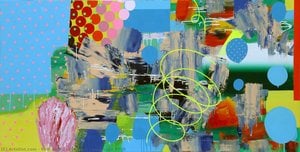
In the mesmerizing realm of Janaina Tschäpe’s "Pol," viewers are invited into a dreamscape where the boundaries between the organic and the abstract dissolve into a rhythmic dance of color. Created in 2012, this piece serves as a profound exploration of movement and metamorphosis, characteristic of Tschäpe’s unique ability to blend aquatic imagery with botanical whispers. The composition is anchored by a striking blue and yellow color scheme, a duality that evokes both the deep, tranquil mysteries of an underwater world and the vibrant, sun-drenched energy of life in bloom. At its heart lies a central, commanding circle, surrounded by a constellation of smaller celestial or cellular forms that seem to drift across the canvas like organisms suspended in a liquid medium.
The painting’s visual language is one of delightful surprise and whimsical complexity. Amidst the swirling geometric shapes and circular motifs, the unexpected presence of two bananas—one nestled near the top left and another drifting toward the bottom right—injects a playful, surrealist element into the work. These organic fragments act as anchors of reality within an otherwise ethereal abstraction, challenging the viewer to find meaning in the intersection of the mundane and the magnificent. This juxtaposition is a hallmark of Tschä-pe’s practice, where she utilizes gestural movement to replicate the mutation and flux found in nature's most hidden corners.
Technique and the Essence of Nature
Tschäpe’s technique in "Pol" reflects her deep-seated fascination with the relationship between the human body and the material world. The application of color suggests a liquid appearance, where edges are not rigid but rather fluid, mimicking the contours of minerals, plants, or even the undulating movement of sea creatures. This sense of "shaping fluid" allows the artwork to breathe, creating an atmosphere that feels less like a static image and more like a captured moment of biological transformation. The interplay between the bold yellows and the deep, immersive blues creates a visual tension that is both soothing and stimulating, making it a centerpiece capable of commanding attention in any sophisticated interior.
For the discerning collector or interior designer, this piece offers much more than mere decoration; it provides an emotional gateway. The artwork resonates with themes of harmony, growth, and the cyclical nature of life. Whether placed in a contemporary gallery setting or used to add a layer of intellectual depth to a residential living space, "Pol" acts as a window into a world of endless possibility. It is a work that rewards prolonged contemplation, inviting one to lose themselves in its circular rhythms and discover the quiet beauty of the abstract metamorphosis occurring right before their eyes.
Питання та відповіді
Який настрій та емоцію передає «Pol» роботи Janaina Tschäpe?
«Pol» роботи Janaina Tschäpe передає Playful відчуття в межах загального Playful настрою.
Яка насиченість кольорів у творі «Pol» роботи Janaina Tschäpe?
«Pol» роботи Janaina Tschäpe вирізняється Balanced насиченістю кольорів.
Які розміри оригіналу "Pol"?
«Pol» має розмір 55 x 76 cm в оригіналі. Оригінальні розміри є корисним орієнтиром під час вибору розміру репродукції.
Схожі твори мистецтва




Біографія митця
A Universe of Metamorphosis
Janaina Tschäpe exists within a realm where the boundaries between the organic and the abstract dissolve into a rhythmic dance of color and form. Born in Munich, Germany, and raised in São Paulo, Brazil, her identity as a Brazilian/German artist informs a practice that is profoundly interdisciplinary. Her work does not merely sit upon a surface; it breathes, shifting between representation, fantasy, and abstraction to create what can be described as a holistic cosmology. Through painting, drawing, photography, video, and sculpture, Tschäpe invites viewers into dreamscapes where the distinction between the human body, botanical whispers, and aquatic mysteries becomes beautifully blurred.
Her artistic journey is marked by a deep fascination with the concept of metamorphosis. In her early photographic and video works, such as One Hundred Little Deaths, she explored themes of mortality and transformation, often staging herself or models as nebulous, mysterious beings. These creatures, adorned with appendages made from fabric, water-filled latex, or inflatables, inhabit landscapes that serve as narrative sources where the whimsical and the actual coexist. This exploration of the body—often reflecting a feminist resistance to the policing of the female form—allows her to excavate the nature of landscape and the complex interactions between humanity and the natural world.
Technique and the Fluidity of Nature
The visual language of Tschäpe is one of delightful surprise and whimsical complexity. In her paintings, particularly her vibrant watercolors, she captures the transformative properties of water through a meticulous application of media including watercolor, casein, colored pencil, and pastel. Her canvases often possess a liquid appearance, where edges are not rigid but fluid, mimicking the undulating movement of sea creatures or the contours of minerals. This sense of shaping fluid allows her work to evoke both the deep, tranquil mysteries of an underwater world and the sun-drenched energy of life in bloom.
There is a dynamic tension inherent in her compositions: a struggle between loose, luscious forms that pervade the canvas and precise systems of markings that overlay and unify the piece. This technique creates a sensation of movement, where biomorphic shapes function as emotive signifiers of her interior thoughts. Whether she is utilizing saturated colors to suggest growth or incorporating unexpected elements—like the surrealist presence of fruit within an abstract field—her work remains anchored in the exploration of how life transitions and mutates.
Legacy and Global Presence
Since moving to New York in 1997, Tschäpe has established a significant presence in the international art world. Her multidisciplinary oeuvre is not merely a collection of individual pieces but a gesamtkunstwerk—a total work of art—where each creation plays a supporting role in a grand evolutionary opera. Her ability to collapse scale, making the grand cosmos feel as intimate as the infinitesimal cellular level, has earned her recognition in some of the most prestigious institutions globally.
Her profound contributions to contemporary art are reflected in the permanent collections of numerous world-renowned museums, including:
- Centre Pompidou, Paris, France
- Solomon R. Guggenheim Museum, New York
- National Gallery of Art, Washington, D.C.
- Museo Nacional Centro de Arte Reina Sofía, Madrid, Spain
- Harvard Art Museum, Cambridge, Massachusetts
- Moderna Museet, Stockholm, Sweden
- Thyssen-Bornemisza Art Contemporary, Vienna, Austria

Janaina Tschäpe
1973 -