


The picture follows your choices: , .
Опис експоната
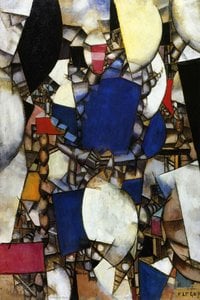
This dynamic Cubist study by Fernand Léger captures a woman in repose, embodying the spirit of the machine age with bold geometric forms and an evocative depiction of pregnancy—a powerful exploration of form and emotion from 1921.
 Розгорнути текст
Біографія митця
Фернан Леже (1881-1955) – французький художник, піонер кубізму та "Тюбізму". Його картини відображають сучасність, механіку та людську фігуру – передісторія поп-арту!
Олійная репродукція ручної роботи
Написана вручну олією на полотні у вашому розмірі та рамі, виготовлена на замовлення нашими художниками. ( Перейти до друку Перейти до цифрових зображень)
More about this painting
 Переглянути в інтер'єрі
 Надіслати як листівку
 Поділитися
 Деталі витвору
 Посібник

 Завантажити
 Схожі екземпляри
 Рентгенівське дослідження
 Слайд-шоу
 Q&A
Q&A Статистика
Order your painting in four simple steps
Take your time. You can change any answer; the price in your order card follows each choice.
1 Step one of four
Which size would you like?
These sizes keep the proportions of the original painting. The drawing shows your choice on a wall, above a two-metre sofa.
Or give your own measurements
Обирайте з наших стандартних розмірів, що відповідають оригінальним пропорціям твору мистецтва.

Введіть необхідну ширину та висоту, щоб картина підійшла до вашої рами або стіни. Оскільки це ручний розпис, для зміни пропорцій художник може дописати трохи більше по краях або дещо обрізати композицію — вибір за вами. Перед початком роботи ми надішлемо вам цифровий макет для затвердження. Зображення, показане на цій сторінці, не є реальним результатом — лише макет відображає майбутній вигляд.
2 Step two of four
How should it be prepared: rolled, stretched or framed?
The prices below are for the size you chose in step one.
Choose the edges of the stretched canvas
Choose your frame

White ₴1

Blurside ₴1

Extended ₴1

P118B ₴10

P118H ₴10

P118W ₴10

P438Z ₴10

P508JH ₴12

P508YH ₴12

P805H ₴10

P805Z ₴10

P919BZ ₴10

P919G ₴10

P919XJ ₴10

P959ZH ₴10

P968JZ ₴12

W106C ₴8

W218G ₴10

W218JH ₴8

W218Y ₴10

W307PJ ₴10

W316G ₴10

W316PJ ₴8

W316Y ₴10

W398PJ ₴8

W4111J ₴10

W500HY ₴15

W500JH ₴15

W692G ₴12

W849H ₴8

W940BG ₴15

W953PJ ₴8

H24-GOLD ₴30

H24-SILVER ₴30

H36-GOLD ₴45

H36-SILVER ₴45
У рамі
Moulding: . Overall size with the frame: .
3 Step three of four
Would you like anything changed in the painting?
Most people answer no. Because each painting is made by hand, our artist can also adapt it for you.
After order, ArtsDot.com team will email client for instructions and provide a mockup preview
4 Step four of four
A few finishing options
All of them are optional. The answers already selected cost nothing extra.
Who paints it?
Доставка по всьому світу () за 3–4 тижні замість стандартних 5 тижнів. (2 Листопад). Без жодних компромісів у якості.
A nameplate, as in a museum?
Деталі гравірування на бронзовій табличці
This elegant plaque features the artist's name and the title of the artwork, finely engraved for a timeless presentation.
It is made from bronze with a refined, elegant finish. The text is precisely laser-engraved for a sharp and permanent result. Measuring 9x2 cm, the plaque is compact yet easy to read. It's built to be durable and scratch-resistant, offering a professional, museum-quality look. Mounting is simple thanks to the included adhesive backing.
Деталі прозорої акрилової таблички
The plaque includes essential engraved details such as the artist's name, the title of the artwork, the date it was created, the type of media used-like oil on canvas or watercolor-a brief description of the piece, and a QR code that links to the complete artwork information.
It is crafted from clear acrylic, offering a sleek, modern appearance. The text is UV-engraved in black to ensure strong visual contrast. With a size of 10x15 cm, it ensures optimal readability. It comes equipped with two metal hooks for secure wall mounting. The plaque is designed to be weather-resistant, making it suitable for various environments, and it includes interactive features that work seamlessly with smartphone scanning.
Деталі чорної акрилової таблички
This elegant plaque includes engraved information such as the artist's name, the title of the artwork, the date it was created, the type of media used (like oil on canvas or watercolor), a short description of the artwork, and a QR code for quick access to more information.
The plaque itself is made from refined black acrylic with a premium finish. The text is laser-engraved in white for high contrast and readability. Its size is 10x15 cm, designed to be easy to read. It comes with two metal hooks for professional mounting. The design is sleek and fits any interior style. It is also weather-resistant and durable, with built-in digital integration for mobile compatibility.
A protective varnish?
When do you need it?
✓ Check and order
Your painting, as you ordered it

Study for breakfast
Матеріал репродукції
Розмір репродукції
-

Видатний майстер-художник
Більше деталізації, витонченості та додаткового часу на створення твору
-

Рама для репродукції
-
-
Для творів мистецтва або репродукцій, розмір яких перевищує 105 см (приблизно 41 дюйм) з будь-якого боку, рама доставляється у вигляді розібраного комплекту. Такий метод гарантує безпечну доставку та запобігає пошкодженням під час транспортування.
Потребує професійного збирання — це не продукт для самостійного виготовлення (DIY).
Комплект має бути зібраний, а полотно натягнуте досвідченим майстром багетних робіт із використанням клейового дерева (не входить у комплект), щипців для натягування полотна та затискачів, щоб підрамник залишався рівним під час висихання клею. Неправильне збирання або нерівномірне натягування полотна може призвести до незворотного пошкодження твору мистецтва, що не підпадає під дію нашої гарантії.
 Для творів мистецтва або репродукцій, розмір яких перевищує 105 см (приблизно 41 дюйм) з будь-якого боку, рама доставляється у вигляді розібраного комплекту. Такий метод гарантує безпечну доставку та запобігає пошкодженням під час транспортування.
У комплект входять усі бруски з цільного дерева, точно вирізані за розміром.
Збирається за допомогою гвинтів, що входять до комплекту, а також клейового розчину для кутових з'єднань, який не входить до комплекту і має бути підготовлений вашим майстром.
Потрібні професійні інструменти, які не входять до комплекту: щипці для натягування полотна (натягувач) та затискачі, щоб утримувати рейки рівно під час висихання клею.
Важливо:
Для з'єднання кутів потрібен клей для дерева, перекладини необхідно затиснути струбцинами до повного висихання клею, а для натягування полотна на зібрану раму знадобляться щипці для натягування полотна. Жоден із цих інструментів не входить до комплекту. Будь ласка, проконсультуйтеся з досвідченим майстром багетного оформлення перед замовленням рами такого розміру.

Етикетка експоната
-
-

Захисний лак
Глянцевий лак (підсилює яскравість кольорів, захищає від світла та вологи)
-

Персоналізувати мій витвір
Приклади можливих змін: заміна обличчя на фото клієнта; додавання домашньої тварини (наприклад, заміна кота на собаку); додавання прихованого повідомлення на фоні; зміна пейзажу або елементів фону.
-

Прискорено
Доставка по всьому світу () за 3–4 тижні замість стандартних 5 тижнів. (2 Листопад). Без компромісів у якості.
-
Експрес-доставка
Доставка по всьому світу () протягом 5 тижнів. (9 Листопад).
Включено в ціну
Підсумкова вартість
₴ 11823
Скляний варіант доступний лише для розмірів до 110 см
Included with every order
- Безкоштовна експрес-доставка по всьому світу
- Високоякісне лляне полотно
- Повне страхове покриття доставки
- Гарантія повернення митних зборів
- Гарантія точного відтворення кольорів
- Політика повернення протягом 100 днів (лише у разі виявлення дефектів)
- Гарантія повернення 100% коштів
- Пропозиція на оптові замовлення


A Mechanical Dance of Form: The Essence of Study for Breakfast
In the vibrant landscape of early twentieth-century modernism, few works capture the rhythmic pulse of a changing world as evocatively as Fernand Léger’s "Study for Breakfast." Painted in 1921, this masterpiece serves as a profound manifesto of the burgeoning Cubist spirit, moving far beyond a simple depiction of a morning meal. Instead, it presents a masterful distillation of life into geometric shapes that seem to pulsate with an internal, mechanical energy. The artwork invites the viewer into a space where the boundaries between the organic human form and the structured precision of the machine age begin to blur, creating a visual experience that is both intellectually stimulating and deeply rhythmic.
Léger’s approach in this study is characterized by a radical departure from traditional academic realism. Drawing heavily from the Cubist principles championed by his contemporaries Picasso and Braque, Léger dismantles illusionistic space to present a fragmented reality. The subject—a figure captured in a moment of repose—is dissected into angular planes and bold, cylindrical forms. This technique, often referred to as "tubism," allows the artist to portray objects from multiple viewpoints simultaneously, challenging our preconceived notions of perspective. Through the use of stark lines and contrasting textures, the painting creates a visual tapestry that speaks to the underlying, structured essence of modern existence.
The Pulse of the Machine Age
To understand "Study for Breakfast," one must look toward the historical tremors of the post-World War I era. This was a period defined by rapid industrialization and a societal shift toward rationalism and urban dynamism. Léger, deeply influenced by the aesthetics of factories and the relentless movement of cityscapes, sought to translate this industrial vigor onto the canvas. The painting reflects an era grappling with upheaval, yet it finds beauty in the precision of the new age. There is a muscularity to the composition; every shape feels engineered, as if the figures themselves are part of a larger, beautifully orchestrated mechanical ballet.
For the discerning collector or interior designer, this piece offers more than mere decoration; it provides a focal point of profound intellectual depth. The monochromatic nuances and the deliberate simplification of form allow the artwork to integrate seamlessly into sophisticated modern interiors, where its bold geometry can act as a conversation starter. It embodies a sense of strength and stability through its structured composition, while its dynamic energy prevents it from feeling static. Owning a high-quality reproduction of this work means bringing a piece of art history into the home—a piece that celebrates the resilience and the vibrant, rhythmic heartbeat of the modern world.
Питання та відповіді
Чи можу я переглянути «Study for breakfast» роботи Леже перед замовленням?
Щоб переглянути репродукцію «Study for breakfast» роботи Леже, відкрийте сторінку попереднього перегляду Перегляд у інтер'єрі цього твору.
Яка яскравість у «Study for breakfast» роботи Леже?
«Study for breakfast» роботи Леже має рівень яскравості Bright Balance. Яскравість описує, скільки світла відбивають кольори.
Яке розміщення найкраще підходить для формату «Study for breakfast» роботи Леже?
Формат Portrait для твору «Study for breakfast» роботи Леже рекомендовано розміщувати у Living Room. Поєднання формату та простору допоможе вам ідеально підібрати місце для репродукції.
Схожі твори мистецтва




Леже
1881 - 1955, Франція
Біографія митця
A Life Forged in Form: The World of Fernand Léger
Fernand Léger, born Joseph Fernand Henri Léger in 1881 amidst the rural landscapes of Argentan, Normandy, stands as a pivotal figure in the evolution of modern art. His journey from the farmlands of his youth to the forefront of Parisian avant-garde circles is a testament to an unwavering artistic vision and a relentless pursuit of capturing the spirit of the machine age. Unlike many of his contemporaries who embraced abstraction as a retreat from representation, Léger sought to *integrate* modernity – its dynamism, its mechanical forms, its very essence – into a new visual language that was both powerfully abstract and deeply rooted in the observable world. His early life, steeped in the physicality of agricultural labor, provided a grounding contrast to the industrialized future he would so passionately depict. Initially destined for architecture, Léger’s path shifted towards painting after arriving in Paris around 1900, supporting himself through drafting work while honing his artistic skills. This period was marked by traditional academic training, but it wasn't until encountering the groundbreaking work of Paul Cézanne that a true transformation began to unfold.The Birth of ‘Tubism’ and the Section d’Or
Cézanne’s retrospective in 1907 acted as a catalyst, liberating Léger from conventional representation and propelling him towards a more geometric and structural approach. He began dismantling forms, analyzing their underlying structures, and rebuilding them on canvas with a newfound emphasis on solidity and volume. This exploration quickly led him into the orbit of Cubism, but Léger wasn’t content to simply replicate the styles of Picasso or Braque. Instead, he developed his own distinct idiom – a personal form of Cubism that critics playfully dubbed “Tubism.” Characterized by cylindrical forms, flattened planes, and bold color contrasts, Tubism celebrated the machine aesthetic long before it became a widespread artistic preoccupation. It was an art born from observing the burgeoning industrial world, recognizing beauty in its functional shapes and mechanical rhythms. Léger’s approach differed significantly; he retained a sense of volume and depth that many Cubists had sacrificed for pure abstraction. This wasn't merely about breaking down forms but about reconstructing them with a deliberate emphasis on their essential qualities. The movement was closely linked to the *Section d’Or* (The Golden Section), a group of artists who explored mathematical principles of harmony and proportion, seeking to infuse their art with a sense of order and rationality. Léger actively participated in this circle, alongside figures like Jean Metzinger and Marcel Duchamp, pushing the boundaries of artistic expression through experimentation with geometry and perspective. The *Section d’Or* aimed for a synthesis between art and science, believing that beauty could be found in the application of mathematical ratios to visual form.War, Mechanization, and a New Aesthetic
The outbreak of World War I profoundly impacted Léger’s life and work. Serving at the front from 1914 to 1916 exposed him to the brutal realities of modern warfare – artillery barrages, aerial combat, and the dehumanizing effects of mechanized conflict. This experience didn't lead to disillusionment or a rejection of modernity; rather, it solidified his fascination with machines and their power. Sketches made during his service documented the stark beauty of military technology, transforming instruments of destruction into subjects of artistic contemplation. The repetitive patterns of trenches, the gleaming metal of tanks, and the angular forms of aircraft became sources of inspiration for Léger’s evolving style. Upon returning to civilian life, Léger’s aesthetic underwent a further evolution. His paintings began to reflect a more streamlined, mechanistic sensibility, celebrating the dynamism and efficiency of the industrial world. *Soldier with a Pipe* (1916) exemplifies this shift, showcasing simplified forms and bold colors that evoke the feeling of mechanical precision. This wasn't merely an aesthetic choice; it was a philosophical statement – an affirmation of modernity’s potential for progress and renewal, even in the wake of devastating conflict. He began to incorporate elements of Futurism into his work, embracing speed, movement, and the energy of the machine age.The Development of Style and Major Works
Léger's style continued to evolve throughout the 1920s and beyond. He experimented with various techniques, including collage and sculpture, exploring new ways to represent form and space. His *Paysages animés* (Animated Landscapes) series from 1921 showcased figures and animals seamlessly integrated into streamlined compositions, blurring the boundaries between organic and inorganic forms. These works demonstrated his ability to synthesize disparate elements – human and machine, natural and artificial – into a cohesive visual narrative. Other notable works include *The Great Parade* (1923), which captures the energy of a bustling city street with its bold colors and simplified figures, and *Nudes in the Forest* (1915), an early example of his distinctive style that combined elements of Cubism and Surrealism. Léger’s artistic output was remarkably prolific, encompassing paintings, sculptures, theater designs, and even experimental films. He sought to create a total work of art, integrating visual and spatial elements to evoke a specific atmosphere or mood.Legacy and Lasting Influence
In his post-war years, Léger continued to explore the intersection of art and industry, creating works that celebrated modern life with a unique blend of abstraction and figuration. His later works, characterized by a focus on the heroic aspects of the ordinary individual, reflect his belief in art’s potential for social responsibility and collective benefit. Léger's influence on subsequent generations of artists is undeniable. His bold simplification of form, his embrace of industrial imagery, and his celebration of popular culture anticipated the emergence of Pop Art decades later. Artists like Roy Lichtenstein and Andy Warhol owe a clear debt to Léger’s pioneering work. He bridged the gap between abstract art and figurative representation, demonstrating that it was possible to create works that were both intellectually rigorous and visually engaging. Today, Fernand Léger’s paintings are held in major museums worldwide, including the Musée d'Art et d’Histoire in France and the Musée National Fernand Léger, dedicated solely to his work. He remains a towering figure of 20th-century art – a visionary who dared to find beauty in the machine age and to translate its energy onto canvas with unparalleled boldness and originality. His legacy is not merely as a painter, but as a prophet of modernity. A true pioneer whose work continues to resonate with audiences today.


Пов'язані статті

Топ-25 шедеврів Василя Кандинського: подорож у світ абстрактного мистецтва | ArtsDot.com
Відкрийте для себе 25 найвідоміших шедеврів Василя Кандинського! Пориньте у світ абстрактного мистецтва, експресіонізму та кольорових композицій. Репродукції картин Кандинського преміум-якості на ArtsDot.com – для вашого інтер'єру з душею. Дослідіть повну колекцію онлайн!

Топ-10 шедеврів геометричної абстракції: мистецтво для вашого інтер'єру від ArtsDot.com
Відкрийте для себе 10 шедеврів геометричної абстракції від Кандинського, Малевича та Мондріана! Історія мистецтва, кольори та форми. Репродукції картин преміум-класу на ArtsDot.com – ідеальний декор для вашого дому.

Топ-25 шедеврів Фернана Леже: мистецтво машинного віку для вашого дому | ArtsDot
Відкрийте для себе 25 шедеврів Фернана Леже – піонера кубізму та тубізму! Історія мистецтва, кольори та форми машинного віку. Репродукції картин високої якості від ArtsDot.com. Дослідіть повну колекцію онлайн!