


 Переглянути в інтер'єрі
 Надіслати як листівку
 Поділитися
 Детальніше

 Завантажити
 Схожі експонати
 Рентгенівське дослідження
 Слайд-шоу
Stung


 Читати далі
Олійная репродукція ручної роботи
Написана вручну олією на полотні у вашому розмірі та рамі, виготовлена на замовлення нашими художниками. ( Замовити принт Купити цифрове зображення)




































Обирайте з наших стандартних розмірів, що відповідають оригінальним пропорціям твору мистецтва.

Ви можете вказати власні розміри, щоб репродукція ідеально підійшла до конкретної рами або інтер'єру. Якщо вибраний вами розмір не відповідає пропорціям оригіналу, ми або обріжемо полотно, або доповнимо картину додатковими елементами, промальованими вручну. Цифровий макет буде надіслано вам на затвердження перед початком виробництва.
Зверніть увагу, що попередній перегляд на екрані не відображає фактичне обрізання або розширення зображення. Тільки макет точно покаже остаточну композицію.
Хоча ми можемо виготовити виріб у нестандартному розмірі, для збереження оригінальних пропорцій рекомендуємо обирати варіанти зі встановленого списку.
Після оформлення замовлення команда ArtsDot.com зв'яжеться з клієнтом електронною поштою для отримання інструкцій та надасть попередній макет
Доставка по всьому світу () за 3–4 тижні замість стандартних 5 тижнів. (15 Серпень). Без жодних компромісів у якості.

Безкоштовна експрес-доставка по всьому світу

Високоякісне лляне полотно

Повне страхове покриття доставки

Гарантія відшкодування митних зборів

Гарантія точного відтворення кольорів

Політика повернення протягом 60 днів (лише у разі виявлення дефектів)

Гарантія повернення 100% коштів

Пропозиція на оптові замовлення
 Скляний варіант доступний лише для розмірів до 110 см

Stung
Матеріал репродукції
Розмір репродукції
-


Підсумкова вартість
$ 263
Схожі твори мистецтва


Біографія митця
The Architect of the Natural World
Carl Ethan Akeley (1864–1926) was far more than a mere craftsman; he was a visionary who bridged the profound gap between scientific precision and artistic soul. Born in the quiet landscape of Clarendon, New York, to Daniel Webster Akelely and Julia Glidden, his early years were steeped in the rhythms of a family farm. This intimate connection to the earth provided the foundational vocabulary for a life dedicated to capturing the essence of living things. Though his formal education was brief, his curiosity acted as an inexhaustible engine, driving him toward a self-directed mastery of anatomy, photography, and sculpture that would eventually redefine how humanity perceives the wild.
His journey into the heart of natural science began with a transformative apprenticeship under David Bruce at Ward’s Natural Science Establishment. It was here, amidst the meticulous preparation of specimens, that Akeley learned to see beyond the surface. He did not merely study the exterior of an animal; he sought to understand the underlying musculature and the very spirit of movement. This period of intense training was punctuated by a brush with global fame when he assisted in mounting P.T. Barnum’s legendary elephant, Jumbo. The sheer scale of such a task demanded a new level of technical innovation, pushing Akeley to develop methods that could preserve the grandeur of nature without losing its vitality.
A Revolution in Immersion and Form
As his career progressed, Akeley moved through the most prestigious scientific institutions of his era, leaving an indelible mark on the Milwaukee Public Museum, the Field Museum of Natural History, and the American Museum of Natural History. He was not content with the static, often lifeless displays that characterized the Victorian era. Instead, he pioneered the concept of the diorama—a revolutionary method of exhibition that placed specimens within meticulously crafted, immersive environments. By integrating realistic backgrounds, lighting, and carefully curated habitats, he transformed museum halls into windows onto distant worlds, allowing spectators to feel as though they were standing on the African savannah or in a dense woodland.
His artistic prowess extended well beyond taxidermy into the realm of fine sculpture. His bronze works, such as the evocative 'Stung' (1914), demonstrate a remarkable ability to capture tension and biological realism through metal. In these sculptures, one can sense the same anatomical rigor found in his museum displays, paired with an emotional depth that breathes life into the inanimate. This duality—the scientist’s eye for detail and the artist’s hand for expression—made him a singular figure in American art history. He was a man who could manipulate clay, bronze, and hide with equal grace to tell the story of life itself.
Legacy of a Naturalist Visionary
The historical significance of Carl Akeley cannot be overstated. As the founder of the AMNH Exhibitions Lab, he established a standard for interdisciplinary design that continues to influence museum curation today. His work was never purely about preservation; it was about communication. Through his inventions and his photographic documentation, he sought to foster a sense of conservation and awe in a public increasingly disconnected from the wild. He understood that to protect nature, one must first learn to love its complexity.
Akeley’s life remains a testament to the power of observation and the pursuit of excellence across multiple disciplines. His contributions include:
- The Father of Modern Taxidermy: Revolutionizing the field through the development of lightweight, anatomically accurate mounting techniques.
- Pioneer of Diorama Exhibition: Creating immersive, habitat-based museum displays that revolutionized scientific education.
- Master Sculptor and Photographer: Utilizing various media to document and celebrate the intricate beauty of global wildlife.
- Conservation Advocate: Using his platform to inspire a deeper respect for the natural world and the importance of preserving its diverse ecosystems.
Though he passed away in 1926, the echoes of his work remain visible in every museum hall that invites us to step into another realm. Carl Ethan Akeley did not just preserve specimens; he preserved the wonder of the living world.

carl ethan akeley
1864 - 1926 , United States of America
Короткі факти
- Artistic Movement Or Style: Taxidermy
- Artists Or Movements Influenced By This Artist: ['Victorian Era']
- Artists Who Influenced This Artist: ['David Bruce']
- Date Of Birth: May 19, 1864
- Date Of Death: November 17, 1926
- Full Name: Carl Ethan Akeley
- Nationality: American
- Notable Artworks:
- Stung
- The Old Man of Mikeno
- Place Of Birth: Clarendon, United States
Пов'язані статті
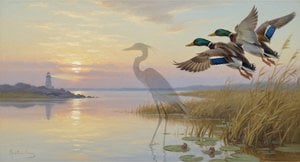
Frank Weston Benson: Capturing American Luminism & the Essence of Wildlife Painting
Explore the captivating art of Frank Weston Benson, a leading American Impressionist renowned for his luminous landscapes, wildlife paintings & masterful portraits. Discover his legacy and find museum-quality reproductions at ArtsDot.

The Enduring Legacy of Bronze Sculpture: Technique, Symbolism & Cultural Impact
Explore the rich history & enduring appeal of bronze sculpture with expert insights for collectors. Learn about casting techniques, iconic artists, collecting tips & contemporary interpretations at ArtsDot.

10 Легендарних Бронзових Шедеврів, Які Змінили Мистецтво | ArtsDot
Відкрийте для себе 10 легендарних бронзових шедеврів, що змінили мистецтво! Історія створення, художні техніки та вплив скульпторів Ренесансу й Античності. Купуйте репродукції картин на ArtsDot.com – музейна якість для вашого дому.

Heywood Hardy: Navigating Victorian Sentiment Through Marine Painting & Wildlife Illustration
Explore the captivating world of Heywood Hardy (1842-1933), a master of Victorian animal & equestrian painting. Discover his realistic landscapes, hunting scenes, and enduring legacy with ArtsDot.

Тварини у мистецтві: оживляючи простір та символізм української культури
Дослідіть символізм тварин в українському мистецтві! Від народних оберегів до сучасних інтерпретацій – розкрийте глибину культурної спадщини та вплив образів на простір.

