


The picture follows your choices: , .
Опис експоната
Explore Alice Bailly’s ‘Self Portrait,’ a dynamic Expressionist painting featuring warm tones, impasto texture & symbolic depth. A unique piece of early 20th-century art.
Біографія митця
Аліса Байллі (1872-1938) – швейцарська художниця, новаторка у сфері сучасного мистецтва. Відома своїми експериментальними полотнами з вовняних ниток, впливом кубізму та футуризму, а також самопортретами, що відображають її незалежну особистість.
 Розгорнути текст
Олійная репродукція ручної роботи
Написана вручну олією на полотні у вашому розмірі та рамі, виготовлена на замовлення нашими художниками. ( Перейти до друку Перейти до цифрових зображень)
More about this painting
 Переглянути в інтер'єрі
 Надіслати як листівку
 Поділитися
 Деталі витвору
 Посібник

 Завантажити
 Схожі екземпляри
 Рентгенівське дослідження
 Слайд-шоу
 Q&A
Q&A Статистика
Order your painting in four simple steps
Take your time. You can change any answer; the price in your order card follows each choice.
1 Step one of four
Which size would you like?
These sizes keep the proportions of the original painting. The drawing shows your choice on a wall, above a two-metre sofa.
Or give your own measurements
Обирайте з наших стандартних розмірів, що відповідають оригінальним пропорціям твору мистецтва.

Введіть необхідну ширину та висоту, щоб картина підійшла до вашої рами або стіни. Оскільки це ручний розпис, для зміни пропорцій художник може дописати трохи більше по краях або дещо обрізати композицію — вибір за вами. Перед початком роботи ми надішлемо вам цифровий макет для затвердження. Зображення, показане на цій сторінці, не є реальним результатом — лише макет відображає майбутній вигляд.
2 Step two of four
How should it be prepared: rolled, stretched or framed?
The prices below are for the size you chose in step one.
Choose the edges of the stretched canvas
Choose your frame

White ₴1

Blurside ₴1

Extended ₴1

P118B ₴10

P118H ₴10

P118W ₴10

P438Z ₴10

P508JH ₴12

P508YH ₴12

P805H ₴10

P805Z ₴10

P919BZ ₴10

P919G ₴10

P919XJ ₴10

P959ZH ₴10

P968JZ ₴12

W106C ₴8

W218G ₴10

W218JH ₴8

W218Y ₴10

W307PJ ₴10

W316G ₴10

W316PJ ₴8

W316Y ₴10

W398PJ ₴8

W4111J ₴10

W500HY ₴15

W500JH ₴15

W692G ₴12

W849H ₴8

W940BG ₴15

W953PJ ₴8

H24-GOLD ₴30

H24-SILVER ₴30

H36-GOLD ₴45

H36-SILVER ₴45
У рамі
Moulding: . Overall size with the frame: .
3 Step three of four
Would you like anything changed in the painting?
Most people answer no. Because each painting is made by hand, our artist can also adapt it for you.
After order, ArtsDot.com team will email client for instructions and provide a mockup preview
4 Step four of four
A few finishing options
All of them are optional. The answers already selected cost nothing extra.
Who paints it?
Доставка по всьому світу () за 3–4 тижні замість стандартних 5 тижнів. (31 Жовтень). Без жодних компромісів у якості.
A nameplate, as in a museum?
Деталі гравірування на бронзовій табличці
This elegant plaque features the artist's name and the title of the artwork, finely engraved for a timeless presentation.
It is made from bronze with a refined, elegant finish. The text is precisely laser-engraved for a sharp and permanent result. Measuring 9x2 cm, the plaque is compact yet easy to read. It's built to be durable and scratch-resistant, offering a professional, museum-quality look. Mounting is simple thanks to the included adhesive backing.
Деталі прозорої акрилової таблички
The plaque includes essential engraved details such as the artist's name, the title of the artwork, the date it was created, the type of media used-like oil on canvas or watercolor-a brief description of the piece, and a QR code that links to the complete artwork information.
It is crafted from clear acrylic, offering a sleek, modern appearance. The text is UV-engraved in black to ensure strong visual contrast. With a size of 10x15 cm, it ensures optimal readability. It comes equipped with two metal hooks for secure wall mounting. The plaque is designed to be weather-resistant, making it suitable for various environments, and it includes interactive features that work seamlessly with smartphone scanning.
Деталі чорної акрилової таблички
This elegant plaque includes engraved information such as the artist's name, the title of the artwork, the date it was created, the type of media used (like oil on canvas or watercolor), a short description of the artwork, and a QR code for quick access to more information.
The plaque itself is made from refined black acrylic with a premium finish. The text is laser-engraved in white for high contrast and readability. Its size is 10x15 cm, designed to be easy to read. It comes with two metal hooks for professional mounting. The design is sleek and fits any interior style. It is also weather-resistant and durable, with built-in digital integration for mobile compatibility.
A protective varnish?
When do you need it?
✓ Check and order
Your painting, as you ordered it

Self Portrait
Матеріал репродукції
Розмір репродукції
-

Видатний майстер-художник
Більше деталізації, витонченості та додаткового часу на створення твору
-

Рама для репродукції
-
-
Для творів мистецтва або репродукцій, розмір яких перевищує 105 см (приблизно 41 дюйм) з будь-якого боку, рама доставляється у вигляді розібраного комплекту. Такий метод гарантує безпечну доставку та запобігає пошкодженням під час транспортування.
Потребує професійного збирання — це не продукт для самостійного виготовлення (DIY).
Комплект має бути зібраний, а полотно натягнуте досвідченим майстром багетних робіт із використанням клейового дерева (не входить у комплект), щипців для натягування полотна та затискачів, щоб підрамник залишався рівним під час висихання клею. Неправильне збирання або нерівномірне натягування полотна може призвести до незворотного пошкодження твору мистецтва, що не підпадає під дію нашої гарантії.
 Для творів мистецтва або репродукцій, розмір яких перевищує 105 см (приблизно 41 дюйм) з будь-якого боку, рама доставляється у вигляді розібраного комплекту. Такий метод гарантує безпечну доставку та запобігає пошкодженням під час транспортування.
У комплект входять усі бруски з цільного дерева, точно вирізані за розміром.
Збирається за допомогою гвинтів, що входять до комплекту, а також клейового розчину для кутових з'єднань, який не входить до комплекту і має бути підготовлений вашим майстром.
Потрібні професійні інструменти, які не входять до комплекту: щипці для натягування полотна (натягувач) та затискачі, щоб утримувати рейки рівно під час висихання клею.
Важливо:
Для з'єднання кутів потрібен клей для дерева, перекладини необхідно затиснути струбцинами до повного висихання клею, а для натягування полотна на зібрану раму знадобляться щипці для натягування полотна. Жоден із цих інструментів не входить до комплекту. Будь ласка, проконсультуйтеся з досвідченим майстром багетного оформлення перед замовленням рами такого розміру.

Етикетка експоната
-
-

Захисний лак
Глянцевий лак (підсилює яскравість кольорів, захищає від світла та вологи)
-

Персоналізувати мій витвір
Приклади можливих змін: заміна обличчя на фото клієнта; додавання домашньої тварини (наприклад, заміна кота на собаку); додавання прихованого повідомлення на фоні; зміна пейзажу або елементів фону.
-

Прискорено
Доставка по всьому світу () за 3–4 тижні замість стандартних 5 тижнів. (31 Жовтень). Без компромісів у якості.
-
Експрес-доставка
Доставка по всьому світу () протягом 5 тижнів. (7 Листопад).
Включено в ціну
Підсумкова вартість
₴ 11790
Скляний варіант доступний лише для розмірів до 110 см
Included with every order
- Безкоштовна експрес-доставка по всьому світу
- Високоякісне лляне полотно
- Повне страхове покриття доставки
- Гарантія повернення митних зборів
- Гарантія точного відтворення кольорів
- Політика повернення протягом 100 днів (лише у разі виявлення дефектів)
- Гарантія повернення 100% коштів
- Пропозиція на оптові замовлення


Схожі твори мистецтва


Аліса Байллі
1872 - 1938, Швейцарія
Біографія митця
A Pioneer of Swiss Modernism: The Life and Art of Alice Bailly
Alice Bailly, born in Geneva in 1872, was a true original—a fiercely independent spirit who navigated the turbulent currents of early 20th-century art with unwavering conviction. Her journey began within a modestly situated family; her father’s untimely death when she was just fourteen cast a long shadow but also instilled a resilience that would define her artistic path. Her mother, a German teacher, cultivated an environment rich in culture and intellectual curiosity for Alice and her sisters, fostering a love of learning that proved foundational to Bailly's later explorations. Though initially drawn to formal education, attending the École des Beaux-Arts in Geneva at seventeen, she quickly recognized its limitations, believing true artistry stemmed from individual expression rather than rigid doctrine. This early rejection of convention foreshadowed a career marked by constant experimentation and a refusal to be categorized. Early studies under Hugues Bovy and Denise Sarkiss provided technical grounding, but Bailly’s restless spirit soon led her beyond the confines of Swiss academia. A scholarship to Munich proved unfulfilling; she found more inspiration in independently studying the Old Masters—Rubens and Van Dyck particularly—at the city's art galleries, absorbing their techniques and compositional mastery while forging her own unique vision. Years spent back in Geneva yielded limited success, a period of quiet preparation before the seismic shift that awaited her in Paris.Parisian Awakening: Fauvism, Cubism, and Avant-Garde Circles
The year 1904 marked a pivotal moment when Bailly relocated to Paris, immersing herself in the heart of the avant-garde. This was not merely a change of scenery but an intellectual and artistic rebirth. She quickly became part of a vibrant circle of artists—Juan Gris, Francis Picabia, Albert Gleizes, Jean Metzinger, Fernand Léger, Sonia Lewitska, and Marie Laurencin among them—who were challenging the established norms of art. These friendships weren’t simply social; they were intellectual collaborations, fueling Bailly's artistic development through debate, exchange, and mutual inspiration. A brief sojourn at the Villa Médicis-Libre in Rome in 1905 offered a sanctuary for independent study, further solidifying her commitment to forging her own path. Initially exhibiting wood engravings, Bailly soon found herself captivated by the explosive energy of Fauvism. The movement’s bold use of color, its disregard for naturalistic representation, and its emphasis on emotional expression resonated deeply with her burgeoning artistic sensibilities. Her Fauvist paintings were showcased at the prestigious Salon d'Automne in 1908, placing her among the leading figures of this revolutionary style. This success was followed by a significant recognition in 1912 when Bailly’s work represented Switzerland in an exhibition that toured Russia, England, and Spain, bringing her art to an international audience. From there, she delved into the complexities of Cubism and the dynamism of Futurism, absorbing their principles while always maintaining her distinct artistic voice.Wool Paintings and Dadaist Explorations: A Unique Artistic Signature
The outbreak of World War I forced Bailly’s return to Switzerland, but rather than curtailing her creativity, it sparked one of the most innovative phases of her career. Between 1913 and 1922, she invented her signature “wool paintings”—a truly unique contribution to modern art. These weren't simply paintings *with* wool; they were constructed *from* short strands of colored yarn meticulously arranged on the canvas, mimicking brushstrokes and creating a textured, almost sculptural surface. This technique was a radical departure from traditional painting methods, offering a new way to explore color, form, and composition. Approximately fifty of these remarkable works emerged during this period, each a testament to Bailly’s ingenuity and her willingness to push artistic boundaries. Her experimental spirit also led her to briefly engage with the Dada movement—a deliberately provocative and anti-establishment force that sought to dismantle traditional notions of art and society. While her involvement was relatively short-lived, it influenced her exploration of unconventional forms and challenged her to question the very purpose of art. Throughout this period, Bailly remained a regular exhibitor at the Salon des Indépendants, a haven for artists who defied conventional standards, alongside other pioneering female Cubist painters.Major Achievements and Artistic Style
Alice Bailly’s artistic style evolved dramatically throughout her career, reflecting her constant experimentation and willingness to embrace new influences. Initially rooted in traditional academic training, she quickly moved beyond the constraints of realism, embracing the bold colors and expressive forms of Fauvism. Her early works demonstrate a masterful command of technique, combined with an intuitive understanding of color theory. The transition to Cubism marked a significant shift towards abstraction, as Bailly began to deconstruct objects into geometric shapes and explore multiple perspectives simultaneously. However, she never fully abandoned her interest in figurative representation, often incorporating recognizable forms within her abstract compositions. Perhaps most notably, Bailly’s invention of the “wool paintings” represents a truly singular achievement—a unique fusion of painting and textile art that created a tactile and visually arresting experience for the viewer. Her works are characterized by their vibrant color palettes, dynamic compositions, and innovative use of materials. She was particularly drawn to depicting landscapes, portraits, and still lifes, often imbuing them with a sense of movement and emotion.Legacy and Lasting Influence
Alice Bailly’s artistic legacy rests on her unwavering commitment to innovation and her fearless exploration of diverse styles—from the vibrant hues of Fauvism to the fractured forms of Cubism, the dynamism of Futurism, and the singular texture of her wool paintings. Her willingness to experiment with materials and techniques set her apart as a truly unique figure in early 20th-century art. *Self-Portrait (1917)*, often considered her masterpiece, exemplifies this avant-garde approach—a compelling blend of traditional pose, Fauvist color palette, and Futurist dynamism. Other notable works like **At the Ball (1927)**, **The Battle of Tolochenaz (1916)**, **Geneva Harbor (1915)**, **Landscape at Orsay (1912)**, and **Vacation (1922)** further demonstrate the breadth and depth of her artistic vision. In 1923, she settled in Lausanne, where she continued to work and exhibit until her death in 1938. Even in her later years, Bailly remained dedicated to her art, accepting a demanding commission from the Theatre of Lausanne to create eight large murals for its foyer—a project that unfortunately contributed to her declining health. Beyond her artistic achievements, Bailly demonstrated a profound commitment to supporting future generations of artists by establishing a trust fund in her will to aid young Swiss talents. She stands as an important figure in the development of abstract and experimental art, a testament to the power of individual vision and the enduring legacy of a truly pioneering artist.Пов'язані статті

Топ-25 шедеврів Амедео Модільяні: мистецтво, краса та декор для вашого дому
Відкрийте для себе 25 найвідоміших шедеврів Амедео Модільяні! Портрети, ню та скульптури художника модерну. Історія мистецтва, техніка живопису та ідеї декору з ArtsDot.com. Дослідіть повну колекцію онлайн!
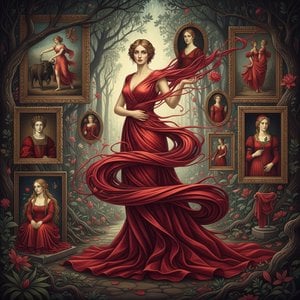
Crimson Threads of Narrative: Exploring Symbolism & Representation in Artworks Featuring the Red Dress
Explore the rich symbolism of the red dress in art history! From ancient power displays to iconic portraits like Cézanne’s 'Madame Cezanne', discover the cultural and artistic significance behind this captivating color. Expert analysis & insights.

Mastering the Palette: How Warm and Cool Tones Can Transform Your Space Through the Lens of Art History
Unlock the secrets of color theory to transform your home. Learn how to balance warm and cool tones using timeless art history principles. From vibrant energy to tranquil depths, discover how the right fine art reproduction can create a masterpiece in your living space.