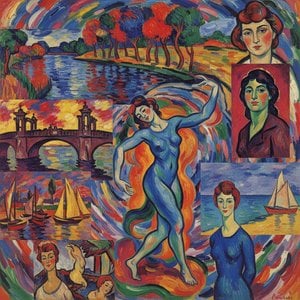
A Search for Visual Language
Yvan Theys lived a life defined by a quiet, persistent inquiry into the nature of seeing. Born in 1936, he spent his years navigating the delicate space between the recognizable world and the abstract idea. His training began at Sint-Lucas in Tournai, where he studied under Eugène Dodeigne, a period that helped shape his early understanding of form and line. He was a man of many hands, working as a painter, draughtsman, printmaker, engraver, and sculptor. This versatility was not a sign of indecision, but rather a reflection of a continuous dialogue with the act of creation itself.
His work often felt like a conversation with the past. He looked toward the Flemish Primitives and Rubens, finding a way to weave their weight and presence into a modern context. He did not simply copy these predecessors; instead, he absorbed their essence to fuel his own explorations of expressionism and the lessons of the Cobra movement. By the 1960s, he had moved away from the strictures of academic figuration, seeking instead a way to express the human condition through a more personal, existential lens.
The Evolution of Form
As his career progressed, Theys refused to settle into a single, comfortable style. He moved through different phases, often blending geometric signs and flat pictorial spaces with lyrical, expressive elements. This refusal to be categorized allowed him to remain deeply engaged with the shifting landscape of Belgian art. His practice was marked by several key developments:
- The integration of abstract elements into figurative subjects.
- A transition into three-dimensional work, beginning with his first sculptures in 1980.
- The creation of wooden figures starting in 1993.
- A focus on graphic works and editioned prints, such as the 200-piece edition of 'Les amants'.
His breakthrough came in 1964 when he was awarded the Prix de Rome. This recognition opened doors to international exhibitions in Spain, Munich, and Amsterdam. He was part of a generation of artists who sought to redefine the boundaries of representation, often associated with the New Figuration movement, though his specific interpretation remained uniquely his own.
A Lasting Presence
By the time of his death in 2005, Theys had established a body of work that was both idiosyncratic and coherent. His paintings, drawings, and sculptures were not merely objects, but records of a lifelong attempt to reconcile thought with emotion. He remained a central figure in the Belgian art scene, maintaining close ties with contemporaries like Eugène Leroy and Roger Raveel.
Today, his legacy is held in various collections, including the Centraal Museum in Utrecht. His ability to navigate the tension between the physical and the abstract ensures that his work remains a subject of study for those interested in the complexities of postwar European art. He left behind a diverse archive of media, from oil on canvas to intricate engravings, all unified by a singular, searching spirit.
Soru ve Cevaplar
Yvan Theys adlı sanatçının eserlerine renk paletine göre göz atabilir miyim?
Yvan Theys'in eserlerine, sanatçının Renk Paletlerine Göre sayfasından renk paletine göre göz atabilirsiniz.
Yvan Theys hangi dönem sanatçısıdır?
Yvan Theys, Modern döneminde eserlerini vermiştir. Bu dönem, sanatçının çalışmalarını tarihsel bir bağlama oturtur.
Yvan Theys adlı sanatçının eserlerine tekniklerine göre göz atabilir miyim?
Tüm Teknikler sayfası, Yvan Theys eserlerini tekniğe göre gruplandırır.
Yvan Theys sanatçısının renklere göre ayrılmış eserlerine nereden ulaşabilirim?
Yvan Theys'in eserlerini, sanatçının Renk Spektrumu sayfasında renklere göre keşfedebilirsiniz.