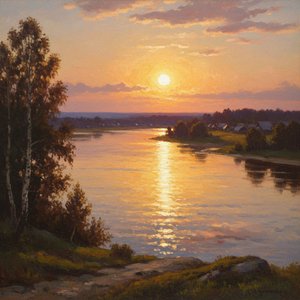
The Precision of the Imperial Guard
Narkiz Bunin was a painter and graphic artist whose work captures a specific, rigid slice of Russian history. He did not rely on vague sentiment; instead, he focused on the technical accuracy required by the battle painting class at the Imperial Academy of Arts. His presence in the academy was unconventional. He joined the institution in 1881 as a voluntary student, a choice that suggests a disciplined, self-directed approach to his craft rather than a standard academic progression.
His output is defined by a commitment to the formal details of military life. In his 1889 work, Sentry of the Life-Guards Horse Regiment in the Winter Palace, Bunin demonstrates the exactitude expected of a specialist in the genre. This piece exists in two forms: an oil on wood version and a larger oil on canvas held by the State Hermitage Museum. This repetition shows a professional preoccupation with a specific subject, ensuring the visual record of the regiment was captured with absolute fidelity.
Technical Discipline and Subject Matter
Bunin’s technique was rooted in the rigorous training of the Imperial Academy. He worked primarily with oil, often applying it to wood to achieve a specific surface tension. His focus remained fixed on the intersection of military ceremony and formal portraiture. He was not interested in the chaos of the battlefield, but rather in the structured, ceremonial reality of the Imperial Guard.
The historical significance of his work lies in its documentation. He provides a visual ledger of the era's military aesthetics. His paintings function as more than mere art; they are precise observations of:
- The specific uniforms of the Life-Guards Horse Regiment.
- The architectural atmosphere of the Winter Palace.
- The formal posture required of imperial sentries.
To look at a Bunin is to see the intersection of art and military record. He avoided the sweeping narratives of romanticism, opting instead for the sharp lines of the graphic artist and the heavy, deliberate strokes of the battle painter. His legacy is found in this refusal to embellish the reality of the soldier's station.
Soru ve Cevaplar
Narkiz Bunin sanatçısının anahtar kelimelere göre gruplandırılmış eserlerine nereden ulaşabilirim?
Narkiz Bunin sanatçısının Anahtar Kelimelerle sayfası, sanatçının eserlerini anahtar kelimelerine göre gruplandırır.
Narkiz Bunin hangi şehir ve ülkede doğmuştur?
Narkiz Bunin, Kastornoye, Russia doğumludur.
Narkiz Bunin en çok hangi renkleri kullandı?
Narkiz Bunin eserlerinin renk profiline Narkiz Bunin için hazırlanan Palet Genomu sayfasından ulaşabilirsiniz.
Narkiz Bunin tarafından üretilen tüm eserleri belirli bir teknik/materyal türünde nasıl bulabilirim?
Narkiz Bunin tarafından belirli bir teknikte üretilmiş tüm eserleri bulmak için sanatçının Tüm Teknikler sayfasını kullanabilirsiniz.