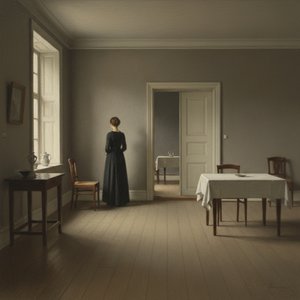
The Physicality of the Canvas
In the quiet corners of Paide, a life began that would eventually seek to dismantle the very boundaries of the painted surface. Mihkel Ilus emerged from his origins with a curiosity for the weight and presence of things, a drive that led him from the halls of the University of Tartu to the studios of the Estonian Academy of Arts. His path was never one of simple representation; instead, he became a seeker of the object itself. He looked at a painting and saw more than a window into another world; he saw a physical entity, a collision of wood, fabric, and pigment that occupied a specific, unyielding space.
His practice moved steadily toward the edge where painting meets spatial installation. He became preoccupied with how a work exists within a room, questioning the tension between the white cube of the gallery and the dark, enclosed atmosphere of the black box. This investigation was not a mere academic exercise but a deep, tactile inquiry into how a viewer’s body moves through a space to encounter an object. He stripped away the distractions of color, often retreating into the stark, disciplined registers of monochrome and black and white to force a confrontation with the essential form.
A Study in Form and Space
The evolution of his work reveals a mind deeply engaged with the structural logic of art. He did not merely paint; he interrogated the relationship between the canvas, the frame, and the surface. His presence in the academic world, moving from an assistant to a visiting lecturer and eventually to technical staff at the Estonian Academy of Arts, mirrors his commitment to the fundamental mechanics of the craft. His investigations often took him across borders, finding resonance in the spaces of Bergen and the galleries of Tartu.
His artistic inquiries often centered on several key elements:
- The dialogue between the physical frame and the painted surface.
- The use of large-scale works to command the viewer's physical presence.
- The tension between the monochrome palette and the spatial environment.
- The intersection of painting with the language of ceramics and design.
The Dialogue of Materials
In later years, his work expanded to include a dialogue with other mediums, seeking a connection between the printed line and the sculptural form. He explored the possibilities of offset lithographs, attempting to find a common language with the textures of ceramic work. His studio, located in a space that holds the historical echoes of a painter's room floor, serves as a site where the past and the present meet. He has been known to exhibit fragments of historical design work, treating the very floor of a studio as a component of his artistic investigation. Through this, he bridges the gap between the finished work and the raw, material reality of the space where art is conceived.
Soru ve Cevaplar
Mihkel Ilus’in tüm eserlerindeki renk kullanımını inceleyebilir miyim?
Mihkel Ilus sanatçısının Palet Genomu, sanatçının eserlerinin renk profilini sunan bir sayfadır.
Mihkel Ilus adlı sanatçının eserlerini belirli bir renk paletine göre nasıl bulabilirim?
Renk Paletlerine Göre sayfasında Mihkel Ilus adlı sanatçının eserleri renk paletlerine göre gruplandırılmıştır.
Mihkel Ilus sanatçısının en çok görüntülenen eserleri hangileridir?
Mihkel Ilus adlı sanatçının eserlerine dair istatistiklere sanatçının İstatistikler sayfasından ulaşılabilir.
Mihkel Ilus sanatçısına ait katalogda kaç adet eser bulunuyor?
Tüm Sanat Eserleri sayfasında Mihkel Ilus imzalı 4 sanat eseri eseri inceleyebilirsiniz.