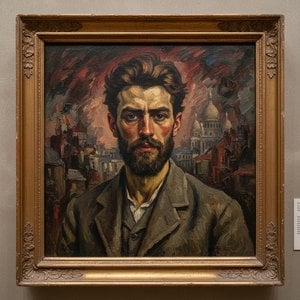
The Life and Artistic Journey of Fritz Kronenberg
Born in Cologne, Germany, Fritz Kronenberg pursued a diverse artistic education, beginning with studies in woodcut techniques at the art school in his hometown. His formal training expanded through the Kunstakademie Düsseldorf and the Kunstakademie Karlsruhe, where he studied drawing, sculpture, and woodcarving. His early years were marked by extensive travel, including journeys to the United States, Spain, North Africa, and Norway. A significant period in Paris allowed him to encounter the works of cubists such as Pablo Picasso, Juan Gris, Georges Braque, and Helmut Kolle. This exposure to French Cubism was so profound that friends bestowed upon him the nickname Kronenbraque.
After returning to Cologne and teaching at the art school there, Kronenberg moved to Hamburg in 1927. He became a member of the Hamburgische Sezession, participating in their exhibitions and contributing to the development of the Sezessionsstil. His work often featured large-scale, tectonically structured still lifes and landscapes that maintained a connection to the subject matter through a sense of space and air perspective.
Later Years and Artistic Legacy
During the period of National Socialist rule, Kronenberg withdrew from the official art scene, though he continued to teach privately and collaborated with the Griffelkunst-Vereinigung Hamburg. In 1937, ten of his paintings were confiscated by the Nazi regime as entartete Kunst (degenerate art). Following the destruction of his home and studio during the air raids on Hamburg in 1943, he found refuge in Keelbek. After the war, he was involved in the re-establishment of the Hamburgische Sezession and was represented in exhibitions such as the 1952 show at the Mannheimer Kunsthalle.
In his later years, Kronenberg engaged in various creative endeavors, including a ceramic wall for the Meßberg U-Bahn station in Hamburg. He also hosted a television series titled Malen mit Fritz Kronenberg, where he demonstrated various artistic techniques. His notable works include:
Soru ve Cevaplar
Fritz Kronenberg sanatçısına ait katalogda kaç adet eser bulunuyor?
Tüm Sanat Eserleri sayfasında Fritz Kronenberg imzalı 3 sanat eseri eseri inceleyebilirsiniz.
Fritz Kronenberg eserlerini renk spektrumuna göre keşfedebilir miyim?
Fritz Kronenberg'in eserlerini, sanatçının Renk Spektrumu sayfasında renklere göre keşfedebilirsiniz.
Fritz Kronenberg adlı sanatçının çalışmalarını kronolojik olarak nasıl takip edebilirim?
Fritz Kronenberg’in eserlerini kronolojik sırayla sanatçının Eser Kronolojisi sayfasında inceleyebilirsiniz.
Fritz Kronenberg adlı sanatçının eserlerini bir 3D galeride nerede görebilirim?
Fritz Kronenberg sanatçısının 3B Galeri, sanatçının eserlerini sanal bir üç boyutlu galeride sergileyen sayfadır.