The Quiet Observer of Antwerp
Born in Antwerp on August 31, 1881, Edgard Wiethase grew up in a city that was a central pulse for Belgian creativity. His early years were shaped by the rigorous traditions of the Royal Academy of Fine Arts Antwerp, where he learned to see the world through a lens of precision. He studied under Charles Boom, Charles Mertens, and Piet Verhaert, masters who instilled in him a deep respect for the fundamentals of drawing and the careful arrangement of a scene. This academic foundation provided him with the tools to translate the physical world onto canvas with a sense of order and clarity.
As his perspective matured, he sought to deepen his understanding of the natural world. He moved on to the Nationaal Hoger Instituut voor Schone Kunsten to study under Frans Van Leemputten, a painter known for his work with animals. This period of his life refined his ability to observe the subtle textures of life, whether in a landscape or a quiet interior. By the time he joined the artistic circle Als ik Kan in 1903, he had developed a way of seeing that balanced technical discipline with a personal, luminous touch.
A Life in Color and Light
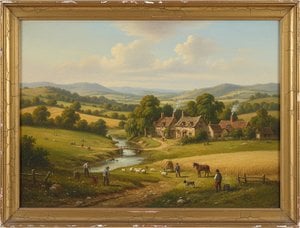
Wiethase’s work often felt like a conversation between the subject and the light hitting it. He was a painter of many subjects, moving between the stillness of still lifes and the open air of rural landscapes. His style was characterized by a luminous realism, a way of capturing the atmosphere of a place without losing the solid reality of its forms. His later works are particularly noted for their bright, clear colors, which gave his scenes a sense of clarity and presence.
His artistic output was diverse, reflecting a keen interest in the textures of everyday existence:
- Landscapes that captured the shifting light of the Belgian countryside.
- Rural scenes that depicted the quiet rhythms of life outside the city.
- Interiors that focused on the play of light within a room.
- Portraits and still lifes that required a steady, observant hand.
Eventually, he moved toward the outskirts of Brussels, finding a different kind of peace in the periphery. His paintings remained grounded in the tradition of his training, yet they possessed a lightness that felt modern for his time. He did not seek to break the world apart into abstract shapes, but rather to find the light within the shapes that already existed.
Legacy and Recognition
The value of his work has been recognized by both institutions and collectors. His paintings have found a permanent home in the Royal Museum of Fine Arts Antwerp, ensuring that his vision of the Belgian landscape remains part of the public record. His ability to capture a specific moment of light and stillness allowed his work to endure beyond his own lifetime.
Edgard Wiethase passed away in Uccle on April 16, 1965. He left behind a body of work that remains a window into the light and life of his era, marked by a commitment to the honest representation of the world around him.
Soru ve Cevaplar
Edgard Wiethase tarafından üretilen tüm eserleri nasıl görebilirim?
bu web sitesi üzerindeki Edgard Wiethase imzalı tüm eserlere sanatçının Tüm Sanat Eserleri sayfasından göz atabilirsiniz.
Edgard Wiethase tarafından resmedilen tüm konuların bir özeti mevcut mu?
Edgard Wiethase sanatçısının Konu Atlası, sanatçının eserlerini konularına göre listeleyen bir sayfadır.
Edgard Wiethase eserlerini anahtar kelimelere göre keşfedebilir miyim?
Edgard Wiethase'in eserlerini, sanatçının Anahtar Kelimelerle sayfasında anahtar kelimelere göre keşfedebilirsiniz. Her anahtar kelime ilgili eserleri bir araya getirir.
Edgard Wiethase adlı sanatçının eserleri ne kadar popüler?
Edgard Wiethase'in İstatistikler sayfası, Edgard Wiethase'in bu web sitesi üzerinde listelenen eserlerinden elde edilen istatistikleri sunar.