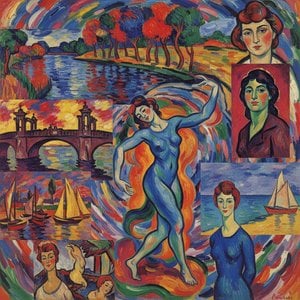
The Belgian Impressionist Trace
Adolphe Hamesse remains a figure defined by the quiet persistence of his Belgian origins. Born in 1849, his life spanned a transformative era in European visual culture, yet his presence in the modern canon is marked by a specific, localized impact. He was a painter who operated within the shifting currents of the late nineteenth century, capturing a sense of place that resisted the loud, frantic movements of his contemporaries. His work does not demand attention through spectacle; instead, it relies on a steady, observational hand.
To look at his surviving output is to see a man preoccupied with the immediate. He did not chase the grand narratives of history or mythology. Instead, his focus remained on the tangible world, a practice that placed him firmly within the tradition of Belgian realism and the burgeoning interest in light and atmosphere. His legacy is not one of revolution, but of a disciplined, professional commitment to the craft of painting.
Technical Focus and Provenance
The physical evidence of Hamesse's career is found in the collections that preserve his vision. His work has survived through institutional stewardship, ensuring that his specific approach to composition remains accessible to those studying the Belgian school. His output is characterized by a certain restraint, avoiding the heavy-handedness that often plagues artists of his period.
- Primary Collection: Jakob Smitsmuseum, Mol
- Geographic Focus: Belgium
- Artistic Medium: Painting
His connection to the Jakob Smitsmuseum in Mol highlights his relevance to the regional art history of the Low Countries. This placement suggests a work that resonates with the specific light and landscape of the Belgian terrain. He was a painter who understood the weight of his subject matter, treating the canvas as a space for direct observation rather than a stage for artifice.
Historical Context and Family Legacy
Hamesse’s influence extended into the next generation, though perhaps in a different direction than his own brushwork. His son, Paul Hamesse, moved into the realm of architecture and art, studying at the Academy of Fine Arts in Brussels. This transition from the painterly to the structural reflects a broader shift in the Belgian artistic landscape at the turn of the century. While Adolphe focused on the surface and the light of the world, his lineage moved toward the permanence of built form.
He died in 1925, leaving behind a body of work that serves as a factual record of a specific Belgian aesthetic. He was a professional, a man of his time who contributed to the visual vocabulary of his nation without the need for unnecessary ornamentation. His importance lies in this very reliability—the ability to capture a moment in time with clarity and purpose.
Soru ve Cevaplar
Adolphe Hamesse adlı sanatçının eserlerini kronolojik sırayla nerede görebilirim?
Adolphe Hamesse’in eserlerini kronolojik sırayla sanatçının Eser Kronolojisi sayfasında inceleyebilirsiniz.
Adolphe Hamesse’in tüm eserlerindeki renk kullanımını inceleyebilir miyim?
Adolphe Hamesse eserlerinin renk profiline Adolphe Hamesse için hazırlanan Palet Genomu sayfasından ulaşabilirsiniz.
Adolphe Hamesse’in kariyeri hangi dönemlere ayrılıyor?
Adolphe Hamesse adlı sanatçının eserlerinin kronolojik bir dökümü, yapıtların yaratım sırasına göre bölüm bölüm ilerlediği Sanat Yolculuğu sayfasında sunulmaktadır.
Adolphe Hamesse hangi akımlarda eser verdi?
Tüm Sanat Akımları sayfası, Adolphe Hamesse eserlerini sanat akımlarına göre gruplandırır.