The Genesis of Fragmentation: Cézanne's Influence & Early Experiments
To understand Cubism it helps to go back to Cézanne's still life paintings or even further, to the Renaissance. Let's use an example that worked nicely in the ...
The seismic shift that was Analytical Cubism didn’t erupt from a vacuum; its roots lie firmly embedded within the post-Impressionist explorations of Paul Cézanne. While often lauded as the father of modern art, Cézanne wasn’t seeking to dismantle representation entirely, but rather to fundamentally question *how* we perceive it. His late still lifes, particularly those depicting fruit and drapery, demonstrate a deliberate fracturing of form – not for stylistic effect alone, but as an attempt to capture the totality of an object's presence. He sought to represent not just what he saw from a single vantage point, but all possible perspectives simultaneously, building up the image through multiple facets. This ambition—to convey volume and depth not through traditional chiaroscuro but through geometric construction—became a crucial stepping stone for Picasso and Braque.
Before the full flowering of Cubism around 1908, both artists were engaged in preparatory work that hinted at the revolution to come. Picasso’s explorations of Iberian sculpture, with its simplified forms and distorted features, provided an alternative model for representing the human figure—one divorced from classical ideals of beauty. Braque, meanwhile, was deeply influenced by Cézanne's landscapes, particularly his series of views from L’Estaque. These early paintings, though still recognizable as depictions of houses and trees, reveal a growing interest in reducing forms to their essential geometric components. The palette remained relatively conventional at this stage, but the seeds of fragmentation were undeniably sown.
Picasso & Braque: A Collaborative Revolution in Form
The period between 1908 and 1912 witnessed an extraordinary artistic partnership between Pablo Picasso and Georges Braque. Working in close proximity—often sharing ideas, techniques, and even subject matter—they embarked on a radical deconstruction of pictorial space. It’s difficult to overstate the intensity of this collaboration; their works from this period are so closely aligned that distinguishing authorship can sometimes be challenging. They weren't merely influencing each other, but engaged in a shared investigation, pushing the boundaries of representation further and faster than either could have achieved alone.
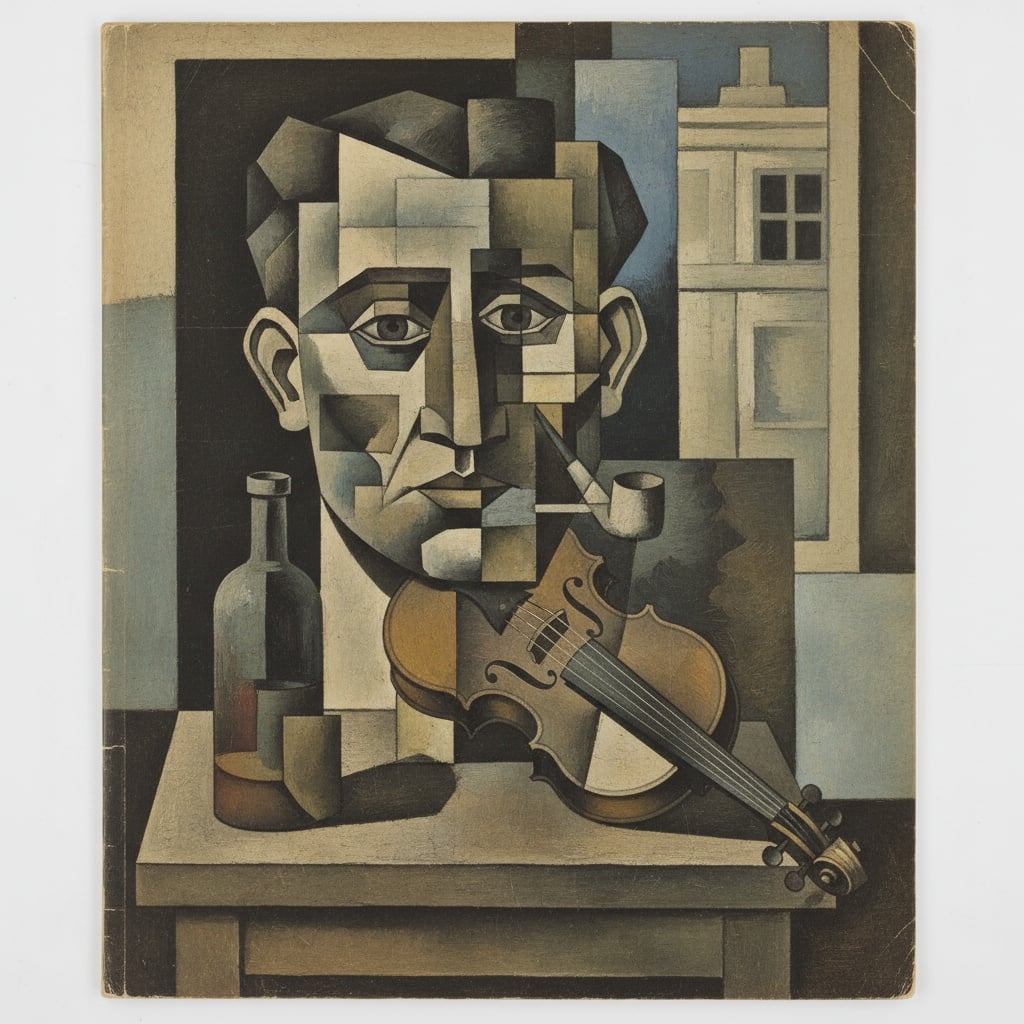
Georges Braque’s Still Life II (1912) exemplifies this collaborative spirit. The composition is almost entirely monochromatic—a deliberate choice that forces the viewer to focus on form rather than color. Fragmented objects – a bottle, a musical instrument, a newspaper – are broken down into geometric shapes and reassembled in a complex interplay of planes. Similarly, Picasso’s works from this period, such as his portraits of Daniel-Henry Kahnweiler, demonstrate a similar reduction of the human figure to its constituent parts. The faces are dissected, rearranged, and presented from multiple viewpoints simultaneously.
Analytical Cubism Defined: Key Characteristics & Techniques
Analytical Cubism is characterized by a deliberate rejection of traditional perspective and representation. Artists sought to analyze objects—to break them down into their fundamental geometric forms—and then reconstruct them on the canvas in a fragmented, multi-faceted manner. This wasn’t simply about depicting an object from different angles; it was about representing its very essence, its underlying structure.
Several key techniques define this style. Monochromatic palettes, typically limited to browns, grays, and blacks, were employed to minimize distractions and emphasize form. The use of fragmentation is paramount—objects are broken down into a network of intersecting planes and angles. Overlapping forms create a sense of depth and ambiguity, challenging the viewer’s perception of space. Furthermore, Analytical Cubists often incorporated letters and numbers—fragments of newspaper or wallpaper—into their compositions, blurring the boundaries between representation and reality.
Beyond Representation: Exploring the Intellectual and Philosophical Underpinnings
Analytical Cubism wasn't merely a stylistic innovation; it was deeply rooted in broader intellectual and philosophical currents. The movement coincided with advancements in science—particularly Einstein’s theory of relativity, which challenged traditional notions of space and time. Artists were grappling with questions about the nature of perception, reality, and representation.
The influence of Henri Bergson, a French philosopher who emphasized the importance of intuition and subjective experience, is also evident in Cubist thought. Bergson’s concept of “duration”—the idea that time is not linear but rather a continuous flow—resonates with the Cubists' attempt to capture multiple perspectives simultaneously. By breaking down objects into their constituent parts and reassembling them on the canvas, they were attempting to represent not just what an object *looks* like, but also how it *feels* – its totality of presence across time and space.
The Legacy of Analytical Cubism: Impact on Subsequent Movements
Though relatively short-lived—lasting roughly from 1908 to 1912—Analytical Cubism exerted a profound influence on the development of modern art. It paved the way for Synthetic Cubism, which embraced brighter colors and collage techniques. More broadly, it inspired movements such as Futurism, with its emphasis on dynamism and machine age imagery, and Constructivism, which sought to create abstract forms based on geometric principles.
The fragmentation of form pioneered by Picasso and Braque became a defining characteristic of 20th-century art. From the abstract paintings of Jackson Pollock to the sculptures of Jeff Koons, artists continued to explore the possibilities of deconstruction and reassembly. Analytical Cubism’s legacy extends beyond painting and sculpture—it has influenced architecture, literature, music, and even film.
Collecting Analytical Cubism: Identifying Authenticity & Value
Acquiring a work from the Analytical Cubist period is a significant undertaking, requiring careful research and expert guidance. Given the collaborative nature of the movement and the limited number of works produced, authentication can be challenging. Provenance—the documented history of ownership—is crucial. Works with clear provenance are more likely to be authentic and command higher prices.
Condition is also important; however, some degree of craquelure (fine cracking in the paint) is common due to the age of these works. ArtsDot.com offers a curated selection of high-quality reproductions of Analytical Cubist masterpieces, allowing art enthusiasts to experience the beauty and intellectual rigor of this groundbreaking movement. For those considering an original work, consulting with a reputable art dealer or appraiser is essential. The value of an Analytical Cubist painting depends on factors such as artist, size, subject matter, condition, and provenance. Investing in a piece from this period is not merely acquiring an artwork; it’s owning a fragment of art history itself.